History of paper money worksheet for Years 3–7: A promise on paper
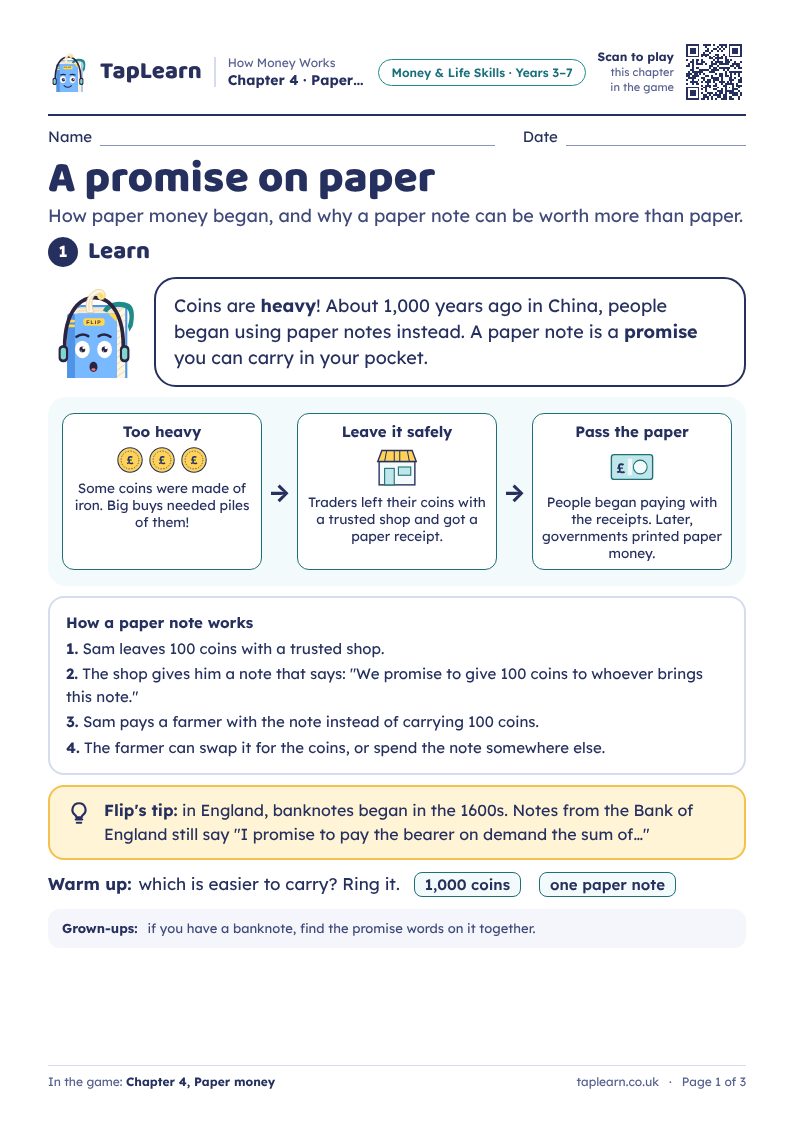
A Promise on Paper is a printable history of paper money worksheet for Years 3 to 7 (ages 7 to 12) that teaches how paper notes began in China about 1,000 years ago as promises to pay heavy coins. Children design their own banknote, order the story of a paper receipt and explain why notes only work when people trust them.
This worksheet is for members
Membership opens every chapter of every game and every worksheet, for all your children.
See the plansAlready a member? Log in to print it.
Start with the free one: Why swapping was tricky (chapter 1).
Print it on A4, in colour or black and white. Do it after the chapter, or before it to see what your child already knows.
What's on the worksheet
Learn how paper money began in China as receipts for heavy coins, why a banknote is a promise, and why notes only work if people trust them. With a design-a-banknote activity and answers.
- Page 1 · Learn
- Heavy iron coins, a trusted shop and paper receipts show how paper money began, then Sam's 100 coins become a note step by step. A warm-up asks which is easier to carry.
- Page 2 · Try it together
- Design a banknote: choose a value, write a promise, draw a picture and add two ideas to stop copying, then ask a grown-up if they would trust it. Then order Sam's story.
- Page 3 · Practise
- True or false statements, fill the gaps about receipts and trust, explain what happens if the shop loses its coins, and a challenge: is a banknote just paper?
- Answers sheet
- Every answer by page, with notes on the order of coins and notes and why paper itself isn't the point.
3 A4 pages and an answers sheet · about 25 minutes
In the classroom
- Hold a class vote on which pupil-designed banknote people would trust most, and why.
- Act out Sam's story with a pupil as the trusted shop and cards as coins.
Questions from the worksheet
- True or false: the first paper notes were a promise to pay coins.
- Fill the gaps: Coins were ___, so traders left them with a shop and got a paper ___.
- What might happen if people found out the shop had lost all its coins?
- Leo says, "A banknote is just paper, so it's worth nothing." Is he right? Explain.
The answers are on the answers sheet, for grown-ups.
Using it at home
- The banknote design takes about 10 minutes: pencils or crayons are all you need, and you get to decide whether you'd trust it.
- If you have a banknote, find the promise words on it together after the Learn page.
Watch out for
- Thinking notes are valuable because of the paper.
- The paper isn't the point: the promise and people's trust are.
- Thinking paper money came before coins.
- Coins came first, about 2,600 years ago; paper money came much later, about 1,000 years ago.
Questions and answers
Where did paper money begin?
Paper money began in China about 1,000 years ago. Traders left heavy coins with trusted shops and used the paper receipts to pay, and later the government printed official paper money.
Why is a banknote called a promise?
The first notes were promises to pay coins to whoever brought the note. Bank of England notes still carry the words "I promise to pay the bearer on demand the sum of".
More worksheets from How Money Works: The Story from Barter to Bank Cards
- Chapter 1: Barter worksheet: Why swapping was tricky Free
- Chapter 2: Commodity money worksheet: Shells, salt and metal Members
- Chapter 3: History of coins worksheet: How coins began Members
- Chapter 5: How banks began worksheet Members
- Chapter 6: Fiat money worksheet: Why money works Members
- Chapter 7: How money is created worksheet: Making new money Members
- Chapter 8: Inflation worksheet: Rising prices Members
- Chapter 9: Digital money worksheet: Tap to pay Members
 TapLearn