Digital money worksheet for Years 3–7: Tap to pay
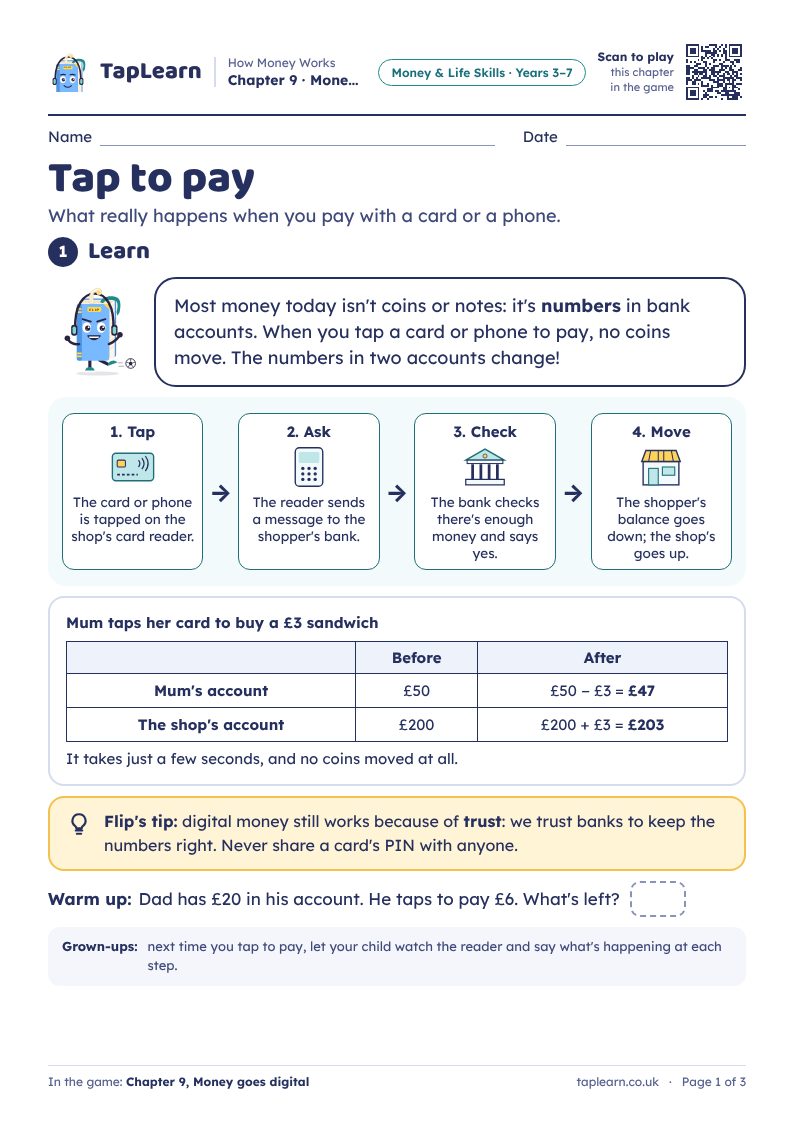
Tap to Pay is a printable digital money worksheet for Years 3 to 7 (ages 7 to 12) that teaches what happens when you pay by card or phone and why most money today is numbers in bank accounts. Children play a paper bank shopping game, order the steps of a card payment and work out new balances.
This worksheet is for members
Membership opens every chapter of every game and every worksheet, for all your children.
See the plansAlready a member? Log in to print it.
Start with the free one: Why swapping was tricky (chapter 1).
Print it on A4, in colour or black and white. Do it after the chapter, or before it to see what your child already knows.
What's on the worksheet
Learn what happens when you pay by card or phone, work out bank balances, and see why digital money works because people trust it. With a paper bank shopping game and answers.
- Page 1 · Learn
- Four steps from tapping a card to two balances changing, then Mum's 3-pound sandwich in a before and after table. A warm-up works out what's left from 20 pounds.
- Page 2 · Try it together
- Paper bank: the child shops with 20 pounds using price labels on things around the home, the grown-up bank checks each tap and says yes or declined, and balances are recorded. Then order the steps.
- Page 3 · Practise
- Work out new balances, including a payment that is declined, true or false statements, explain why to keep a PIN secret, and a challenge about whether card money is real.
- Answers sheet
- Every answer by page, with notes on digital money and gold, and on overspending with cards.
3 A4 pages and an answers sheet · about 25 minutes
In the classroom
- Run the paper bank in pairs with one pupil as the bank, then discuss what happened to declined payments.
- Use the balance table as a money subtraction starter.
Questions from the worksheet
- Work out the new balance: 45.50 pounds before, taps to pay 5.50 pounds.
- True or false: when you tap a card, coins travel from the bank to the shop.
- Why should you never tell anyone a card's PIN?
- Sam says, "Money on a card isn't real money, because you can't hold it." Is he right? Explain.
The answers are on the answers sheet, for grown-ups.
Using it at home
- Set up the paper bank with four price labels before you start; the game takes about 10 minutes and you play the bank.
- Next time you pay by card, let your child watch and say each step from the Learn page.
Watch out for
- Thinking digital money is backed by gold.
- It isn't, and neither are notes and coins. All of it works because people trust and accept it.
- Thinking tapping to pay is free money.
- Every tap takes real money from someone's account. Look at a bank statement or app together, if you're comfortable.
Questions and answers
What happens when you tap to pay?
The card reader sends a message to your bank, the bank checks you have enough money and approves it, and the amount is taken from your account and added to the shop's account. No coins move.
Is money in a bank account real money?
Yes. Most money today is digital, held as numbers in bank accounts. It can be spent like notes and coins, and it works because people trust banks and accept card payments.
More worksheets from How Money Works: The Story from Barter to Bank Cards
- Chapter 1: Barter worksheet: Why swapping was tricky Free
- Chapter 2: Commodity money worksheet: Shells, salt and metal Members
- Chapter 3: History of coins worksheet: How coins began Members
- Chapter 4: History of paper money worksheet: A promise on paper Members
- Chapter 5: How banks began worksheet Members
- Chapter 6: Fiat money worksheet: Why money works Members
- Chapter 7: How money is created worksheet: Making new money Members
- Chapter 8: Inflation worksheet: Rising prices Members
 TapLearn