Fiat money worksheet for Years 3–7: Why money works
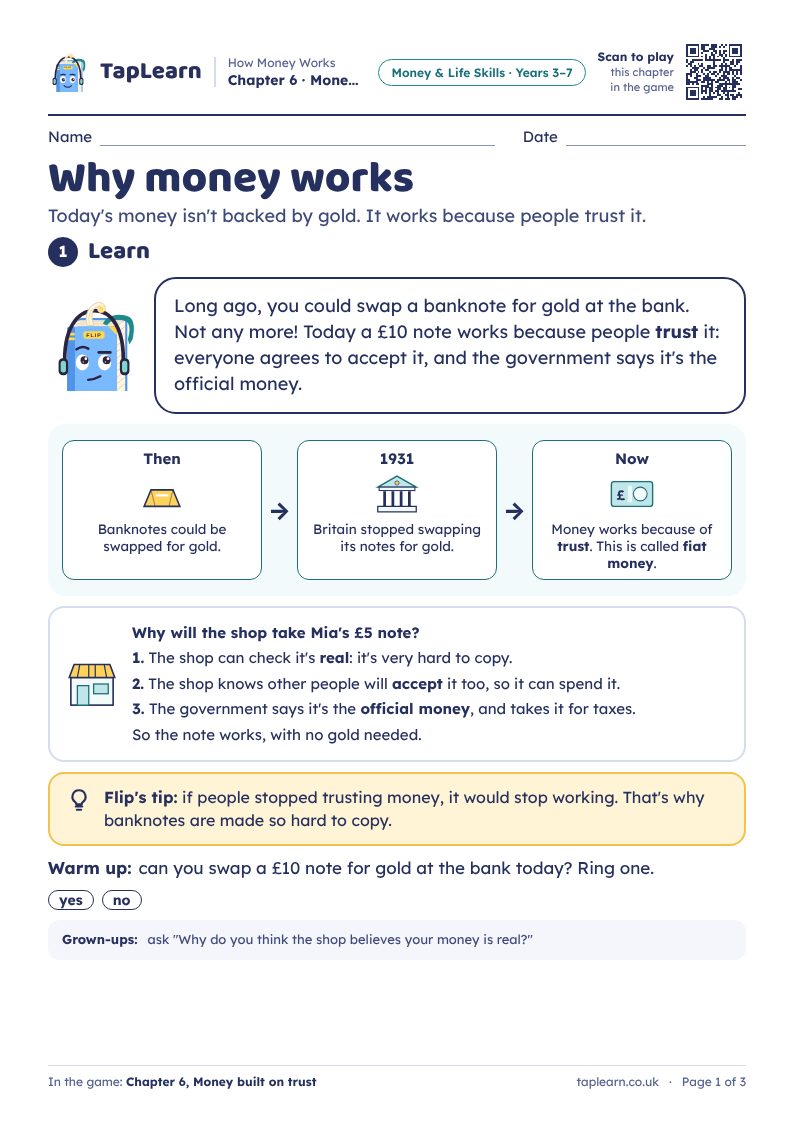
Why Money Works is a printable fiat money worksheet for Years 3 to 7 (ages 7 to 12) that teaches that money today isn't backed by gold and works because people trust and accept it. Children hunt for a banknote's security features, sort true and false reasons why money works and explain what would happen without trust.
This worksheet is for members
Membership opens every chapter of every game and every worksheet, for all your children.
See the plansAlready a member? Log in to print it.
Start with the free one: Why swapping was tricky (chapter 1).
Print it on A4, in colour or black and white. Do it after the chapter, or before it to see what your child already knows.
What's on the worksheet
Learn that money today isn't backed by gold and works because people trust and accept it, and find the security features that make banknotes hard to copy. With a banknote detective activity and answers.
- Page 1 · Learn
- A timeline from notes swapped for gold to 1931 and today's money built on trust, then three reasons a shop will take Mia's 5-pound note. A yes or no warm-up about gold.
- Page 2 · Try it together
- Banknote detective: hold a note to the light to find the see-through window, tilt it for the hologram, and look and feel for tiny and raised printing. Then tick the true reasons money works.
- Page 3 · Practise
- Fill the gaps about trust and gold, explain why notes have windows and holograms, imagine a day when nobody trusts the pound, and a challenge about gold kept for each note.
- Answers sheet
- Every answer by page, with notes on the common belief that money is backed by gold.
3 A4 pages and an answers sheet · about 25 minutes
In the classroom
- Project an enlarged description of a note's security features and let pupils explain what each one stops.
- Use the no-trust scenario as a short group discussion before writing.
Questions from the worksheet
- Fill the gaps: Today, banknotes can't be swapped for ___. Money works because people ___ it.
- Why do banknotes have see-through windows and holograms?
- Imagine one morning nobody trusted the pound any more. What might happen when you tried to buy something?
- Sam says, "My 10-pound note is worth 10 pounds because the bank keeps 10 pounds of gold for it." Is he right?
The answers are on the answers sheet, for grown-ups.
Using it at home
- Keep hold of the banknote yourself during the detective activity and let your child tilt and look; it takes about 10 minutes.
- Ask "Would you swap your bike for a note your friend drew?" to start a talk about trust.
Watch out for
- Thinking money today is backed by gold.
- Explain that it used to be true, but Britain stopped swapping notes for gold in 1931: today money is backed by trust.
- Thinking money built on trust isn't real.
- It is real money. It works every day because millions of people accept it.
Questions and answers
What is fiat money?
Fiat money is money that isn't backed by gold or silver. It has value because people trust it and accept it, and because the government says it is the official money, like the pound today.
Is the pound backed by gold?
No. Britain stopped swapping banknotes for gold in 1931. The pound works because people trust and accept it.
More worksheets from How Money Works: The Story from Barter to Bank Cards
- Chapter 1: Barter worksheet: Why swapping was tricky Free
- Chapter 2: Commodity money worksheet: Shells, salt and metal Members
- Chapter 3: History of coins worksheet: How coins began Members
- Chapter 4: History of paper money worksheet: A promise on paper Members
- Chapter 5: How banks began worksheet Members
- Chapter 7: How money is created worksheet: Making new money Members
- Chapter 8: Inflation worksheet: Rising prices Members
- Chapter 9: Digital money worksheet: Tap to pay Members
 TapLearn