Commodity money worksheet for Years 3–7: Shells, salt and metal
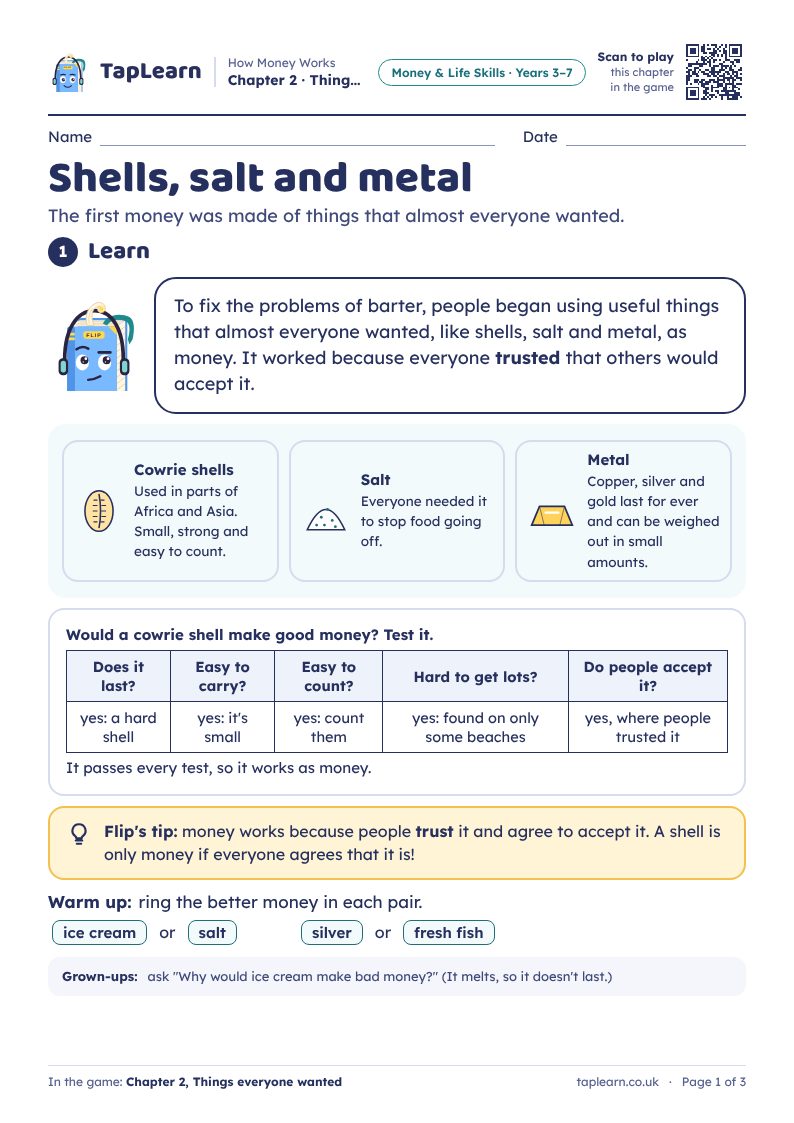
Shells, Salt and Metal is a printable commodity money worksheet for Years 3 to 7 (ages 7 to 12) that teaches why people used useful things such as cowrie shells, salt and metal as early money. Children test household objects against the qualities of good money and explain that money works because people trust and accept it.
This worksheet is for members
Membership opens every chapter of every game and every worksheet, for all your children.
See the plansAlready a member? Log in to print it.
Start with the free one: Why swapping was tricky (chapter 1).
Print it on A4, in colour or black and white. Do it after the chapter, or before it to see what your child already knows.
What's on the worksheet
Find out why early people used shells, salt and metal as money, test what makes good money, and learn that money works because people trust it. With a good money test at home and answers.
- Page 1 · Learn
- Cowrie shells, salt and metal as early money, then a cowrie shell is put through five good-money tests. A warm-up picks the better money in two pairs.
- Page 2 · Try it together
- The good money test: score four things from home, such as pasta, buttons, leaves or grapes, on whether they last, are easy to carry and count, are scarce and wanted. Then match early money to its reason.
- Page 3 · Practise
- True or false statements, explain why sand makes bad money, choose and test your own island money, and a challenge about whether money must be gold.
- Answers sheet
- Every answer by page, with notes on the belief that money must be gold to work.
3 A4 pages and an answers sheet · about 25 minutes
In the classroom
- Give groups a bag of objects to rank as money using the five tests, then compare rankings.
- The island money task works as a short persuasive speaking activity.
Questions from the worksheet
- True or false: fresh milk would make good money.
- Why would sand make bad money on a beach? Explain.
- You live on an island with no money. Choose something to use as money. Which tests does it pass?
- Sam says, "Money only works if it's made of gold." Is he right? Use shells and salt to explain.
The answers are on the answers sheet, for grown-ups.
Using it at home
- Gather four small things for the good money test before you start; it takes about 10 minutes at the kitchen table.
- Ask your child to argue for their island money choice: a short debate helps them use the tests.
Watch out for
- Thinking money is only valuable if it's made of gold.
- Point out that shells, salt and today's coins aren't gold. What matters is that people trust and accept them.
- Thinking anything at all can be money.
- Only things that pass the tests work well: things that rot, or that anyone can find lots of, don't.
Questions and answers
What is commodity money?
Commodity money is money made of something useful in its own right, such as shells, salt or metal. People accepted it because they valued the thing itself and trusted others would accept it too.
What makes good money?
Good money lasts, is easy to carry, can be counted or split into small amounts, is hard to get lots of, and is something people trust and agree to accept.
More worksheets from How Money Works: The Story from Barter to Bank Cards
- Chapter 1: Barter worksheet: Why swapping was tricky Free
- Chapter 3: History of coins worksheet: How coins began Members
- Chapter 4: History of paper money worksheet: A promise on paper Members
- Chapter 5: How banks began worksheet Members
- Chapter 6: Fiat money worksheet: Why money works Members
- Chapter 7: How money is created worksheet: Making new money Members
- Chapter 8: Inflation worksheet: Rising prices Members
- Chapter 9: Digital money worksheet: Tap to pay Members
 TapLearn