Barter worksheet for Years 3–7: Why swapping was tricky
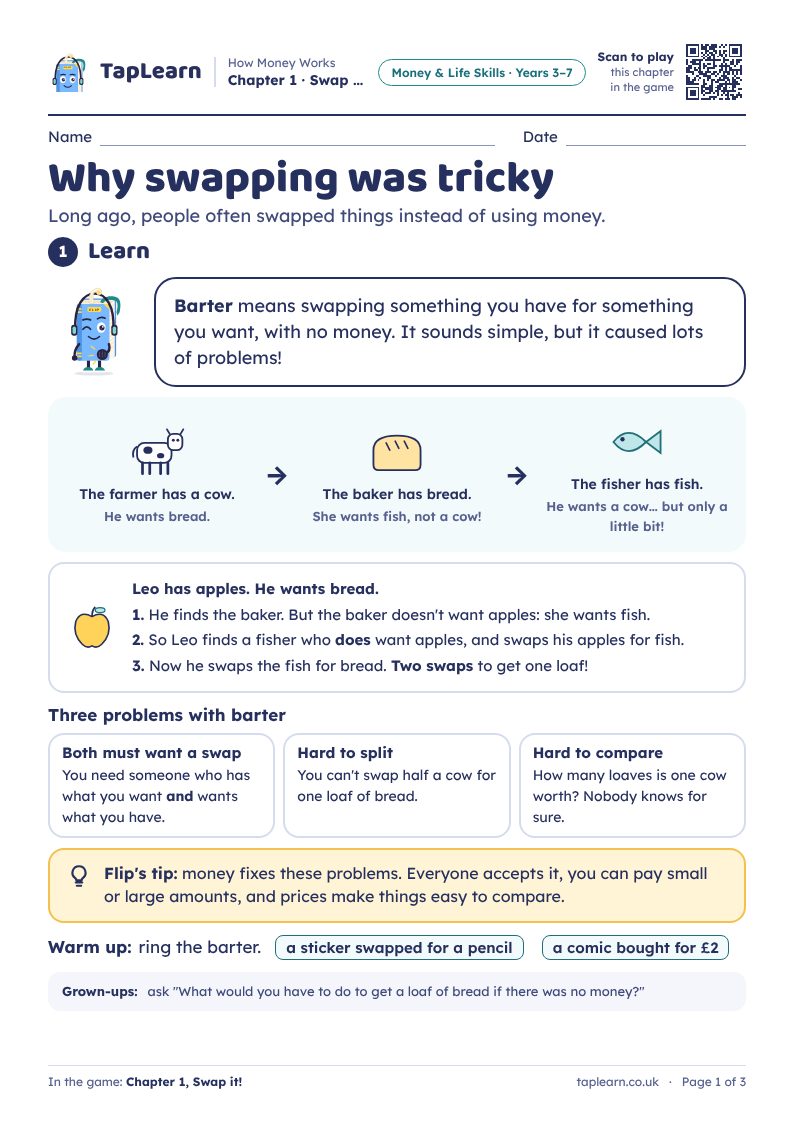
Why Swapping Was Tricky is a printable barter worksheet for Years 3 to 7 (ages 7 to 12) that teaches what barter means and why swapping goods without money caused problems. Children follow a chain of swaps, play a swap shop game at home, solve a swap puzzle and explain why people needed money.
Free to print, no account needed.
Print it on A4, in colour or black and white. Do it after the chapter, or before it to see what your child already knows.
What's on the worksheet
Learn what barter means and why swapping goods was tricky, from finding the right person to splitting a cow, and why people needed money. With a swap shop game and answers.
- Page 1 · Learn
- A farmer, a baker and a fisher show why swaps go wrong, then Leo needs two swaps to turn apples into bread. Three barter problems and a warm-up to ring the barter.
- Page 2 · Try it together
- Swap shop: each person picks three small things and tries to swap for something they want, recording which swaps worked and why. Then a swap puzzle with a ball, a book and a kite.
- Page 3 · Practise
- Match barter problems to examples, true or false statements, explain why swapping a cow for shoes is hard, and a challenge about whether barter is as easy as money.
- Answers sheet
- Every answer by page, what to watch out for, and quick ideas to go further.
3 A4 pages and an answers sheet · about 25 minutes
In the classroom
- Run the swap shop as a whole-class starter with picture cards of goods, then ask who got what they wanted.
- Use the swap puzzle as a pairs problem with three objects to move around.
Questions from the worksheet
- Mia has a ball and wants a book. Sam has a book and wants a kite. Ava has a kite and wants a ball. How can Mia get the book?
- True or false: with barter, it was always easy to find someone to swap with.
- A farmer wants to swap his cow for a pair of shoes. Give two reasons why this might be hard.
- Leo says, "Barter is just as easy as using money. You just swap!" Is he right?
The answers are on the answers sheet, for grown-ups.
Using it at home
- Play the swap shop with toys or snacks: it takes about 10 minutes and works best with three or more people.
- Let your child try the swap puzzle on their own first; acting it out with three objects helps if they get stuck.
Watch out for
- Thinking swapping is always fair and easy.
- Count how many tries failed in the swap shop because one person didn't want the other's thing.
- Thinking money is just coins and notes.
- The big idea is that money is something everyone accepts, so you don't need a perfect swap partner.
Questions and answers
What is barter?
Barter is swapping goods or services for other goods or services without using money, such as trading eggs for a loaf of bread.
Why was barter replaced by money?
Barter only works when both people want what the other has, big things can't be split, and it is hard to agree what things are worth. Money solves these problems because everyone accepts it.
More worksheets from How Money Works: The Story from Barter to Bank Cards
- Chapter 2: Commodity money worksheet: Shells, salt and metal Members
- Chapter 3: History of coins worksheet: How coins began Members
- Chapter 4: History of paper money worksheet: A promise on paper Members
- Chapter 5: How banks began worksheet Members
- Chapter 6: Fiat money worksheet: Why money works Members
- Chapter 7: How money is created worksheet: Making new money Members
- Chapter 8: Inflation worksheet: Rising prices Members
- Chapter 9: Digital money worksheet: Tap to pay Members
 TapLearn