History of coins worksheet for Years 3–7: How coins began
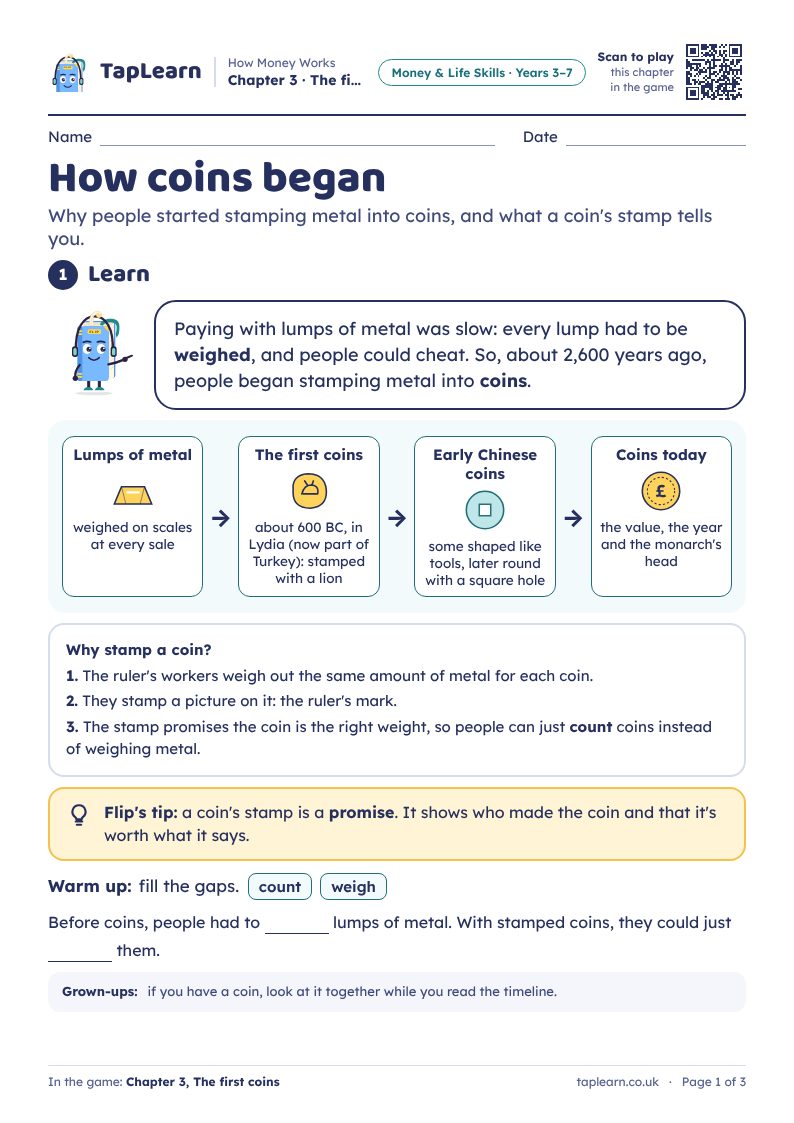
How Coins Began is a printable history of coins worksheet for Years 3 to 7 (ages 7 to 12) that teaches how the first stamped coins began about 2,600 years ago and why stamping metal made paying easier. Children examine real coins, order the story of money, design their own coin and explain what a coin's stamp promises.
This worksheet is for members
Membership opens every chapter of every game and every worksheet, for all your children.
See the plansAlready a member? Log in to print it.
Start with the free one: Why swapping was tricky (chapter 1).
Print it on A4, in colour or black and white. Do it after the chapter, or before it to see what your child already knows.
What's on the worksheet
Learn how the first coins began about 2,600 years ago, why coins were stamped, and what the markings on a coin show. With a coin detective activity and answers.
- Page 1 · Learn
- A timeline from weighed lumps of metal to the first coins in Lydia, early Chinese coins and coins today, then three steps showing why coins were stamped. A fill-the-gap warm-up.
- Page 2 · Try it together
- Coin detectives: find the monarch's head, value and year on three coins, make a coin rubbing and record what's on the back. Then put the story of money in order.
- Page 3 · Practise
- True or false statements, two reasons coins beat lumps of metal, design the front and back of your own coin, and a challenge about whether a coin's worth is its metal.
- Answers sheet
- Every answer by page, with notes on coin sizes and values and on money being worth its metal.
3 A4 pages and an answers sheet · about 25 minutes
In the classroom
- Do coin rubbings as a group, then sort them by value and by year.
- Use the coin design task as a short art and history link.
Questions from the worksheet
- True or false: stamped coins had to be weighed every time you paid.
- Give two reasons why coins were better than lumps of metal.
- Design your own coin. Draw the front and back. Show its value, the year and a picture.
- Mia says, "Coins today are worth something because of the metal they're made of." Is she right? Explain.
The answers are on the answers sheet, for grown-ups.
Using it at home
- Find three different coins for the coin detective activity; the rubbing works best with thin paper and the side of a pencil lead.
- Let your child find the oldest coin you have and work out how many years ago it was made.
Watch out for
- Thinking bigger coins are worth more.
- A 20p coin is smaller than a 10p coin. The value is what's stamped on it.
- Thinking money is worth its metal.
- That was nearer the truth for the first coins. Today, money works because people trust and accept it.
Questions and answers
When were the first coins made?
The first coins were made about 2,600 years ago, around 600 BC, in Lydia, in what is now Turkey. They were lumps of a gold and silver mix stamped with a lion.
Why were coins stamped?
A stamp showed who made the coin and promised it was the right weight, so people could simply count coins instead of weighing metal every time they paid.
More worksheets from How Money Works: The Story from Barter to Bank Cards
- Chapter 1: Barter worksheet: Why swapping was tricky Free
- Chapter 2: Commodity money worksheet: Shells, salt and metal Members
- Chapter 4: History of paper money worksheet: A promise on paper Members
- Chapter 5: How banks began worksheet Members
- Chapter 6: Fiat money worksheet: Why money works Members
- Chapter 7: How money is created worksheet: Making new money Members
- Chapter 8: Inflation worksheet: Rising prices Members
- Chapter 9: Digital money worksheet: Tap to pay Members
 TapLearn