How money is created worksheet for Years 3–7: Making new money
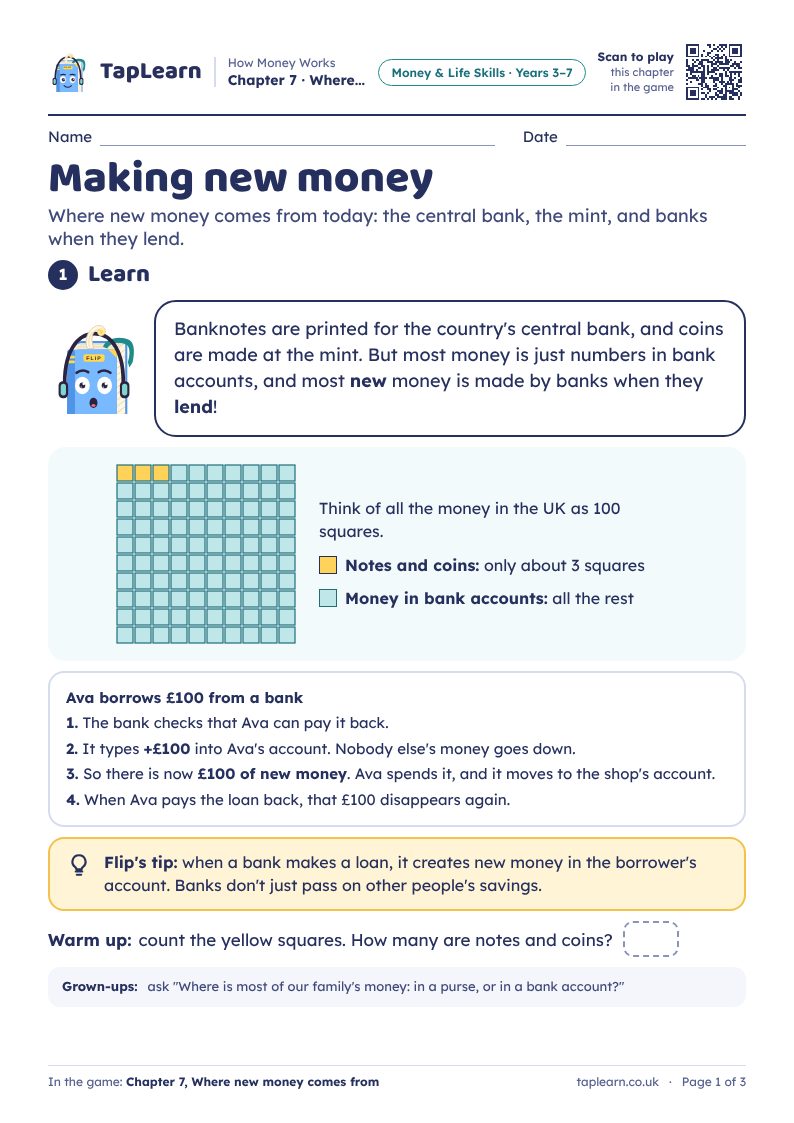
Making New Money is a printable worksheet for Years 3 to 7 (ages 7 to 12) that teaches where new money comes from today: notes and coins are only a small part, and most new money is created by banks when they lend. Children keep an account book to watch the total money rise with a loan and fall when it is repaid.
This worksheet is for members
Membership opens every chapter of every game and every worksheet, for all your children.
See the plansAlready a member? Log in to print it.
Start with the free one: Why swapping was tricky (chapter 1).
Print it on A4, in colour or black and white. Do it after the chapter, or before it to see what your child already knows.
What's on the worksheet
Learn who makes notes and coins, why most money is numbers in bank accounts, and how banks create new money when they lend. With an account book game and answers.
- Page 1 · Learn
- A grid of 100 squares shows notes and coins are about 3 in every 100, then Ava's 100-pound loan is followed from the bank typing it in to it disappearing when repaid. A counting warm-up.
- Page 2 · Try it together
- The account book: the grown-up plays the bank, Leo borrows 5 pounds, spends it at Mia's shop and pays it back, and the child tracks every balance and the total. Then match money to who makes it.
- Page 3 · Practise
- Fill in an account book for Sam and Ava, true or false statements, explain where Ava's 100 pounds came from, and a challenge about whether loans come out of Gran's savings.
- Answers sheet
- Every answer by page, with notes on the belief that banks only lend out savers' money.
3 A4 pages and an answers sheet · about 25 minutes
In the classroom
- Run the account book on the board with three pupils as account holders and the class keeping the totals.
- Use the 100-square grid as a quick fractions and percentages link.
Questions from the worksheet
- Fill in the account book: Ava has 50 pounds and Sam has 30 pounds. The bank lends Sam 20 pounds. What is the total money now?
- True or false: most money in the UK is notes and coins.
- Where did the 100 pounds in Ava's account come from?
- Leo says, "When the bank lends me money, it takes it out of Gran's savings, so Gran has less." Is he right?
The answers are on the answers sheet, for grown-ups.
Using it at home
- The account book game takes about 10 minutes with just a pencil: you play the bank and your child tracks the numbers.
- Pause after the loan row and ask "Did anyone's money go down?" before moving on.
Watch out for
- Thinking banks only lend out other people's savings.
- Show the account book: when Leo borrowed, nobody's money went down, and the total went up.
- Thinking money is mostly notes and coins.
- Only a small part is. Most money is numbers in bank accounts.
Questions and answers
Where does new money come from?
Most new money is created by commercial banks when they make loans, by adding money to the borrower's account. Banknotes are printed for the central bank, and coins are made at the mint.
Do banks lend out savers' money?
Not exactly. When a bank makes a loan, it creates a new deposit in the borrower's account, so savers' balances don't go down. The money disappears again when the loan is repaid.
More worksheets from How Money Works: The Story from Barter to Bank Cards
- Chapter 1: Barter worksheet: Why swapping was tricky Free
- Chapter 2: Commodity money worksheet: Shells, salt and metal Members
- Chapter 3: History of coins worksheet: How coins began Members
- Chapter 4: History of paper money worksheet: A promise on paper Members
- Chapter 5: How banks began worksheet Members
- Chapter 6: Fiat money worksheet: Why money works Members
- Chapter 8: Inflation worksheet: Rising prices Members
- Chapter 9: Digital money worksheet: Tap to pay Members
 TapLearn