Inflation worksheet for Years 3–7: Rising prices
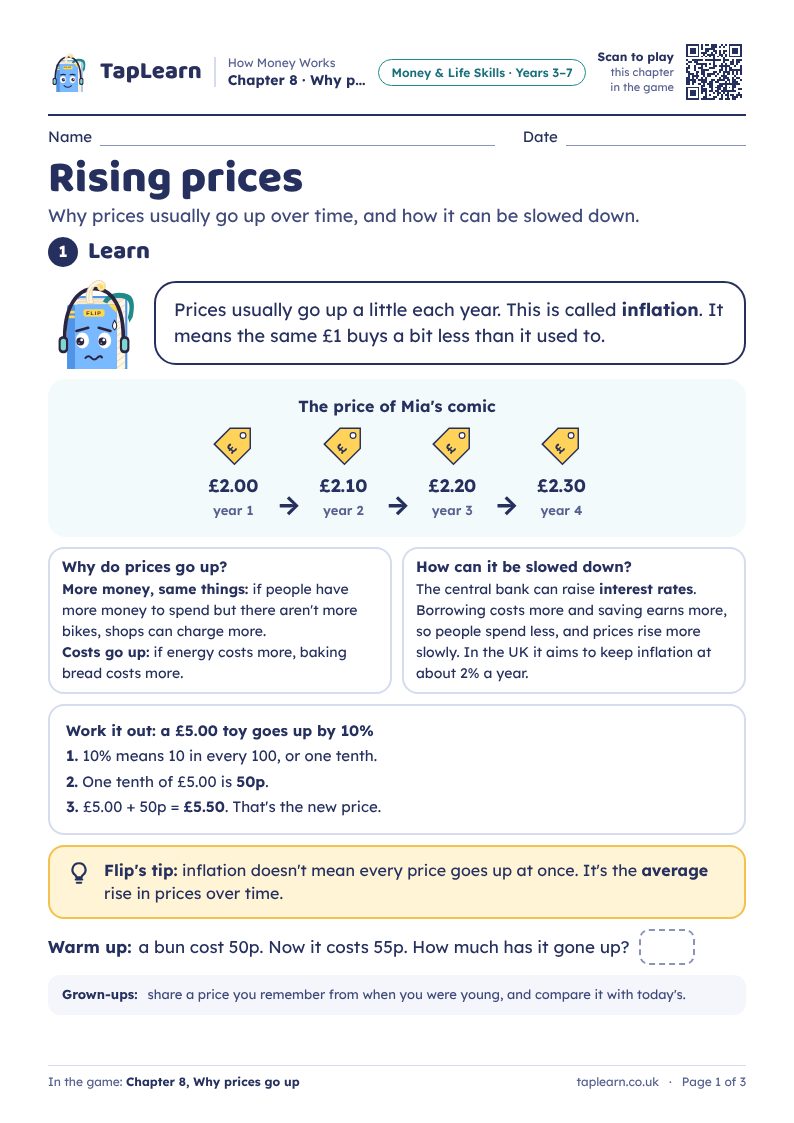
Rising Prices is a printable inflation worksheet for Years 3 to 7 (ages 7 to 12) that teaches why prices usually rise over time and how higher interest rates can slow them down. Children run a button auction to see more money push prices up, and work out new prices after rises in pence and by 10%.
This worksheet is for members
Membership opens every chapter of every game and every worksheet, for all your children.
See the plansAlready a member? Log in to print it.
Start with the free one: Why swapping was tricky (chapter 1).
Print it on A4, in colour or black and white. Do it after the chapter, or before it to see what your child already knows.
What's on the worksheet
Learn what inflation means, why prices rise over time and how higher interest rates can slow it down, with price calculations in pounds and pence. With a button auction game and answers.
- Page 1 · Learn
- A comic's price rising each year, why prices go up and how interest rates slow them, then a worked example of a 10% rise on 5 pounds. A warm-up finds the rise from 50p to 55p.
- Page 2 · Try it together
- Too many buttons: auction three treats with 5 buttons each, then again with 10 buttons each, and compare the winning prices. Then work out four new prices.
- Page 3 · Practise
- Sort causes and cures of rising prices, true or false statements, explain why comics cost more than in Grandad's day, and a challenge about printing lots more money.
- Answers sheet
- Every answer by page, with notes on greedy shops, printing money and working with percentages.
3 A4 pages and an answers sheet · about 30 minutes
In the classroom
- Run the button auction with the whole class and record round 1 and round 2 prices on the board.
- Use the price table as a percentages starter for older pupils.
Questions from the worksheet
- Work out the new price: a 20-pound game goes up by 10%.
- Does each one make prices rise faster, or slow them down? The central bank raises interest rates.
- Grandad says, "When I was your age, a comic cost much less." Why do comics cost more today?
- Mia says, "If the government printed lots more money, everyone would be rich!" Is she right?
The answers are on the answers sheet, for grown-ups.
Using it at home
- The button auction takes about 10 minutes and needs at least two bidders: grown-ups can join in.
- Younger children can skip the 10% rows; older ones find one tenth first, then add it on.
Watch out for
- Thinking shops raise prices just to be greedy.
- Sometimes costs go up, or lots of people want the same things. Talk about a bakery paying more for energy.
- Thinking more money makes everyone richer.
- Only if there are more things to buy. Use the button game to show prices rising instead.
Questions and answers
What is inflation?
Inflation is the rise in prices over time, so the same amount of money buys a bit less than before. In the UK, the central bank aims to keep it at about 2% a year.
How do interest rates slow inflation?
Higher interest rates make borrowing cost more and saving earn more, so people spend less. With less spending, prices rise more slowly.
More worksheets from How Money Works: The Story from Barter to Bank Cards
- Chapter 1: Barter worksheet: Why swapping was tricky Free
- Chapter 2: Commodity money worksheet: Shells, salt and metal Members
- Chapter 3: History of coins worksheet: How coins began Members
- Chapter 4: History of paper money worksheet: A promise on paper Members
- Chapter 5: How banks began worksheet Members
- Chapter 6: Fiat money worksheet: Why money works Members
- Chapter 7: How money is created worksheet: Making new money Members
- Chapter 9: Digital money worksheet: Tap to pay Members
 TapLearn