How banks began worksheet for Years 3–7
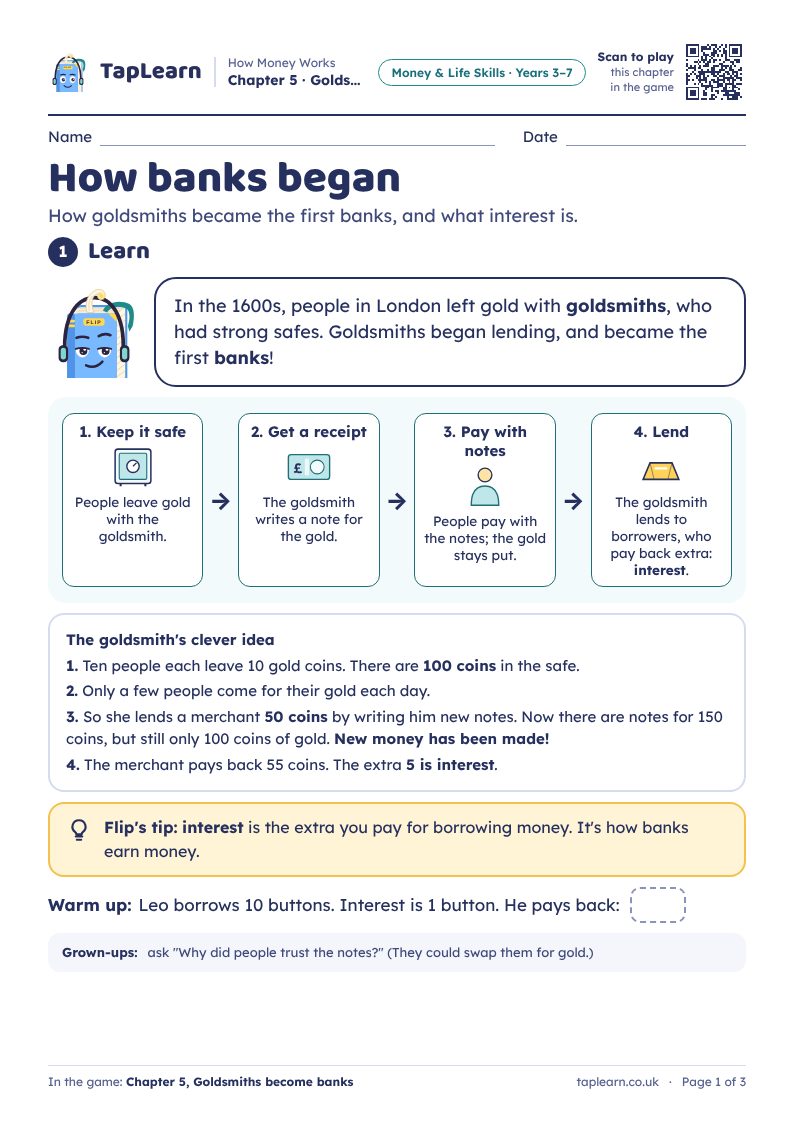
How Banks Began is a printable worksheet for Years 3 to 7 (ages 7 to 12) that teaches how goldsmiths in 1600s London became the first banks and what deposits, loans and interest are. Children play a button bank game, work out interest on loans and explain how a goldsmith's notes created new money.
This worksheet is for members
Membership opens every chapter of every game and every worksheet, for all your children.
See the plansAlready a member? Log in to print it.
Start with the free one: Why swapping was tricky (chapter 1).
Print it on A4, in colour or black and white. Do it after the chapter, or before it to see what your child already knows.
What's on the worksheet
Learn how goldsmiths with strong safes became the first banks, what deposits, loans and interest are, and how lending can make new money. With a button bank game and answers.
- Page 1 · Learn
- Four steps from keeping gold safe to lending, then the goldsmith's clever idea: notes for 150 coins with only 100 coins of gold. A warm-up works out a loan with interest.
- Page 2 · Try it together
- Button bank: deposit buttons with a grown-up bank, borrow some and pay back one extra for every five as interest, then swap jobs. Then find missing numbers in an interest table.
- Page 3 · Practise
- Match deposit, loan, interest and receipt to their meanings, true or false statements, explain why the goldsmith didn't run out of gold, and a challenge about savers' money.
- Answers sheet
- Every answer by page, with notes on the belief that banks only lend out savers' money.
3 A4 pages and an answers sheet · about 25 minutes
In the classroom
- Use the interest table as a mini-whiteboard maths starter.
- Act out the goldsmith story with ten pupils as savers and cards as gold coins and notes.
Questions from the worksheet
- Work out the missing numbers: borrowed 20 coins, paid back 23 coins. What was the interest?
- True or false: everyone came to take their gold out on the same day.
- Why could the goldsmith lend out notes without running out of gold?
- Mia says, "A bank can only lend the exact gold that savers left in its safe." Is she right?
The answers are on the answers sheet, for grown-ups.
Using it at home
- Play button bank with dried pasta if you have no buttons; it takes about 10 minutes and works well with two players.
- Let your child be the bank in round 2 so they see who earns the interest.
Watch out for
- Thinking banks only lend out other people's savings.
- Go back to the goldsmith: her new notes were worth more than the gold in the safe. Lending itself can create money.
- Mixing up who pays interest.
- The borrower pays interest to the lender. Ask "Who gave the extra button in the game?"
Questions and answers
How did goldsmiths become banks?
In the 1600s, people left gold with goldsmiths, who had strong safes, and got receipts that were used as money. Goldsmiths then lent some out and charged interest, which is how banking began.
What is interest?
Interest is the extra money a borrower pays back on top of a loan. If you borrow 10 pounds and pay back 11 pounds, the interest is 1 pound.
More worksheets from How Money Works: The Story from Barter to Bank Cards
- Chapter 1: Barter worksheet: Why swapping was tricky Free
- Chapter 2: Commodity money worksheet: Shells, salt and metal Members
- Chapter 3: History of coins worksheet: How coins began Members
- Chapter 4: History of paper money worksheet: A promise on paper Members
- Chapter 6: Fiat money worksheet: Why money works Members
- Chapter 7: How money is created worksheet: Making new money Members
- Chapter 8: Inflation worksheet: Rising prices Members
- Chapter 9: Digital money worksheet: Tap to pay Members
 TapLearn