Compass Directions: A Treasure Island Quest with Pip
Learn compass directions: north, south, east and west, plus near, far, left and right, by finding places and following routes on island maps.
Online game, chapter 1 free · Years 1 and 2 (KS1) · ages 5–7 · national curriculum in England · no adverts · plays on a phone, tablet or computer · no sign-up to start.
An online earth and geography game for Years 1 and 2 (KS1). It covers the national curriculum in England, Years 1–2 geography: “Use simple compass directions (north, south, east and west) and locational and directional language, to describe the location of features and routes on a map”.
5 short chapters, about 35 minutes in all. Children can stop after any chapter.
Start playing for free. Plays in the browser on phones, tablets and computers: no app, no adverts.
Free for teachers: every chapter on the whiteboard with a free teacher account.
Last updated · Checked against the national curriculum in England by the TapLearn team
What you'll learn
Name the four compass points: north, east, south and west
Put N, E, S and W in the right places on a compass rose
Use near, far, left and right to say where things are on a map
Find places on a map using north, south, east and west
Follow and describe a route by direction and number of squares
Why a compass needle points north and where the sun rises
Chapter by chapter
Near, far, left and right on a mapStart playing for free
Years 1–2 geography · 1
The four compass points: north, south, east and west
Years 1–2 geography · 1
Find places using north, south, east and west
Years 1–2 geography · 1
Follow a route using compass directions
Years 1–2 geography · 1
Describe a route using compass directions
Years 1–2 geography · 1
Explorer challenge: compass directions and routes (8 questions)
What the chapters cover in the national curriculum in England:
Years 1–2 geography: Use simple compass directions (north, south, east and west) and locational and directional language, to describe the location of features and routes on a map
About this adventure
Compass Directions is an interactive game that teaches children aged 5–7 how to use north, south, east and west, and words such as near, far, left and right, to describe where things are and routes on a map. It follows the KS1 Geography curriculum and is pitched mainly at Year 2.
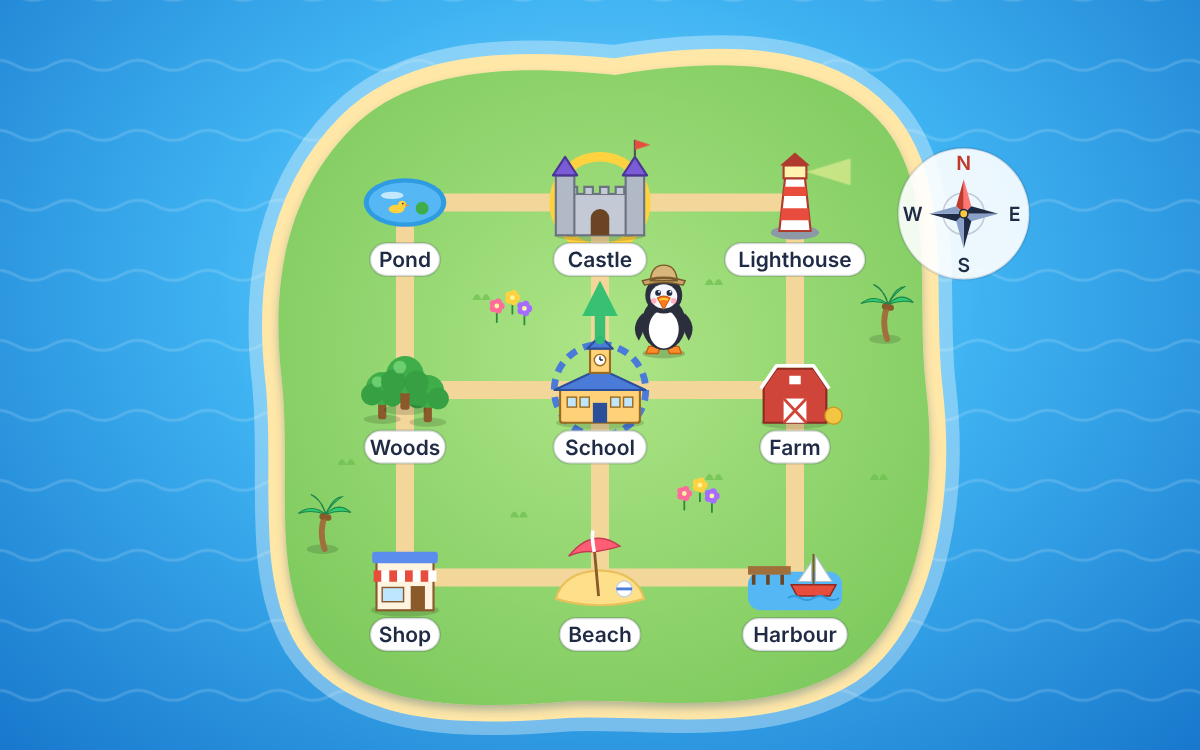
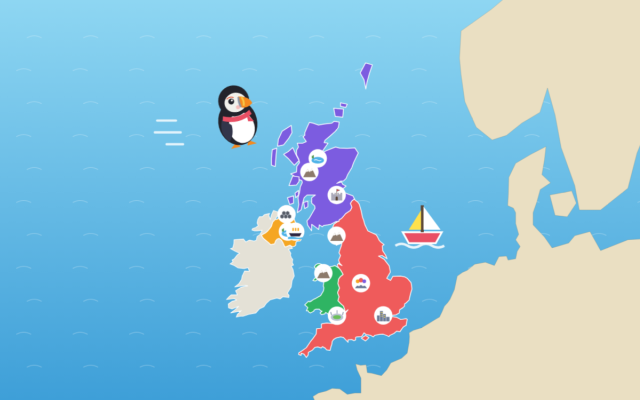
Children explore Compass Island with Pip the puffin. They shake a compass to see its magnetic needle swing back to north, build a compass rose using the rhyme Never Eat Shredded Wheat, and watch the sun rise in the east and set in the west. On grid maps they move Pip square by square to buried treasure, then give their own directions for Pip to follow.
Spoken instructions, a hint after every wrong answer and short animations keep reading to a minimum, and the game works on phones, tablets and computers.
Questions and answers
What are the four compass directions?
The four compass directions are north, east, south and west. On most maps north is at the top, east is on the right, south is at the bottom and west is on the left. Going round clockwise from north, they come in the order N, E, S, W.
How do you remember the order of the compass points?
A popular way is the rhyme Never Eat Shredded Wheat, which gives N, E, S and W. Children start with north at the top and go round the compass the same way a clock's hands turn.
How does a compass work, in simple words?
A compass has a needle that is a tiny magnet, and the Earth behaves like a giant magnet. However you turn the compass, the needle swings round to point north, so you can work out east, south and west from it.
What age is this compass directions game for?
It is made for children aged 5 to 7, mainly Year 2, and follows the KS1 Geography curriculum on compass directions and directional language. It sticks to the four main compass points, so slightly older children can also use it as a refresher.
What does the compass game include and how long does it take?
It has five chapters and an eight-question Explorer Challenge, and takes about 35 minutes to play through. Every instruction is read aloud, and children can start any chapter from the island map and come back to it later.
We count visits to make TapLearn better.We use one cookie, only on this site, to see how families find and use it. No adverts, and nothing is shared.One cookie, only on this site. No adverts.How we measure
 TapLearn