What you'll learn
- The four types of settlement in order: hamlet, village, town, city
- Which services, like shops, schools and hospitals, each settlement usually has
- Why early settlers chose sites with fresh water, food, wood and safety
- The four groups of natural resources: energy, food, minerals and water
- How trade links and new jobs help a village grow into a town
- Six types of land use, from residential to industrial and recreational
Chapter by chapter
- Types of settlement: hamlet, village, town and city Free to try
Years 3–6 geography · 1
- Settlement sites: water, food, wood and safety
Years 3–6 geography · 1
- Why settlements grow: natural resources and trade links
Years 3–6 geography · 1
- Land use: homes, shops, factories, farms and parks
Years 3–6 geography · 1
- Big settlements quiz (10 questions)
What the chapters cover in the national curriculum in England:
- Years 3–6 geography: Describe and understand key aspects of human geography, including: types of settlement and land use, economic activity including trade links, and the distribution of natural resources including energy, food, minerals and water
About this adventure
Towns, Cities and Villages is an interactive geography game that teaches children aged 8–11 the types of settlement, why settlements grow and how land is used, matching KS2 geography in England. Pip the pigeon reads every step aloud, with captions on screen.
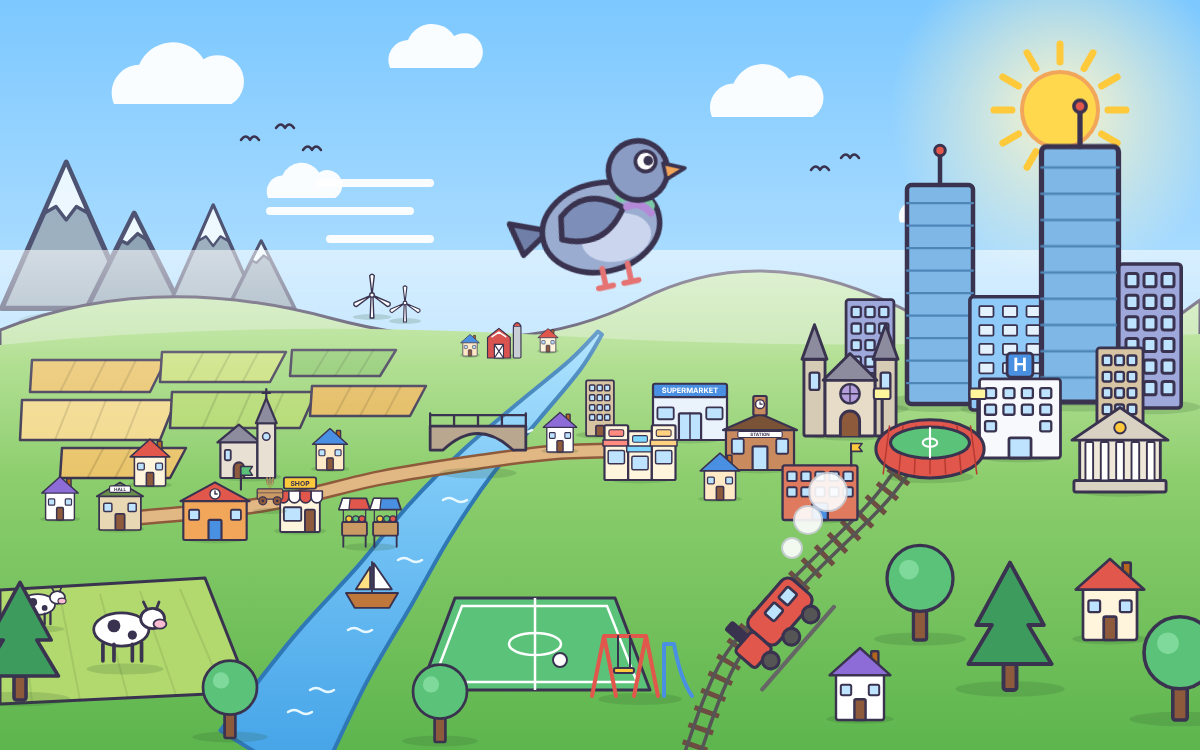
Players fill an empty valley with buildings until it becomes a city, discovering that a settlement is any place where people live and that bigger settlements have more services. They help early settlers find a site with fresh water, food, wood and safety, and see what happens if they build too close to the river.
Later they meet natural resources (energy, food, minerals and water), find out how trade links and economic activity bring jobs and new people, and colour a land use map showing residential, commercial, industrial, agricultural, recreational and transport land.
Questions and answers
What are the different types of settlement?
The four main types of settlement are hamlets, villages, towns and cities, in order of size. A hamlet has just a few houses, a village adds services such as a church, shop and small school, a town has a high street and station, and a city has the most people and services.
Why did early settlers build near rivers?
Early settlers built near rivers because they needed fresh water for drinking, cooking and washing, and rivers also gave them fish and a way to travel and trade. They often chose slightly higher, dry ground nearby so that floods could not reach their homes.
What are the types of land use?
The main types of land use are residential (homes), commercial (shops and offices), industrial (factories and warehouses), agricultural (farms), recreational (parks and sport) and transport (roads and railways). Planners try to keep noisy factories away from homes and put playgrounds where children can walk to them safely.
What age is this settlements game for?
It is for children aged 8 to 11 and is pitched mainly at Year 3, when settlements and land use are usually taught in KS2 geography. Every line is read aloud and shown as a caption, so less confident readers can follow along.
What does the game include and how long does it take?
The game has four chapters, each with an animated introduction, hands-on building, sorting and planning activities and short questions, followed by a 10-question quiz. Playing everything takes about 45 minutes, and children can start any chapter from the menu.


 TapLearn