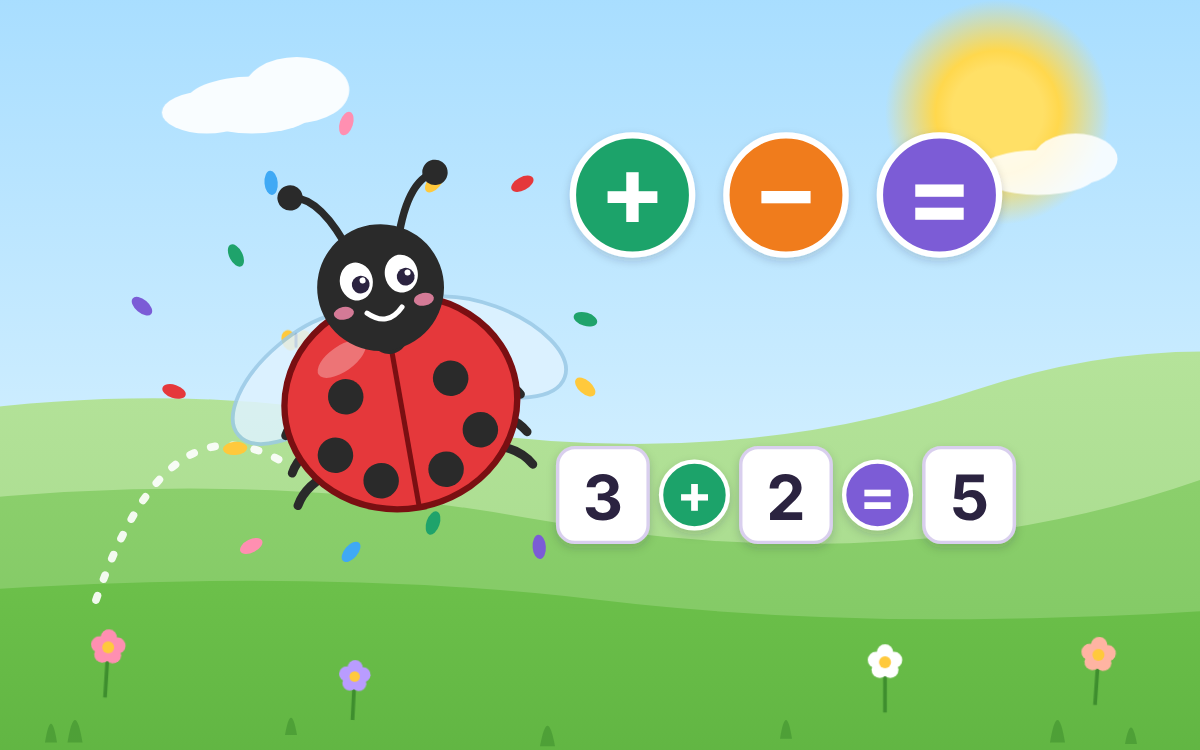
Number Bonds to 20: A Ladybird Meadow Maths Game
Learn number bonds to 20 and the subtraction facts that go with them, by flipping counters, balancing scales and building number sentences.
- Ages 5–7
- About 50 min
- Easy start
- Calculation
Learn number bonds to 20 and the subtraction facts that go with them, by flipping counters, balancing scales and building number sentences.
Year 1 maths · 1
Year 1 maths · 2
Year 1 maths · 2 Year 1 maths · 1
Year 1 maths · 2
Year 1 maths · 1 Year 1 maths · 2
What the chapters cover in the national curriculum in England:
Number Bonds to 20 is an interactive maths game that teaches children aged 5–7 number bonds within 20, the subtraction facts that go with them, and how to read and write number sentences with +, − and =. It follows Year 1 maths in the national curriculum in England.
Dotty the ladybird guides each step out loud. Children flip red and yellow counters on ten frames, move spots between a ladybird's wings and fill in part-whole models, where the whole sits at the top and the two parts below. A balance scale shows that the equals sign means 'is the same as', and a fact family house shows how 7 + 3 = 10 also gives 10 − 3 = 7.
Questions use tapping, card building and a number pad for typed answers, with gentle hints after a mistake. Optional warm-ups refresh counting and teen numbers, and a final challenge checks everything.
Number bonds are pairs of numbers that add together to make a whole number, such as 7 and 3, which make 10. Children often show them with a part-whole model, with the whole at the top and the two parts below.
Every number bond also gives subtraction facts. If 7 + 3 = 10, then 10 − 3 = 7 and 10 − 7 = 3. Together with 3 + 7 = 10, these four number sentences make a fact family.
The equals sign means 'is the same as': both sides have the same value. Many children think it means 'the answer comes next', so the game uses a balance scale and sentences like 10 = 6 + 4 to show it can go at either end.
It is designed for children aged 5 to 7 and matches Year 1 maths in the national curriculum in England. Older children who are still learning their bonds to 20 can also use it for extra practice.
Playing everything takes about 50 minutes, and each chapter can be played on its own. There are five narrated chapters with hands-on activities, two short optional warm-ups, and a 10-question challenge with typed and multiple-choice answers.
 TapLearn
Getting it ready…
Great work on chapter 1! To open the next chapters, ask a grown-up to take a look.
To play this game, ask a grown-up to take a look. There are lots of free games you can play right now too!
Create a free family account and your child can play every chapter of every game for 7 days, with no card needed. Their progress is kept. After that, the free plan is free for ever, and membership is £6.99 a month if you'd like to keep every chapter.
That's all the learning time for today. Great work! Flip will be ready to play again tomorrow.