What children learn, year by year
- Year 1: a half and a quarter of a shape, an object or a group (half of 8 sweets is 4).
- Year 2: a third, a quarter, two quarters and three quarters, and seeing that two quarters is the same as a half.
- Year 3: tenths, fractions of amounts, simple equivalent fractions, and adding and subtracting fractions with the same denominator, such as 2/7 + 3/7.
- Year 4: families of equivalent fractions, hundredths, and decimal equivalents such as 1/4 = 0.25 and 1/2 = 0.5.
- Year 5: comparing fractions, mixed numbers and improper fractions (1 2/5 = 7/5), multiplying a fraction by a whole number, and percentages.
- Year 6: simplifying, adding and subtracting fractions with different denominators, multiplying fractions together, dividing a fraction by a whole number, and linking fractions, decimals and percentages.
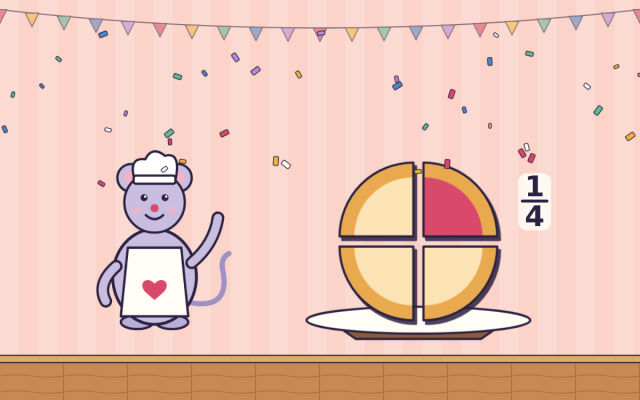
Year 3 Fractions: Bake and Share with Pip the Baker
Learn Year 3 fractions by cutting pies, snapping chocolate into tenths, comparing slices and adding fractions…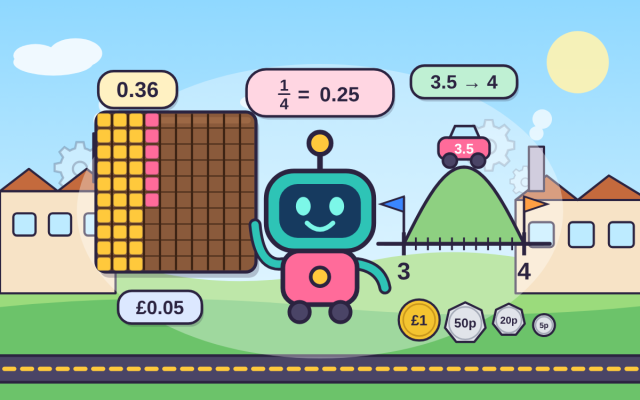
Year 4 Decimals: Chop, Count and Shop with Dot the Robot
Learn Year 4 decimals: tenths, hundredths, rounding and comparing. Chop a chocolate slab, roll cars down Roun…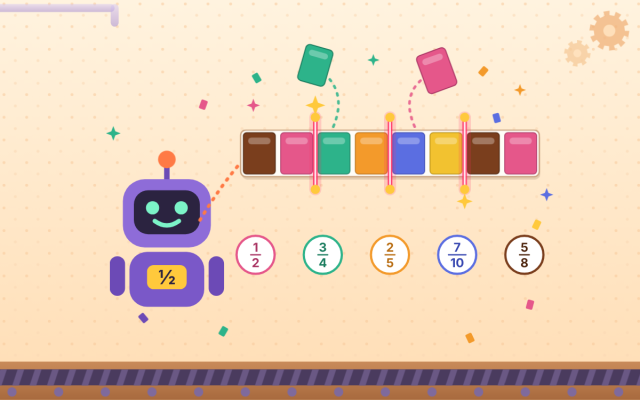
Year 5 Fractions: A Chocolate Factory Adventure
Learn Year 5 fractions: equivalent fractions, mixed numbers, comparing, adding, subtracting and multiplying,…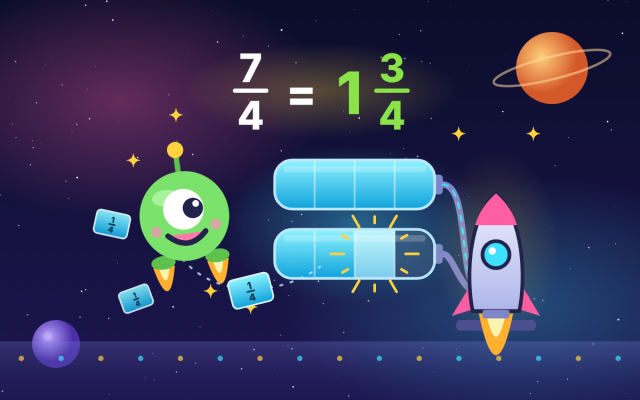
Mixed Numbers and Improper Fractions: A Rocket Fuel Mission
Learn to convert between mixed numbers and improper fractions by packing glowing fuel cells into tanks and fl…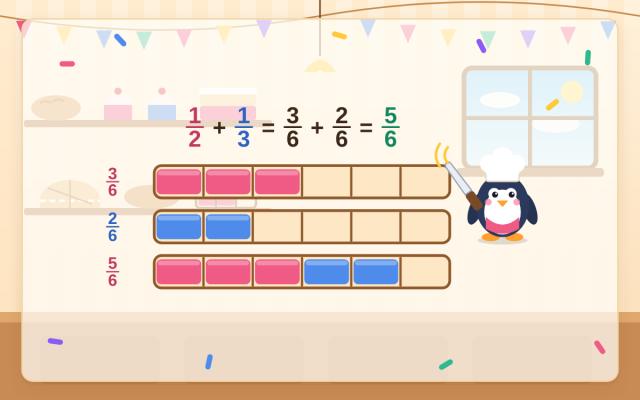
Adding and Subtracting Fractions: Bake with Pip the Penguin
Learn adding and subtracting fractions, mixed numbers included, then simplify, compare and order them by cutt…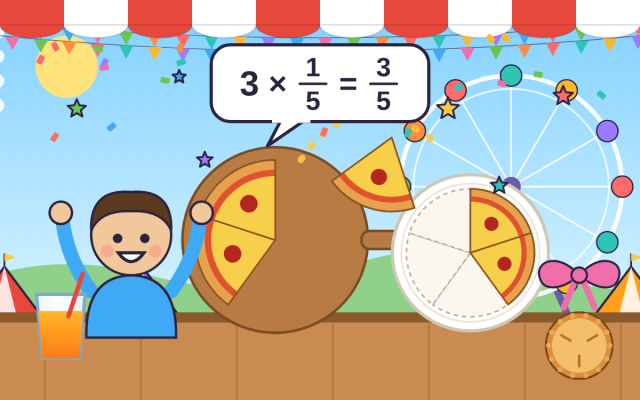
Multiplying Fractions by Whole Numbers: A Fraction Fair
Learn multiplying fractions by whole numbers, including mixed numbers, by serving pizza slices, cutting ribbo…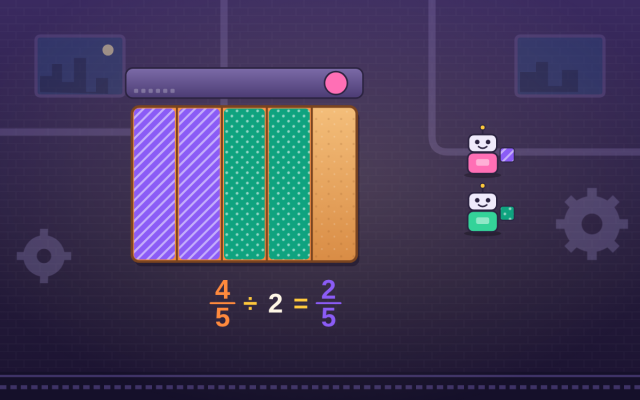
Multiplying and Dividing Fractions: A Fudge Factory Game
Learn multiplying and dividing fractions and how to turn fractions into decimals, by cutting, sharing and sim…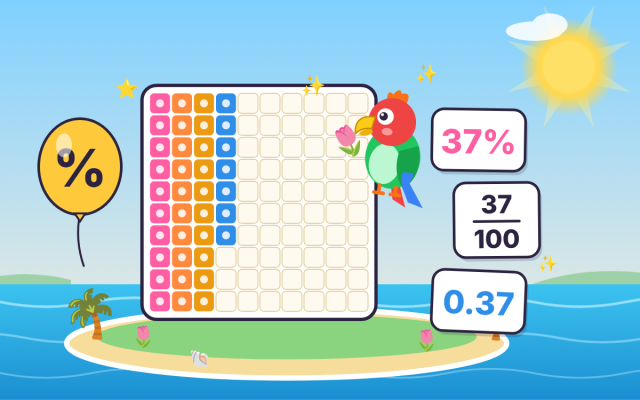
Percentages for Kids: Explore Percent Island with Percy
Learn what per cent means and how percentages, fractions and decimals match. Shade hundred squares, run a fra…The two words that help most
- The denominator (bottom number) says how many equal parts the whole is cut into.
- The numerator (top number) says how many of those parts we have.
The most common mix-up is thinking 1/8 is bigger than 1/4 "because 8 is bigger". Cutting a pizza into 8 makes smaller slices than cutting it into 4, and seeing that is worth more than any rule.
Ideas for home
- Share food fairly. "Can you cut the toast into quarters? Are they equal?"
- Find fractions of amounts. "There are 12 grapes. Half for you, a quarter for me. How many each?"
- Use a chocolate bar or Lego bricks to show that 2/4 and 1/2 are the same amount.
- Cook together. Half a cup, three quarters of a teaspoon, double the recipe.
- Talk about time. Quarter past, half past, quarter to.
- Older children: spot percentages in shop sales, and turn them into fractions (50% off is half price).
- Chapter 1 of Year 5 Fractions: A Chocolate Factory AdventureEquivalent fractions, tenths and hundredthsCan find and write equivalent fractions, including tenths and hundredthsFree taster
- Chapter 1 of Year 6 Percentages: A Fairground Adventure with CentoRecalling equivalent fractions, decimals and percentagesCan recall matching fractions, decimals and percentages, such as 1/2, 0.5 and 50%, and 3/4, 0.75 and 75%Free taster
- Chapter 6 of Percentages for Kids: Explore Percent Island with PercySolving problems with percentage, fraction and decimal equivalentsCan compare and order percentages, fractions and decimals, and solve problems such as finding the part that is left of 100%Members
- Chapter 2 of Year 6 Percentages: A Fairground Adventure with CentoUsing fraction, decimal and percentage equivalents in real lifeCan turn scores, money and lengths into percentages, such as 17 out of 20 into 85%, and order fractions, decimals and percentagesMembers
 TapLearn