What you'll learn
- Find equivalent fractions by multiplying or dividing the numerator and denominator
- Convert between tenths and hundredths, such as 3/10 = 30/100
- Change improper fractions into mixed numbers and back again
- Compare and order fractions whose denominators are multiples of the same number
- Add and subtract fractions with related denominators, like 1/3 + 1/6
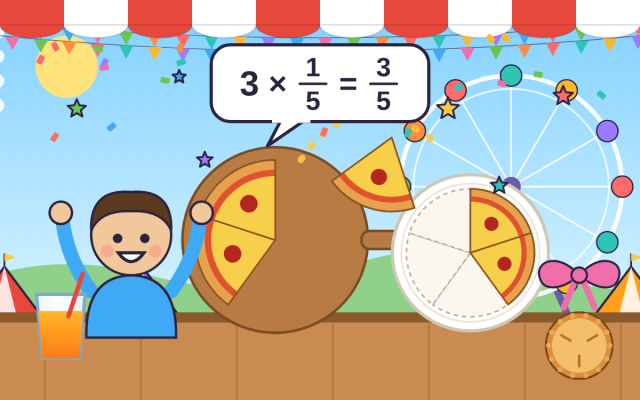
- Multiply fractions and mixed numbers by whole numbers
Chapter by chapter
- Equivalent fractions, tenths and hundredths Free to try
Year 5 maths · 1
- Improper fractions and mixed numbers
Year 5 maths · 2
- Compare and order fractions
Year 5 maths · 3
- Add and subtract fractions with related denominators
Year 5 maths · 4 Year 5 maths · 2
- Multiply fractions and mixed numbers by whole numbers
Year 5 maths · 5 Year 5 maths · 2
- Master Challenge: all Year 5 fraction skills (10 questions)
See every Maths chapter in the chapter library
What the chapters cover in the national curriculum in England:
- Year 5 maths: Identify, name and write equivalent fractions of a given fraction, represented visually, including tenths and hundredths
- Year 5 maths: Recognise mixed numbers and improper fractions and convert from one form to the other and write mathematical statements > 1 as a mixed number
- Year 5 maths: Compare and order fractions whose denominators are all multiples of the same number
- Year 5 maths: Add and subtract fractions with the same denominator, and denominators that are multiples of the same number
- Year 5 maths: Multiply proper fractions and mixed numbers by whole numbers, supported by materials and diagrams
About this adventure
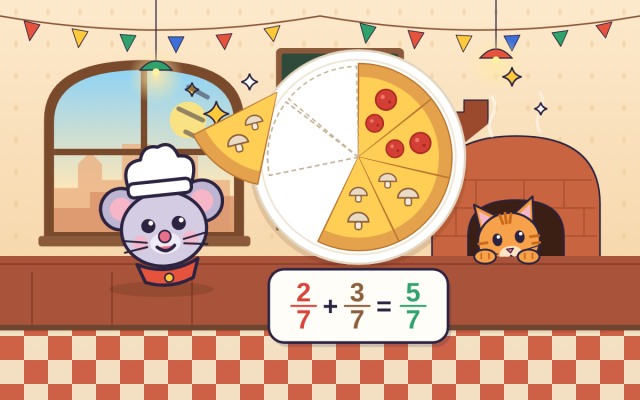
Year 5 Fractions is an interactive maths game that teaches children aged 9 to 11 the fraction skills in the Year 5 national curriculum for England. Set in a chocolate factory, it turns every fraction into bars and pieces that children can cut, pack, pour and compare.
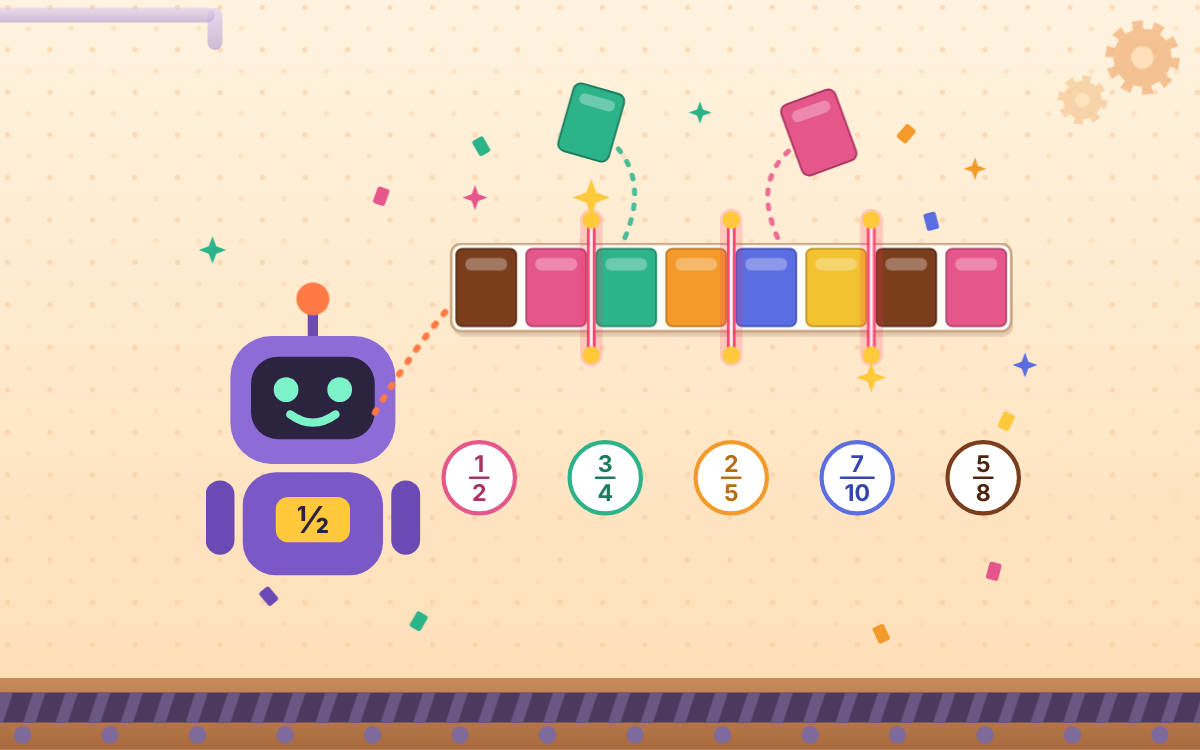
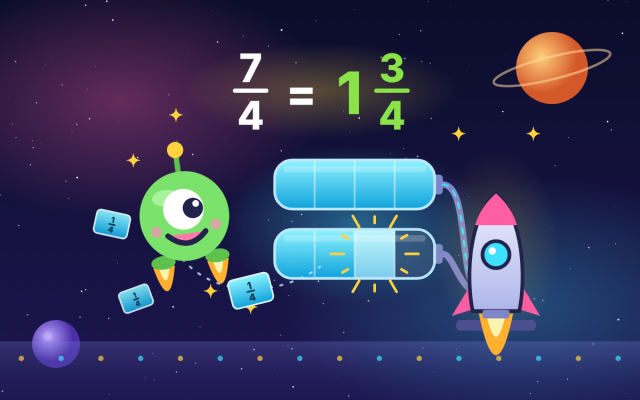
A robot narrator guides each step aloud. Children use a cutter to see that 1/2, 2/4 and 4/8 are equivalent fractions, learning that the denominator counts the equal pieces and the numerator counts the pieces we have. They pack pieces into moulds to turn an improper fraction such as 7/4 into the mixed number 1 3/4, and make pieces the same size before comparing or adding.
Answers are typed on an on-screen fraction keypad, and a wrong answer brings a hint first. A skippable warm-up recaps the basics, and a final Master Challenge checks every skill.
Questions and answers
How do you find equivalent fractions?
You find an equivalent fraction by multiplying or dividing the numerator and the denominator by the same number. For example, multiplying both parts of 2/3 by 5 gives 10/15. The fraction looks different but is worth exactly the same amount.
How do you add fractions with different denominators?
To add fractions with different denominators, first change them so the pieces are the same size, then add the numerators and keep the denominator. For example, 1/3 + 1/6 becomes 2/6 + 1/6 = 3/6. Never add the denominators: the answer is not 2/9.
Which is bigger, 3/4 or 5/8?
3/4 is bigger than 5/8. Change 3/4 into eighths by multiplying the top and bottom by 2, which gives 6/8, and 6/8 is more than 5/8. Making the pieces the same size first is the key to comparing fractions.
What age is this fractions game for?
This game is designed for children aged 9 to 11, matching the Year 5 fractions objectives in the national curriculum for England. Year 6 pupils can also use it to revise, and an optional warm-up recaps numerators, denominators and number lines first.
How long does the Year 5 fractions game take?
Playing every part takes about 45 minutes, so most children spread it over two or three sessions. There are five rooms, an optional warm-up and a 10-question Master Challenge, and children can start from any room and return to the factory floor at any time.
 TapLearn