What the chapters cover in the national curriculum in England:
Year 5 maths: Multiply numbers up to 4 digits by a one- or two-digit number using a formal written method, including long multiplication for two-digit numbers
Year 5 maths: Divide numbers up to 4 digits by a one-digit number using the formal written method of short division and interpret remainders appropriately for the context
Year 5 maths: Solve problems involving addition, subtraction, multiplication and division and a combination of these, including understanding the meaning of the equals sign
Year 5 maths: Solve problems involving multiplication and division, including scaling by simple fractions and problems involving simple rates
About this adventure
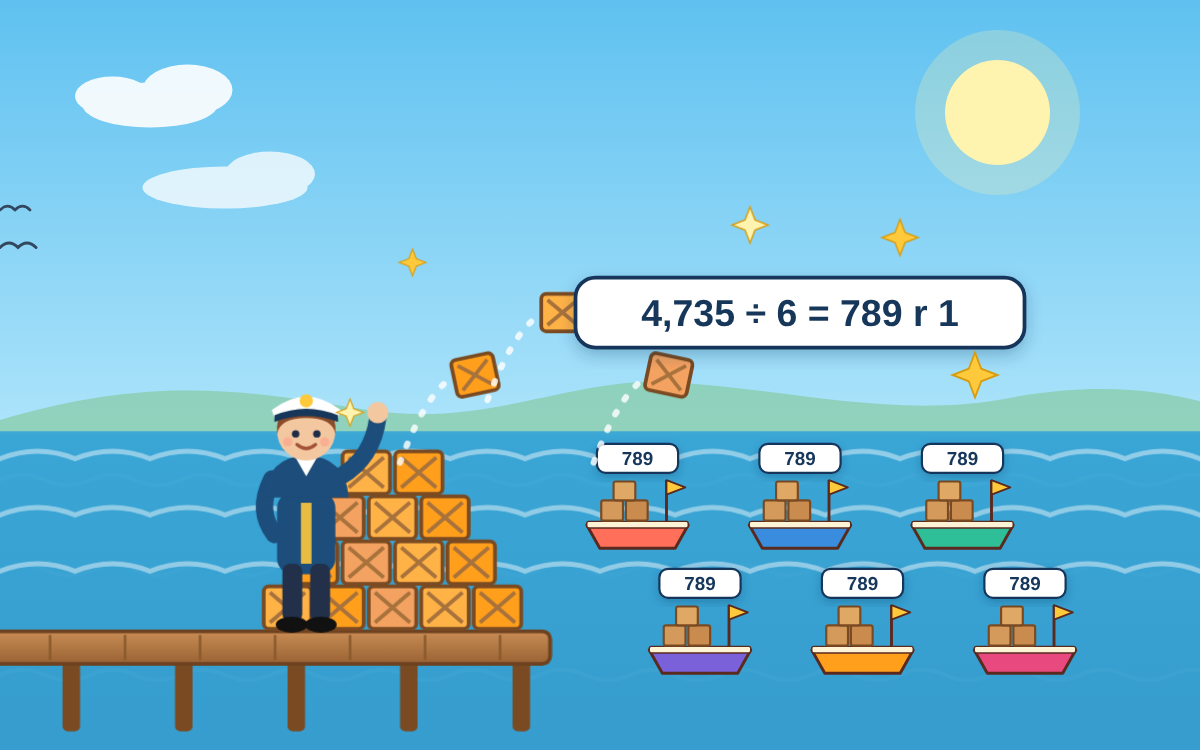
Harbour of Numbers is an interactive maths game that teaches children aged 9–11 the Year 5 multiplication and division methods from the national curriculum in England: short and long multiplication, short division with remainders, the equals sign, scaling and simple rates.
Guided by Captain Nell, the harbour master, players work column by column on a written-method board, typing each step on a number pad. They carry tens, write the placeholder zero in long multiplication and use the bus stop method to share crates between boats. Worked examples come first, then guided practice, then whole answers and word problems.
Around the island, children decide whether a remainder means rounding up, rounding down or using the leftover. They balance number sentences on a market scale, solve two-step problems with bar models, and scale boats and recipes by halves and quarters. Every line is read aloud, with hints that spot common mistakes.
Questions and answers
How do you do long multiplication, in simple steps?
Multiply the top number by the ones digit to make the first row. For the second row, write a zero in the ones column, then multiply by the tens digit. Finally, add the two rows together to get the answer.
How does the bus stop method for short division work?
Put the number being divided inside the bus stop and the divisor outside. Working from the left, find how many times the divisor fits into each digit, write that above, and carry anything left over across to the next digit.
How do children know whether to round a remainder up or down?
It depends on the question. If everyone must fit, such as people in boats, round up. If only full groups count, such as finished necklaces, round down. If the question asks what is left over, the remainder itself is the answer.
What age is this multiplication and division game for?
It is designed for children aged 9 to 10 in Year 5, matching the national curriculum in England. It also suits 10 and 11-year-olds in Year 6 who want to revise written methods before their KS2 maths tests.
What does Harbour of Numbers include and how long does it take?
It has six chapters, each with an animated introduction, worked examples, guided practice and word problems, plus a ten-question final challenge. Playing everything takes about 75 minutes, and children can start any chapter from the harbour map.
Can we count your visit? We'd like to use one cookie, only on this site, to see how families find and use TapLearn, so we can make it better. No adverts, and nothing is shared. How we measure
Create a free family account and your child can play every chapter of every game for 7 days, with no card needed. Their progress is kept. After that, the free plan is free for ever, and membership is £6.99 a month if you'd like to keep every chapter.



 TapLearn