What you'll learn
- Find the number of groups and the number in each group
- Write equal groups as a multiplication sentence using the × sign
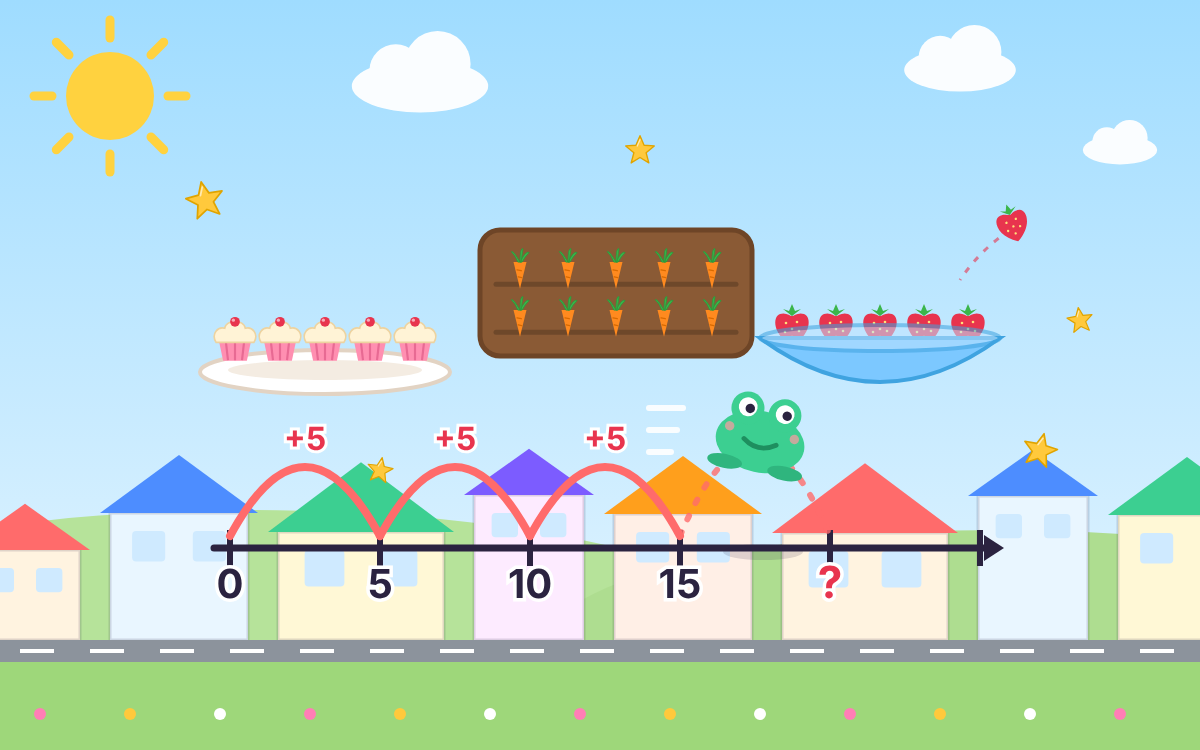
- Use repeated addition and number line jumps to find a total
- Use an array of equal rows to solve a times story
- Tell sharing stories from grouping stories and write them with ÷
- Decide whether a story needs multiplying or dividing
Chapter by chapter
- Spot equal groups in a story Free to try
Year 2 maths · 1
- Solve times stories by adding equal jumps
Year 2 maths · 1
- Solve times stories with arrays
Year 2 maths · 1
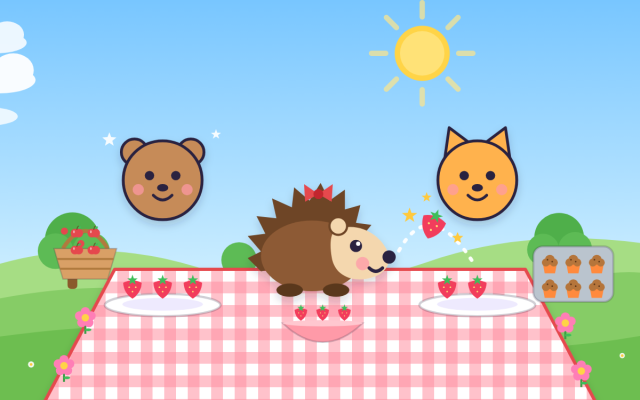
- Solve sharing stories: how many each?
Year 2 maths · 1
- Solve grouping stories: how many groups?
Year 2 maths · 1
- Choose multiply or divide to solve a story
Year 2 maths · 1
- Times Town Challenge: 10 mixed times and sharing stories (10 questions)
What the chapters cover in the national curriculum in England:
- Year 2 maths: Solve problems involving multiplication and division, using materials, arrays, repeated addition, mental methods, and multiplication and division facts, including problems in contexts
About this adventure
Times Town Stories is an interactive maths game that teaches children aged 6–7 (Year 2) to solve multiplication and division word problems using equal groups, arrays, repeated addition and the 2, 5 and 10 times tables.
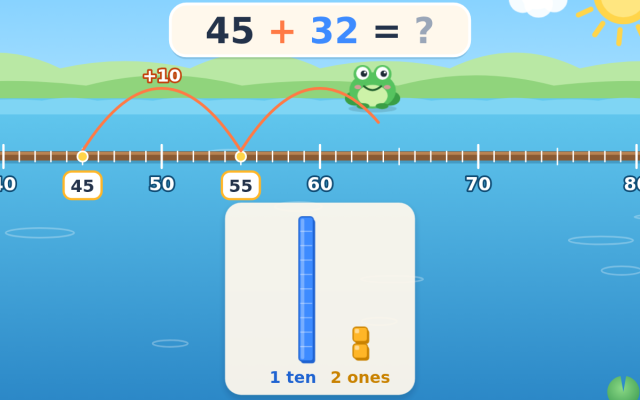
Children build each story before they solve it. They tap plates to fill them and watch 5 + 5 + 5 become 3 × 5, hop a frog along a number line, plant carrots in an array of equal rows, deal strawberries into bowls one at a time and pack crayons into boxes of 5. They also learn to pick out a story's two number clues: how many groups, and how many in each group.
Sharing (how many each?) is kept apart from grouping (how many groups?). Wrong answers get a hint that names the mistake, then a picture to help.
Questions and answers
How do you solve a multiplication word problem in Year 2?
Find the two number clues: how many groups there are and how many are in each group. Then add the equal groups or count in 2s, 5s or 10s, so 4 bikes with 2 wheels each is 2 + 2 + 2 + 2, or 4 × 2 = 8.
What is the difference between sharing and grouping in division?
Sharing tells you how many each one gets, like 15 grapes shared between 5 plates gives 3 on each plate. Grouping tells you how many groups you can make, like 20 crayons in boxes of 5 fills 4 boxes. Both are written with the ÷ sign.
What is an array in Year 2 maths?
An array is a set of objects arranged in equal rows, like an egg box or a chocolate bar. Counting the rows and the number in one row turns a picture into a times fact, so 3 rows of 5 is 3 × 5 = 15.
What age is this multiplication and division game for?
It is designed for children aged 6 to 7 in Year 2 of the English national curriculum. It also suits older children who need a refresher on equal groups, arrays and the 2, 5 and 10 times tables.
What does Times Town Stories include and how long does it take?
It has an optional counting warm-up, six chapters and a 10-question challenge, taking about 45 minutes in total. Each chapter can be played on its own in roughly six minutes, with spoken instructions and typed or tapped answers.


 TapLearn