Addition and Subtraction Word Problems: Crack the Case
Learn to solve addition and subtraction word problems by tapping number clues, building bar models and checking answers with the inverse.
- Ages 6–8
- About 45 min
- Easy start
- Word Problems
Learn to solve addition and subtraction word problems by tapping number clues, building bar models and checking answers with the inverse.
Year 2 maths · 1
Year 2 maths · 1
Year 2 maths · 1
Year 2 maths · 1
Year 2 maths · 2
Year 2 maths · 2 Year 2 maths · 1
What the chapters cover in the national curriculum in England:
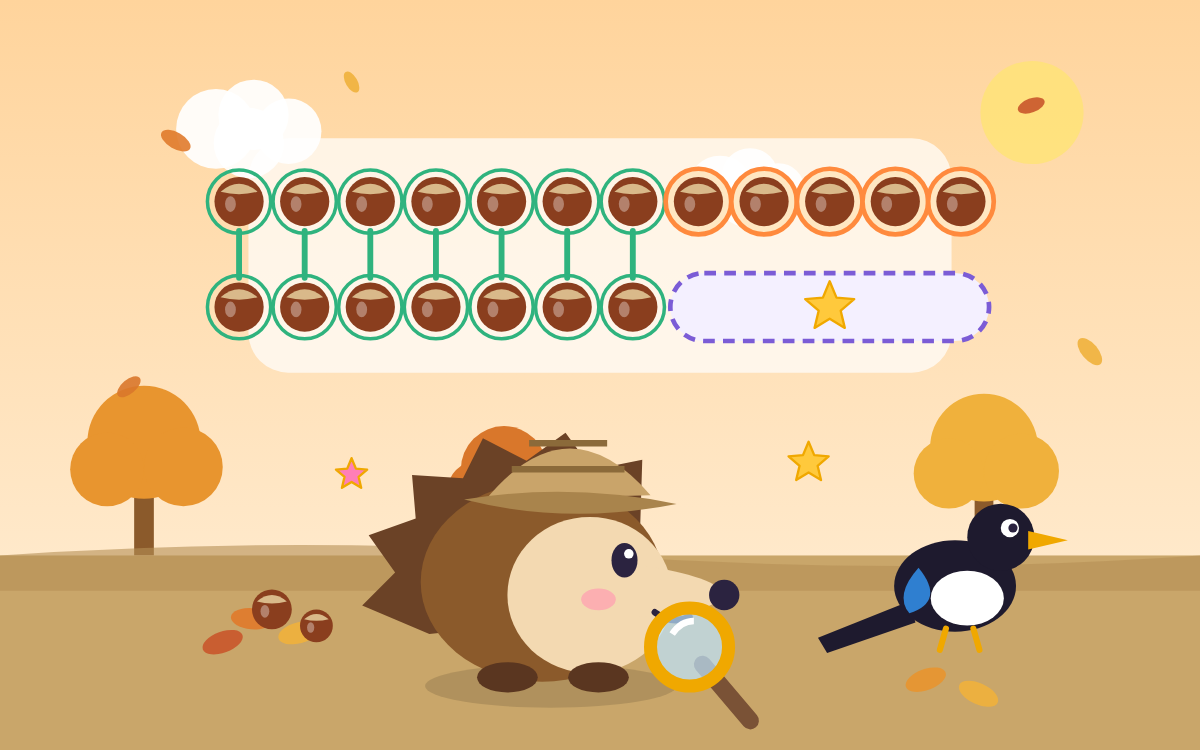
Addition and Subtraction Word Problems is an interactive maths game for children aged 6–8 that teaches the Year 2 skill of turning a number story into a sum, solving it and checking the answer. Nell the hedgehog detective guides every problem through four steps: read, picture, solve and check.
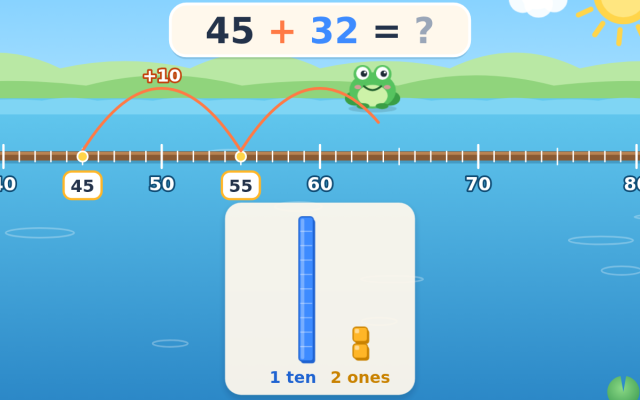
Players tap the numbers in each story to collect clues, act the story out (baking buns, cutting a ribbon, pouring juice) and drag the clues into a bar model, where the whole sits on top and the parts sit underneath. Seeing where the question mark lands tells them whether to add or take away. They then jump along a number line and type the answer.
Along the way they meet the difference between two amounts, units such as cm, kg and ml, and the inverse: adding undoes taking away. A cheeky magpie called Muddle makes common mistakes for children to spot.
Read the story and find the numbers, then draw it as a bar model to see what is missing. If you need the whole, add the parts; if you know the whole and one part, subtract to find the other part, then check your answer.
'How many more' usually means finding the difference, which is a subtraction, even though the word more sounds like adding. Lining the two amounts up and finding the gap shows why: 12 conkers compared with 7 conkers gives a difference of 5.
Using the inverse means doing the opposite calculation to undo a sum. Adding and subtracting are inverses, so children can check 42 − 15 = 27 by working out 27 + 15 and seeing that they get back to 42.
The game is made for children aged 6 to 8 and follows the Year 2 national curriculum in England for KS1 maths. Numbers stay within 100, so it also suits older children who need extra practice with word problems.
The game has six chapters, an optional warm-up on parts and wholes, and a ten-question Detective Challenge at the end. Playing everything takes about 45 minutes, and children can start any chapter from the map.

 TapLearn
Getting it ready…
Great work on chapter 1! To open the next chapters, ask a grown-up to take a look.
To play this game, ask a grown-up to take a look. There are lots of free games you can play right now too!
Create a free family account and your child can play every chapter of every game for 7 days, with no card needed. Their progress is kept. After that, the free plan is free for ever, and membership is £6.99 a month if you'd like to keep every chapter.
That's all the learning time for today. Great work! Flip will be ready to play again tomorrow.