What you'll learn
- Solve one-step story problems about equal groups using objects and pictures
- Share things equally, one at a time, and find how many each gets
- Make equal groups and count how many groups there are
- Use the rows in an array to find how many altogether
- Count in 2s, 5s and 10s to total equal groups quickly
- Match a word problem to a quick circles-and-dots picture
Chapter by chapter
- Equal groups stories: find how many altogether Free to try
Year 1 maths · 1
- Sharing stories: find how many each one gets
Year 1 maths · 1
- Grouping stories: find how many equal groups
Year 1 maths · 1
- Array stories: count rows to find how many
Year 1 maths · 1
- Match a story to a picture, then solve it
Year 1 maths · 1
- Story problem challenge: mixed grouping and sharing stories (8 questions)
What the chapters cover in the national curriculum in England:
- Year 1 maths: Solve one-step problems involving multiplication and division, by calculating the answer using concrete objects, pictorial representations and arrays with the support of the teacher
About this adventure
Grouping and Sharing Word Problems is an interactive maths game that teaches children aged 5–6 how to solve one-step story problems about equal groups, sharing and arrays in Year 1.
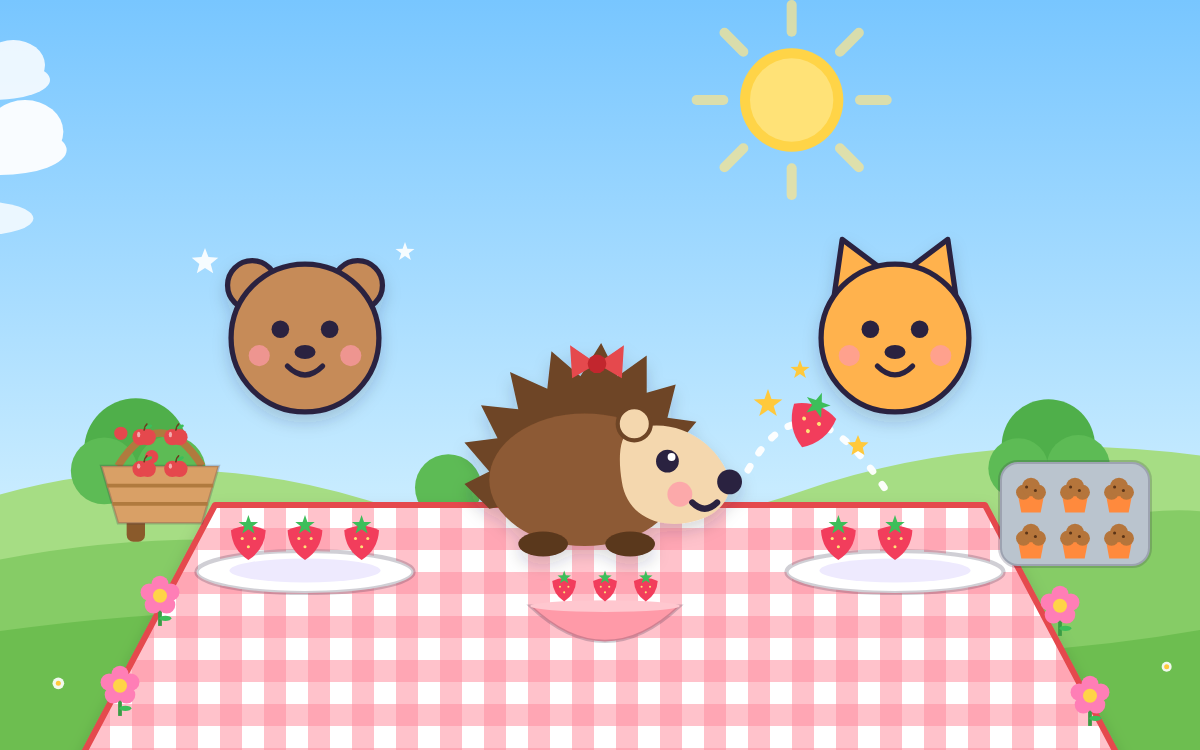
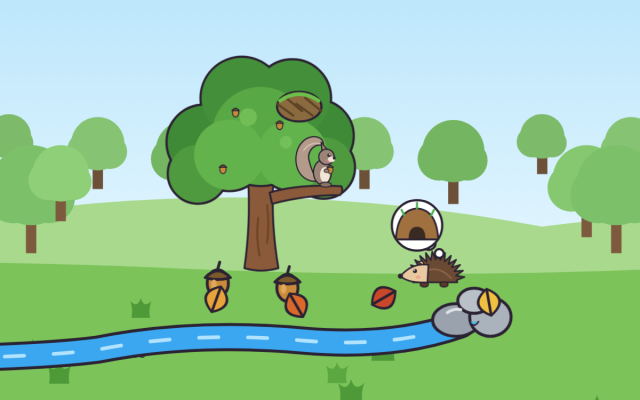
At Hazel the hedgehog's picnic, every story is read aloud. Children tap the numbers in the story that tell them how many groups there are and how many are in each, then act it out: placing eggs in nests, dealing strawberries onto plates one at a time, packing apples into bags and planting carrots in rows. They count in 2s, 5s and 10s, then type their answer on a number pad.
A wrong answer brings a hint about the likely slip, such as adding the two numbers instead of counting every group. Each problem ends with a sentence like "3 groups of 2 is 6", the way Year 1 talks about multiplication and division.
Questions and answers
What is the difference between grouping and sharing?
In sharing, you know how many groups there are and find how many go in each, so 6 strawberries shared between 2 friends gives 3 each. In grouping, you know how many go in each group and find how many groups, so 10 apples in bags of 5 fills 2 bags.
What is an array in Year 1 maths?
An array is a set of objects arranged in neat rows and columns, like eggs in an egg box. Year 1 children count an array row by row, so 3 rows of 5 is counted 5, 10, 15 to find 15 altogether.
Do Year 1 children use the × and ÷ signs?
No, Year 1 children solve multiplication and division problems with objects, pictures and arrays rather than written signs. The × and ÷ signs are introduced in Year 2, so in Year 1 children say sentences such as "3 groups of 2 is 6" instead.
What age is this grouping and sharing game for?
The game is for children aged 5 to 6 in Year 1, and it follows the Key Stage 1 maths curriculum in England. Older children who need a refresher on equal groups, sharing and arrays can also use it.
What does the game include and how long does it take?
The game has an optional warm-up, five chapters with four story problems each and an eight-question challenge, taking about 30 minutes in all. Every story is read aloud, and children can start any chapter from the picnic map.

 TapLearn