What you'll learn
- Dividing by 10 moves every digit one place to the right
- Dividing by 100 moves every digit two places to the right
- Ones become tenths, and tens become ones, when you divide by 10
- Why 6 ÷ 100 needs a placeholder zero: 0.06
- The decimal point stays still while the digits move
- Naming digits after the point as tenths and hundredths
Chapter by chapter
- Divide a one-digit number by 10 Free to try
Year 4 maths · 1
- Divide a two-digit number by 10
Year 4 maths · 1
- Divide one- and two-digit numbers by 100
Year 4 maths · 1
- Name digits as ones, tenths and hundredths
Year 4 maths · 1
- Final challenge: divide by 10 and 100 (10 questions)
See every Maths chapter in the chapter library
What the chapters cover in the national curriculum in England:
- Year 4 maths: Find the effect of dividing a one- or two-digit number by 10 and 100, identifying the value of the digits in the answer as ones, tenths and hundredths
About this adventure
Dividing by 10 and 100 is an interactive maths game that teaches children aged 8–10 (Year 4) what happens to a one- or two-digit number when it is divided by 10 or 100, and what each digit in the answer is worth.
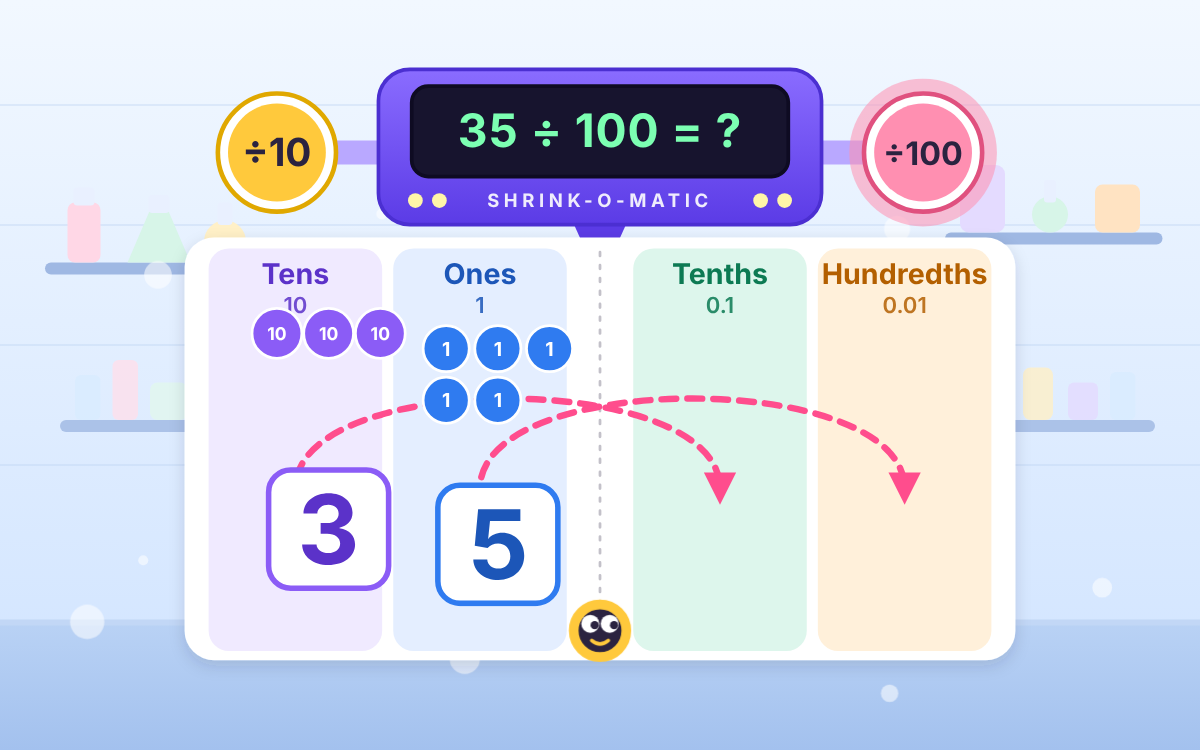
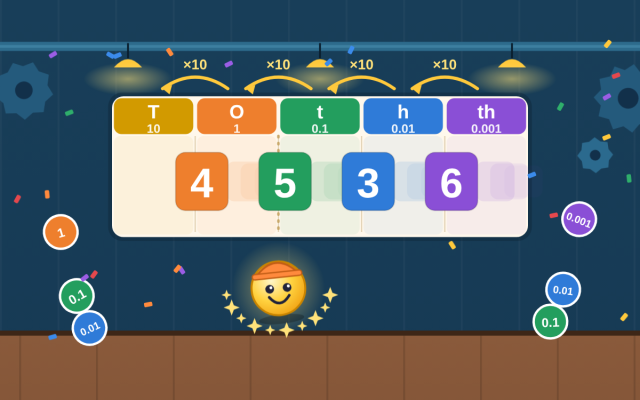
Players work a number machine called the Shrink-o-Matic above a place value chart with tens, ones, tenths and hundredths columns. They press ÷10 and ÷100, drag digits into new columns, add placeholder zeros and type their answers on a keypad. Dot, the decimal point, shows that the point stays still while every digit moves one place right for ÷10 and two places right for ÷100.
The game tackles common mistakes, such as thinking 46 ÷ 10 is 4 or that 6 ÷ 100 is 0.6. Hints explain what went wrong, and a skippable warm-up and a 10-question final challenge complete the set.
Questions and answers
What happens when you divide a number by 10?
When you divide a number by 10, every digit moves one place to the right, so each digit becomes ten times smaller. For example, 34 ÷ 10 = 3.4: the 3 tens become 3 ones and the 4 ones become 4 tenths.
How do you divide a number by 100?
To divide by 100, move every digit two places to the right, because dividing by 100 is the same as dividing by 10 twice. So 35 ÷ 100 = 0.35, with 3 tenths and 5 hundredths.
Why is 6 ÷ 100 equal to 0.06 and not 0.6?
6 ÷ 100 is 0.06 because the 6 moves two places, from the ones into the hundredths. The tenths place is left empty, so a zero holds it; 0.6 would be 6 tenths, which is ten times too big.
What age is this dividing by 10 and 100 game for?
The game is made for children aged 8 to 10 and matches the Year 4 national curriculum in England. Older children who are unsure about tenths and hundredths can also use it to revise.
What does the game include and how long does it take?
The game includes a short warm-up on tenths and hundredths, four lab chapters and a 10-question final challenge. Playing everything takes about 35 minutes, and each chapter can be played on its own.
 TapLearn