The Tudors: Join Fennel the Jester at the Royal Court
Learn who the Tudors were, why Henry VIII broke with Rome and how the Armada was beaten, then compare the lives of rich and poor Tudors.
Online game, chapter 1 free · Years 3 to 6 (KS2) · ages 7–11 · national curriculum in England · no adverts · plays on a phone, tablet or computer · no sign-up to start.
An online history game for Years 3 to 6 (KS2). It covers the national curriculum in England, Years 3–6 history: “A study of an aspect or theme in British history that extends pupils' chronological knowledge beyond 1066. Examples (non-statutory): the changing power of monarchs using case studies such as John, Anne and Victoria; changes in an aspect of social history, such as crime and punishment from the Anglo-Saxons to the present or leisure and entertainment in the 20th Century; the legacy of Greek or Roman culture (art, architecture or literature) on later periods in British history, including the present day; a significant turning point in British history, for example, the first railways or the Battle of Britain”, and 1 more statement listed under the chapters.
5 short chapters, about 35 minutes in all. Children can stop after any chapter.
Start playing for free. Plays in the browser on phones, tablets and computers: no app, no adverts.
Free for teachers: every chapter on the whiteboard with a free teacher account.
Last updated · Checked against the national curriculum in England by the TapLearn team
What you'll learn
The Tudors ruled England from 1485 to 1603
The five Tudor monarchs in order, from Henry VII to Elizabeth I
Why Henry VIII broke with Rome and closed the monasteries
How fireships, guns and storms defeated the Spanish Armada in 1588
How homes, food and clothes differed for rich and poor Tudors
What monarch, reign, heir, dynasty and Reformation mean
Place 1066, 1485 and 1603 on a timeline, see how the Wars of the Roses ended at Bosworth, and hang the five Tudor monarchs' portraits in order using the dates of each reign.
Discover why Henry VIII wanted a male heir, why the Pope refused, and how he became Head of the Church of England in 1534 and dissolved the monasteries, making the monarch more powerful.
Explore a brick manor house and a wattle and daub cottage, sort Tudor food, clothes and beds into rich and poor, and find out who stood or sat at the Globe theatre.
Crown Elizabeth I, find out why Philip II of Spain attacked, then light beacons, launch fireships and track the storms to explain why the Armada failed in 1588.
Chart how religion changed under each Tudor monarch, compare Henry VIII with Elizabeth I, and match history terms such as reign, heir, dynasty and Reformation to their meanings.
What the chapters cover in the national curriculum in England:
Years 3–6 history: A study of an aspect or theme in British history that extends pupils' chronological knowledge beyond 1066. Examples (non-statutory): the changing power of monarchs using case studies such as John, Anne and Victoria; changes in an aspect of social history, such as crime and punishment from the Anglo-Saxons to the present or leisure and entertainment in the 20th Century; the legacy of Greek or Roman culture (art, architecture or literature) on later periods in British history, including the present day; a significant turning point in British history, for example, the first railways or the Battle of Britain
Years 3–6 history: Note connections, contrasts and trends over time and develop the appropriate use of historical terms
About this adventure
The Tudors is an interactive history game that teaches children aged 7–11 when the Tudor dynasty ruled England (1485 to 1603), why Henry VIII broke away from the Pope, how Elizabeth I's England defeated the Spanish Armada, and how rich and poor Tudors lived.
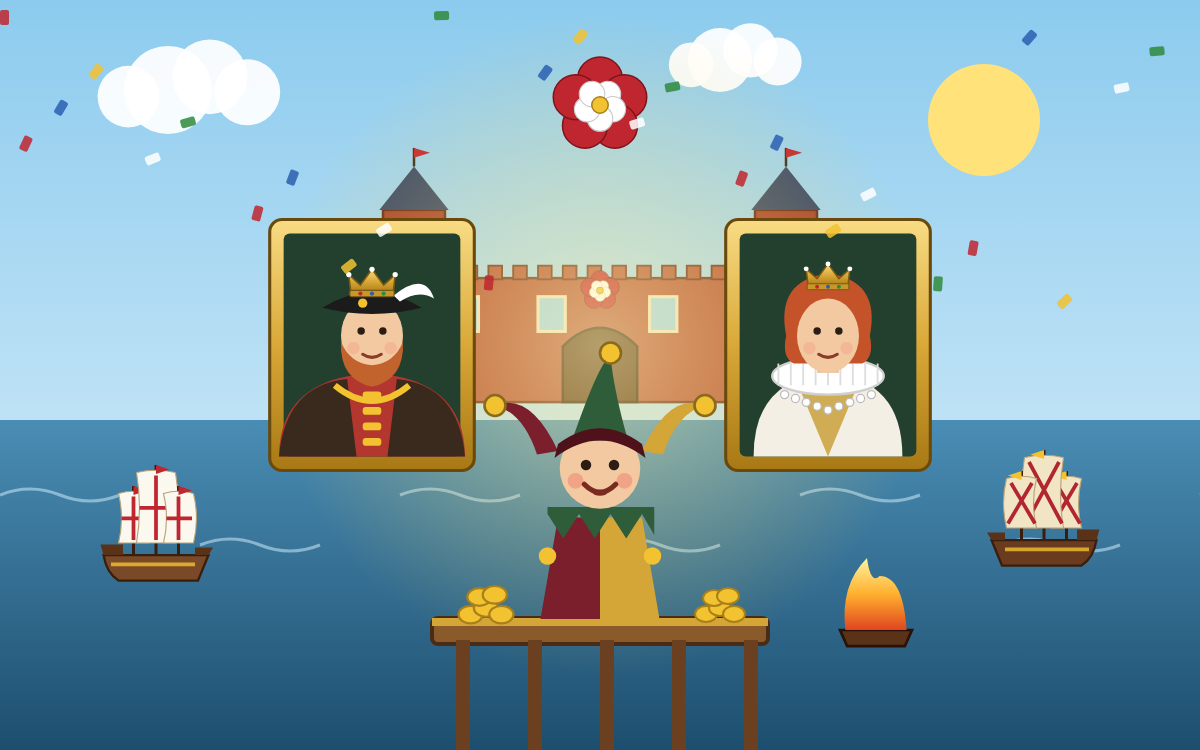
Guided by Fennel the court jester, children build a timeline, hang the five Tudor monarchs' portraits in order, send Henry's letter to Rome and link causes into a chain of events. They light warning beacons, launch fireships at Calais and set off the storms that wrecked the fleet, then read the clues in Elizabeth's Armada Portrait.
Along the way they sort Tudor food, clothes and homes into rich and poor, track how religion swung between Catholic and Protestant, and use history words such as monarch, reign, heir, dynasty and Reformation correctly.
Questions and answers
Who were the Tudors?
The Tudors were a family of five monarchs who ruled England from 1485 to 1603: Henry VII, Henry VIII, Edward VI, Mary I and Elizabeth I. Their time began when Henry Tudor won the Battle of Bosworth.
Why did Henry VIII break away from the Catholic Church?
Henry VIII broke with Rome because the Pope would not end his marriage to Catherine of Aragon, and Henry wanted a son as his heir. In 1534 he made himself Head of the Church of England, then closed the monasteries and took their wealth.
How was the Spanish Armada defeated?
The Spanish Armada was defeated in 1588 by several things together. English fireships scattered the Spanish fleet at Calais, English ships attacked at the Battle of Gravelines, and fierce storms wrecked many ships as they sailed home round Scotland and Ireland.
What age is this Tudors game for?
This Tudors game is made for children aged 7 to 11 in Years 3 to 6 (KS2), and fits best in Year 4. It follows the KS2 history curriculum in England for a study of British history beyond 1066.
What does the Tudors game include and how long does it take?
The game has five chapters and a ten-question Tudor Champion Challenge, and takes about 35 minutes to play through. Each chapter starts with an animated introduction, is read aloud, and can be played on its own.
We count visits to make TapLearn better.We use one cookie, only on this site, to see how families find and use it. No adverts, and nothing is shared.One cookie, only on this site. No adverts.How we measure
 TapLearn