Stone Age to Iron Age: A Time-Travel Adventure in Britain
Learn how life in Britain changed from the Stone Age to the Iron Age by digging up clues, making a bronze axe and building a hill fort.
- Ages 7–9
- About 45 min
- Easy start
- British History
Learn how life in Britain changed from the Stone Age to the Iron Age by digging up clues, making a bronze axe and building a hill fort.
Years 3–6 history · 1
Years 3–6 history · 2 Years 3–6 history · 1
Years 3–6 history · 2 Years 3–6 history · 1
Years 3–6 history · 2
Years 3–6 history · 2
Years 3–6 history · 1 Years 3–6 history · 2
What the chapters cover in the national curriculum in England:
Stone Age to Iron Age is an interactive history game that teaches children aged 7–9 how life in Britain changed from hunter-gatherers to the first farmers, Bronze Age metalworkers and Iron Age tribes. It follows the KS2 history curriculum and is pitched mainly at Year 3.
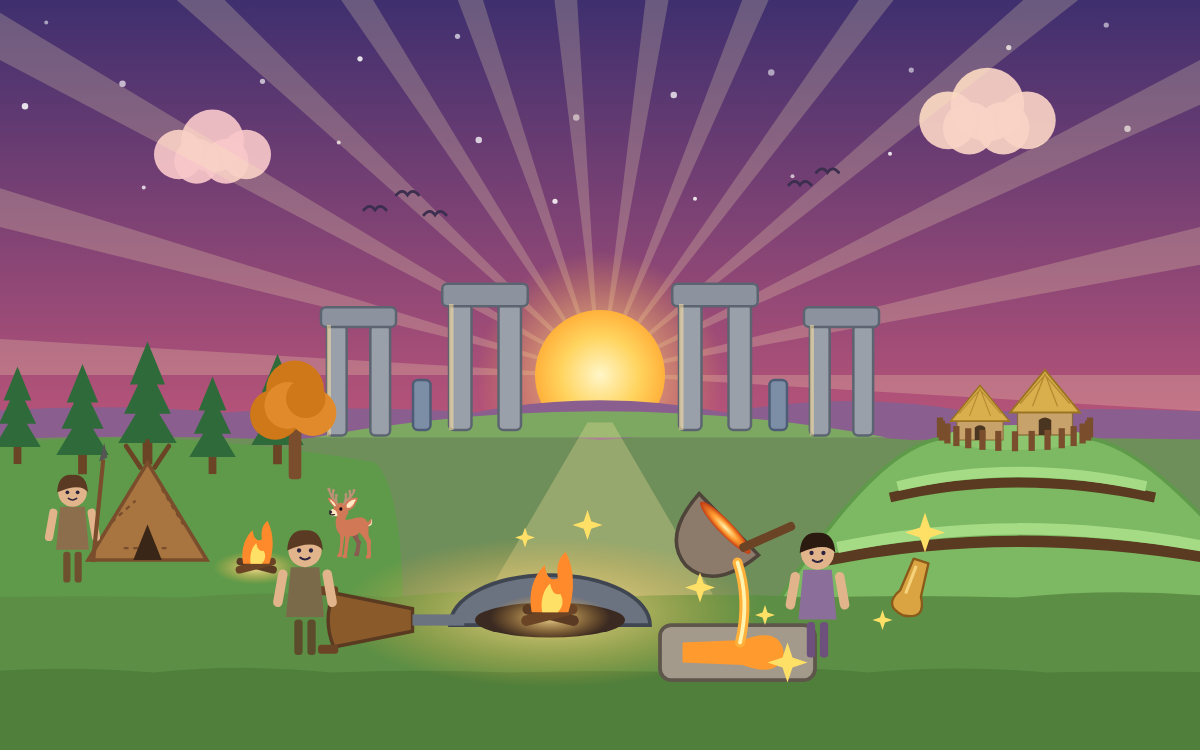
Guided by Ash, a time-travelling archaeologist, players dig through soil layers to find clues and build a timeline using BC dates. They gather wild food, chip a flint blade, plant crops, uncover the stone village of Skara Brae and pour melted copper and tin into a mould to make bronze.
Later they raise the stones of Stonehenge, follow the Amesbury Archer's journey from the Alps, and build an Iron Age hill fort with ditches, ramparts and a palisade. Narration, captions and short questions check understanding, and the game ends with a 10-question challenge.
In Britain, the Stone Age lasted until about 2500 BC, the Bronze Age ran from about 2500 BC to 800 BC, and the Iron Age lasted from about 800 BC until the Romans invaded in AD 43.
Bronze was made by melting copper and tin together, roughly nine parts copper to one part tin. The hot liquid metal was poured into a stone or clay mould and left to cool and harden into tools, weapons or jewellery.
An Iron Age hill fort was a settlement on a hilltop, protected by deep ditches, high banks of earth called ramparts and a wooden fence. Families lived inside in roundhouses, and Maiden Castle in Dorset is one of the largest.
The game is designed for children aged 7 to 9 and matches the KS2 history curriculum in England, where this topic is usually taught in Year 3. Spoken narration and captions help younger or less confident readers.
Playing everything takes about 45 minutes. There are six chapters of roughly six to eight minutes each, plus a 10-question final challenge, and children can start any chapter from the time map and continue later.

 TapLearn
Getting it ready…
Great work on chapter 1! To open the next chapters, ask a grown-up to take a look.
To play this game, ask a grown-up to take a look. There are lots of free games you can play right now too!
Create a free family account and your child can play every chapter of every game for 7 days, with no card needed. Their progress is kept. After that, the free plan is free for ever, and membership is £6.99 a month if you'd like to keep every chapter.
That's all the learning time for today. Great work! Flip will be ready to play again tomorrow.