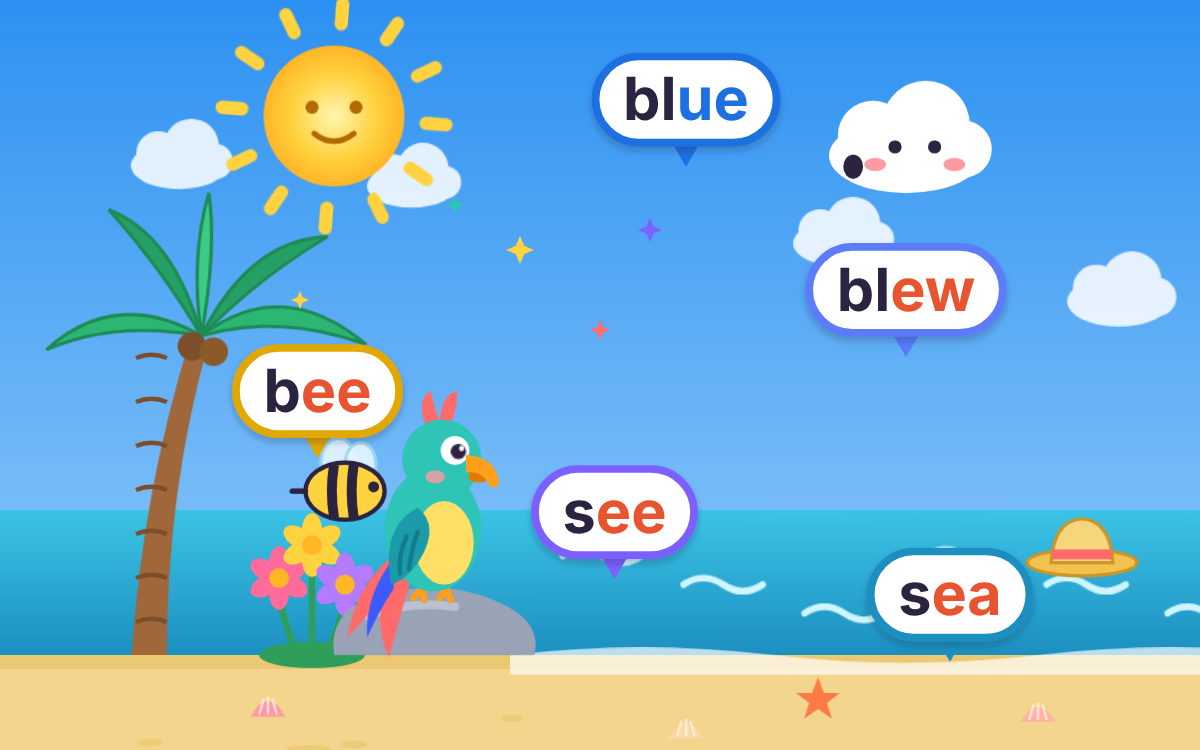
Year 2 Homophones: Sound-Alike Island with Echo
Learn the Year 2 homophones, from see and sea to there, their and they're, by tapping scenes and spelling words with Echo the parrot.
- Ages 6–8
- About 40 min
- Easy start
- Phonics & Spelling
Learn the Year 2 homophones, from see and sea to there, their and they're, by tapping scenes and spelling words with Echo the parrot.
Year 2 english · 1 Year 2 english · 2
Year 2 english · 1 Year 2 english · 2
Year 2 english · 2
Year 2 english · 2
Year 2 english · 2 Year 2 english · 1
What the chapters cover in the national curriculum in England:
Sound-Alike Island is an interactive Year 2 homophones game that teaches children aged 6–8 to choose the right spelling for words that sound the same, following the KS1 English spelling curriculum. A homophone is a word that sounds like another word but has a different spelling and meaning, such as see and sea.
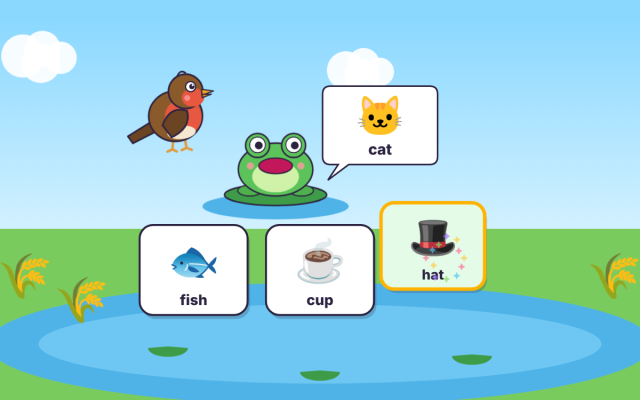
Guided by Echo the parrot, children build each scene step by step: tapping the sea, bringing a knight out of a castle or squashing 'they are' into they're. Spoken narration and captions explain every word, and word cards highlight the letters that spell each sound.
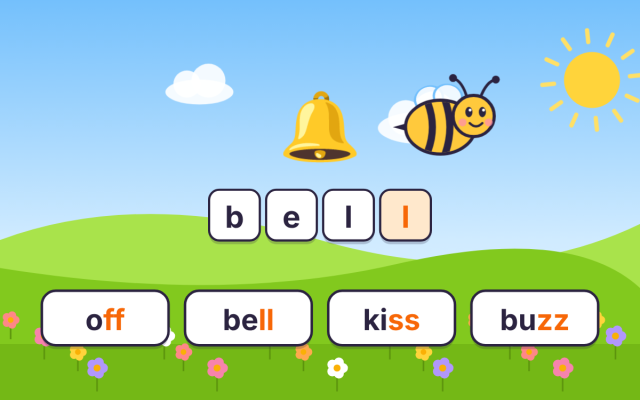
Practice questions ask children to complete sentences and spell words with letter tiles, with gentle hints after a mistake. They also meet near-homophones, words like quite and quiet that sound nearly the same, and finish with a twelve-question Champion Tower challenge.
A homophone is a word that sounds exactly the same as another word but has a different spelling and meaning. For example, see (what your eyes do) and sea (the big salty water) are homophones.
Give each one a clue: there is a place and has the word here hiding inside it, their means something belongs to them, and they're is short for they are. If you can say 'they are' instead, use they're.
Use two for the number 2, too when you mean also or more than enough, and to for going somewhere or before an action, as in 'I want to play'. The extra o in too can remind children that it means extra.
It is designed for children aged 6–8, matching the Year 2 English spelling curriculum in England. Older children who still mix up common homophones such as there and their can also use it to revise.
It has five chapters and a final 12-question challenge, taking about 40 minutes in total. Each chapter has an animated introduction, guided activities with spoken narration and practice questions, and two chapters include a short optional refresher.
 TapLearn
Getting it ready…
Great work on chapter 1! To open the next chapters, ask a grown-up to take a look.
To play this game, ask a grown-up to take a look. There are lots of free games you can play right now too!
Create a free family account and your child can play every chapter of every game for 7 days, with no card needed. Their progress is kept. After that, the free plan is free for ever, and membership is £6.99 a month if you'd like to keep every chapter.
That's all the learning time for today. Great work! Flip will be ready to play again tomorrow.