Short Division and Remainders: The Bus Stop Bakery
Learn short division and what to do with remainders by sharing cookies at a bakery, then solving 4-digit divisions on the bus stop.
Online game, chapter 1 free · Year 5 (KS2) · ages 9–10 · national curriculum in England · no adverts · plays on a phone, tablet or computer · no sign-up to start.
An online maths game for Year 5 (KS2). It covers the national curriculum in England, Year 5 maths: “Divide numbers up to 4 digits by a one-digit number using the formal written method of short division and interpret remainders appropriately for the context”.
5 short chapters, about 60 minutes in all. Children can stop after any chapter.
Start playing for free. Plays in the browser on phones, tablets and computers: no app, no adverts.
Methods taught, by the names schools use: bus stop method.
Free for teachers: every chapter on the whiteboard with a free teacher account.
Last updated · Checked against the national curriculum in England by the TapLearn team
What you'll learn
Divide by sharing hundreds, tens and ones, starting from the left
Exchange a leftover into the next place value: 1 ten = 10 ones
Use short division to divide 4-digit numbers by a 1-digit number
Write zeros in the quotient to hold the place
Find a remainder, which is always smaller than the divisor
Decide whether to round up, round down or give the remainder
Chapter by chapter
Divide by sharing hundreds, tens and onesStart playing for free
Year 5 maths · 1
Exchange leftovers when dividing
Year 5 maths · 1
Short division of 4-digit numbers by 1-digit numbers(bus stop method)
What the chapters cover in the national curriculum in England:
Year 5 maths: Divide numbers up to 4 digits by a one-digit number using the formal written method of short division and interpret remainders appropriately for the context
About this adventure
Short Division and Remainders: The Bus Stop Bakery is an interactive maths game that teaches children aged 9–10 (Year 5) to divide numbers up to 4 digits by a one-digit number using short division, and to decide what a remainder means in a real problem.
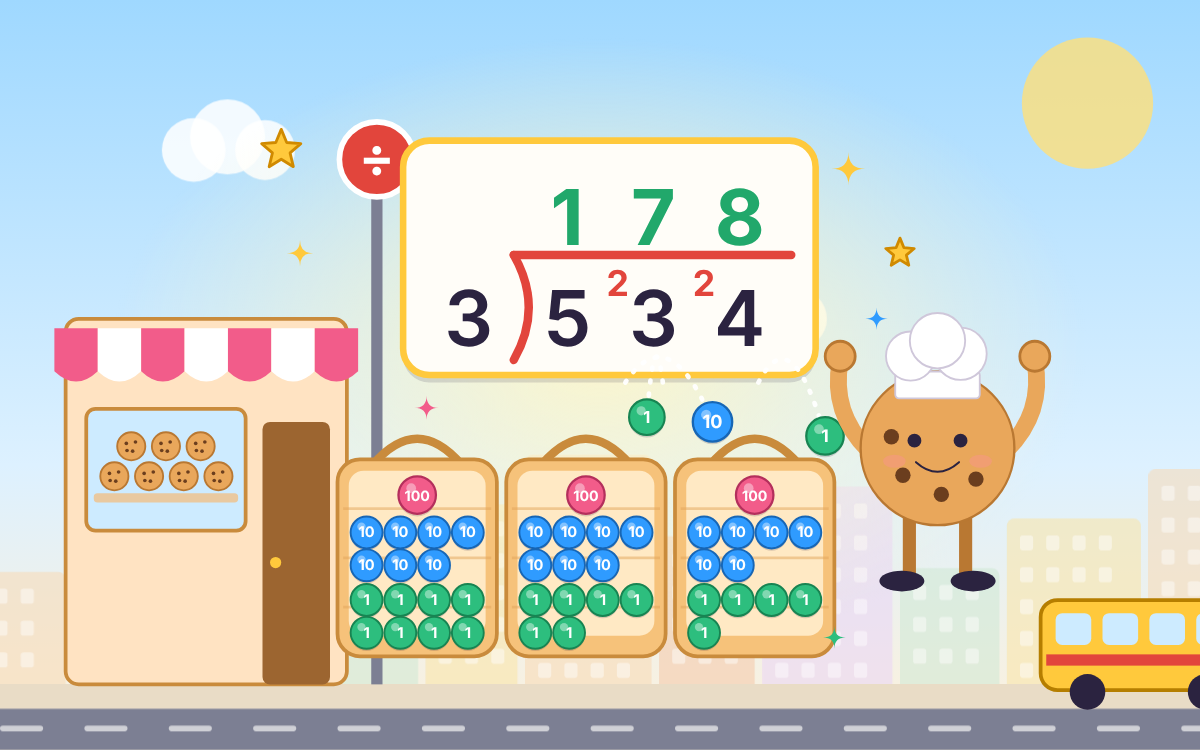
Players deal place value counters into baskets, swap a leftover ten for ten ones, and type each digit of the answer onto the bus stop, the written method where the divisor sits outside and the dividend sits under the shelter. A friendly baker narrates every step and gives a hint matched to the mistake made, such as a missing zero in the answer.
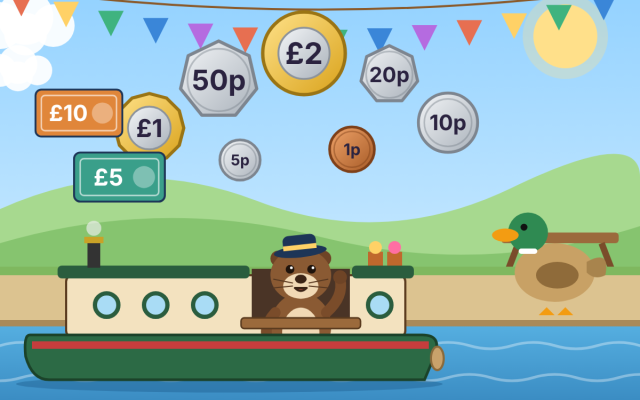
Later, buses, cookie boxes and shops show that a remainder can mean rounding up, rounding down, or giving the leftover itself. Children also check answers using the inverse: quotient × divisor + remainder.
Questions and answers
How do you do short division, in simple steps?
Short division works from left to right, one digit at a time. Ask how many times the divisor fits into the digit and write that number on top. Then move any leftover to the next digit, where it is worth ten times as much. The last leftover is the remainder.
Why is it called the bus stop method?
It is called the bus stop method because the written layout looks like a bus shelter. The number being divided waits under the shelter, the number you divide by stands outside, and the answer is written on the roof.
Can a remainder be bigger than the number you divide by?
No, a remainder must always be smaller than the divisor. If it were the same or bigger, one more group would still fit, so the answer should go up by one. Dividing by 4, for example, the remainder can only be 0, 1, 2 or 3.
What age is this short division game for?
The game is designed for children aged 9 to 10 in Year 5, where short division by a one-digit number is taught in the national curriculum for England. Older children can also use it to revise before learning long division.
What does the Bus Stop Bakery game include and how long does it take?
It includes an optional warm-up, five chapters and a ten-question final challenge, taking about an hour in total. Each chapter opens with an animated introduction and ends with a recap, so children can also play one chapter at a time.
We count visits to make TapLearn better.We use one cookie, only on this site, to see how families find and use it. No adverts, and nothing is shared.One cookie, only on this site. No adverts.How we measure


 TapLearn