What you'll learn
- Use a part–whole bar model to choose between adding and subtracting
- Solve change problems, even when the starting amount is missing
- Find the difference to answer 'how many more?' and 'how many fewer?'
- Understand that the equals sign means both sides are worth the same
- Find missing numbers and check answers using the inverse operation
- Use number facts and place value, such as 80 + 60 = 140
Chapter by chapter
- Part–whole problems: find the total or a missing part Free to try
Year 3 maths · 1
- Change problems: adding on and taking away
Year 3 maths · 1
- Comparing problems: how many more or fewer?
Year 3 maths · 1
- Missing number problems and the equals sign
Year 3 maths · 1
- Using number facts and place value to solve problems
Year 3 maths · 1
- Case files challenge: mixed word problems (10 questions)
See every Maths chapter in the chapter library
What the chapters cover in the national curriculum in England:
- Year 3 maths: Solve problems, including missing number problems, using number facts, place value, and more complex addition and subtraction
About this adventure
Story Problem Detectives is an interactive maths game that teaches children aged 7–9 how to solve addition and subtraction word problems and missing number problems with numbers up to 1,000, following the Year 3 national curriculum.
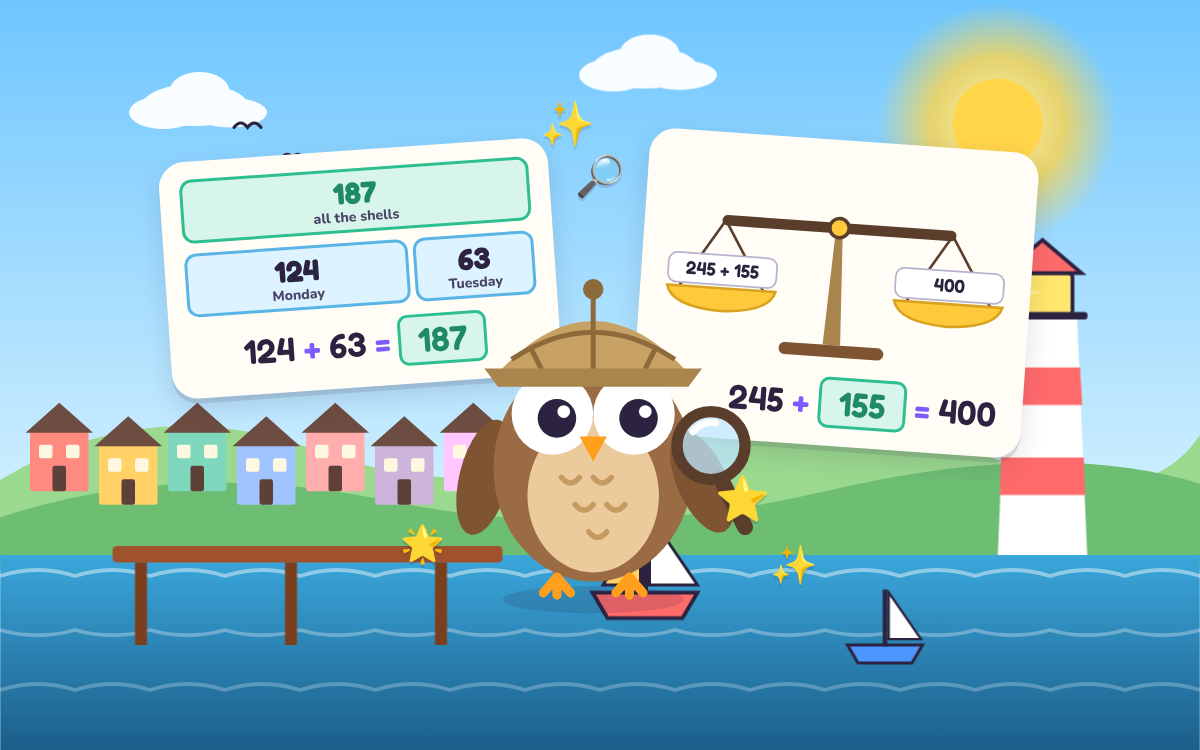
Players join Detective Hoot and solve each case in four steps: read the story, draw it, solve it, then check it. They drag the numbers onto a bar model to show the whole and its parts, line up two bars to find the difference, and balance scales to find a missing number.
Along the way they learn that the equals sign means both sides have the same value, use the inverse (the opposite calculation) to check answers, and turn small facts like 8 + 6 = 14 into 80 + 60 = 140. They also learn that the word 'more' does not always mean add.
Questions and answers
How do you know whether to add or subtract in a word problem?
Work out whether the missing amount is the whole or a part. If the whole is missing, add the parts together; if a part is missing, subtract the other part from the whole. Drawing a bar model makes this easy to see.
Does 'how many more' mean add or subtract?
'How many more' usually means finding the difference, which is a subtraction. For example, if Ava has 74 cards and Ben has 45, Ava has 74 − 45 = 29 more. Looking only for the word 'more' often leads children to add by mistake.
How do you solve missing number problems like 245 + □ = 400?
Use the inverse, which means doing the opposite calculation. To undo adding 245, subtract it: 400 − 245 = 155. Then check by putting 155 back into the number sentence to see that both sides are equal.
What age is this word problems game for?
The game is pitched at Year 3, ages 7–8, and also suits 9-year-olds who want more practice. It uses numbers up to 1,000 and keeps to one-step problems, as set out in the Year 3 national curriculum.
What does the game include and how long does it take?
It has five chapters, an optional number facts warm-up and a 10-question final challenge. Playing everything takes about 45 minutes, and children can start any chapter from the case board and come back to the others later.
 TapLearn