What you'll learn
- Use a bar model to show the equal groups in a story
- Tell sharing from grouping, the two kinds of division problem
- Use the inverse to find missing numbers, like? × 4 = 20
- Solve scaling problems: four times as long means four copies, not four more
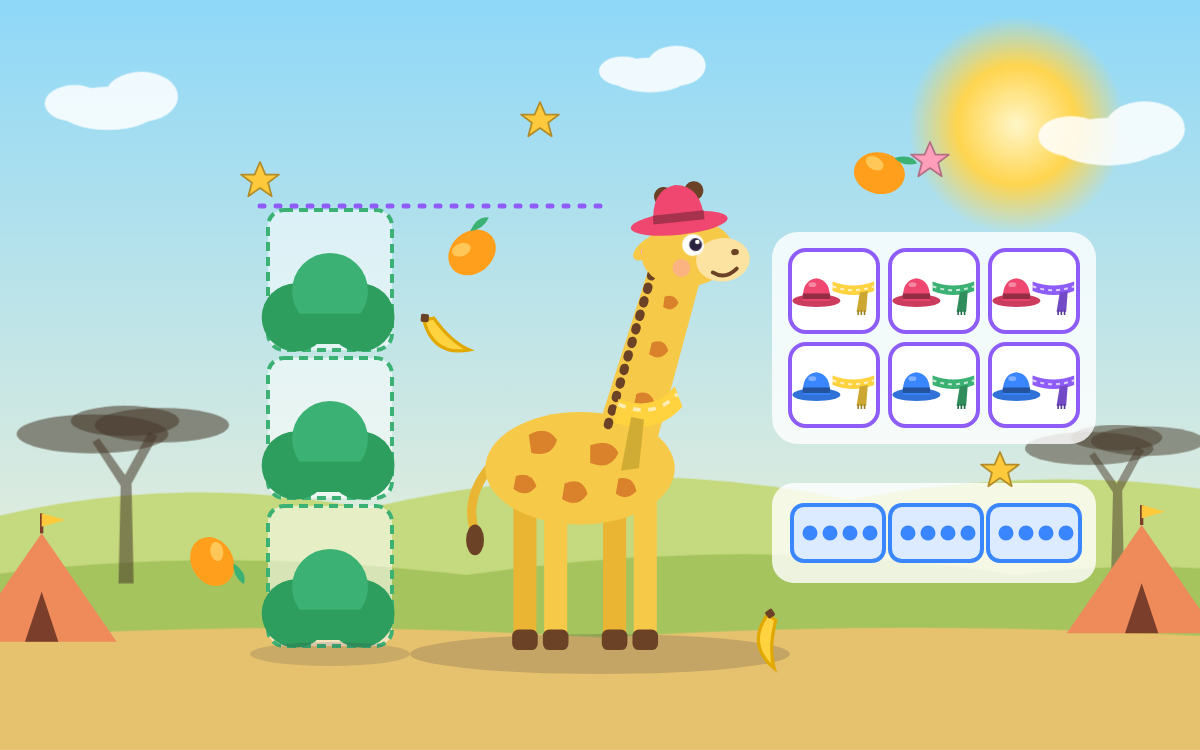
- Multiply to count combinations, like 3 hats and 4 scarves making 12 outfits
- Choose times or divide by asking whether the total is already known
Chapter by chapter
- Solve multiplying and dividing stories with a bar model Free to try
Year 3 maths · 1
- Find the missing number in multiplying and dividing sentences
Year 3 maths · 1
- Solve 'times as long' and 'times as tall' scaling problems
Year 3 maths · 1
- Find how many ways to match things up, like 3 hats and 4 scarves
Year 3 maths · 1
- Choose times or divide for a word problem and check the answer
Year 3 maths · 1
- Safari Challenge: 10 mixed word problems (10 questions)
See every Maths chapter in the chapter library
What the chapters cover in the national curriculum in England:
- Year 3 maths: Solve problems, including missing number problems, involving multiplication and division, including positive integer scaling problems and correspondence problems in which n objects are connected to m objects
About this adventure
Juno's Safari Stories is an interactive maths game that teaches children aged 7–9 how to solve multiplication and division word problems, following the Year 3 national curriculum in England.
Players draw bar models to see the equal groups in a story, deal mangoes into baskets to learn sharing and fill nests to learn grouping. They use the inverse (undoing times with divide) to find missing numbers, lay worms end to end to see that 'four times as long' means four copies rather than four more, and dress Juno in every hat-and-scarf outfit to count combinations.
Spoken hints respond to common mistakes, such as adding instead of multiplying, and a bar model appears after a wrong first try. A 10-question Safari Challenge brings every skill together at the end.
Questions and answers
How do you know whether to multiply or divide in a word problem?
Ask whether the story already gives you the total. If you need to find the total of equal groups, multiply; if the total is given and you are splitting it up, divide. Words like 'each' can appear in both kinds of story, so they are not a reliable clue on their own.
What does 'four times as long' mean in maths?
'Four times as long' means four copies of the shorter length laid end to end, so you multiply. A snake four times as long as a 3 cm worm is 4 × 3 = 12 cm long, not 3 + 4 = 7 cm.
What is a correspondence problem in Year 3 maths?
A correspondence problem asks how many ways things can be matched up, such as hats with scarves. Each item in one group goes with every item in the other, so 3 hats and 4 scarves make 3 × 4 = 12 different outfits.
What age is this multiplication and division word problems game for?
It is made for children aged 7 to 9 and follows the Year 3 maths curriculum in England (KS2). It uses the 2, 3, 4, 5, 8 and 10 times tables, so it also suits older children who want a refresher.
What does the game include and how long does it take?
There are five chapters, an optional warm-up and a 10-question Safari Challenge, taking about 50 minutes to play in full. Each chapter has hands-on activities, spoken narration and practice questions with hints, and children can start from any chapter on the map.


 TapLearn