Learn long division by a two-digit number and what to do with remainders, packing mine gems with Digit the mole one step at a time.
Online game, chapter 1 free · Year 6 (KS2) · ages 10–11 · national curriculum in England · no adverts · plays on a phone, tablet or computer · no sign-up to start.
An online maths game for Year 6 (KS2). It covers the national curriculum in England, Year 6 maths: “Divide numbers up to 4 digits by a two-digit whole number using the formal written method of long division, and interpret remainders as whole number remainders, fractions, or by rounding, as appropriate for the context”.
6 short chapters, about 60 minutes in all. Children can stop after any chapter.
Start playing for free. Plays in the browser on phones, tablets and computers: no app, no adverts.
Methods taught, by the names schools use: chunking.
Free for teachers: every chapter on the whiteboard with a free teacher account.
Last updated · Checked against the national curriculum in England by the TapLearn team
What you'll learn
Build a multiples list and use it to divide by two-digit numbers
Divide, multiply, subtract and bring down in the right order
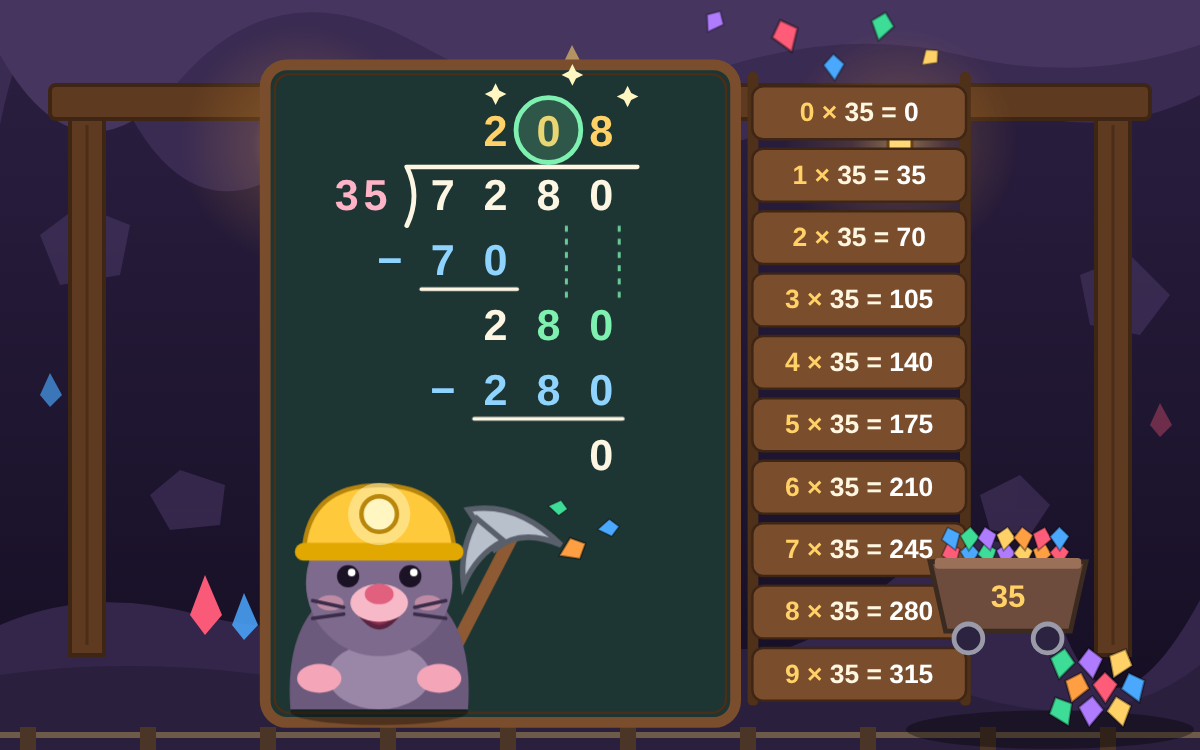
Why a zero sometimes goes in the quotient, as in 208
Why a remainder must always be smaller than the divisor
Write a remainder as a fraction: remainder over divisor
Decide whether to round up, round down or keep the remainder
Chapter by chapter
Using a multiples list to divide by a two-digit number(chunking)Start playing for free
What the chapters cover in the national curriculum in England:
Year 6 maths: Divide numbers up to 4 digits by a two-digit whole number using the formal written method of long division, and interpret remainders as whole number remainders, fractions, or by rounding, as appropriate for the context
About this adventure
Long Division: Dig for Gems with Digit the Mole is an interactive maths game that teaches children aged 10–11 how to divide numbers up to 4 digits by a two-digit number using the formal written method, and how to deal with remainders.
In Digit's gem mine, everything must be packed into cases and carts. Players first build a list of multiples, a 'ladder' they use to see how many times the divisor fits. They then work through divide, multiply, subtract and bring down on a chalk board, typing each digit, and learn why a zero sometimes belongs in the answer (the quotient).
Later levels turn to remainders: checking an answer by multiplying back, writing the remainder as a fraction with the divisor on the bottom, and deciding whether a word problem needs rounding up, rounding down or the remainder itself. Spoken hints help after a wrong answer.
Questions and answers
How do you do long division, in simple steps?
Long division repeats four steps: divide, multiply, subtract and bring down the next digit. You keep going until every digit of the number has been used, and anything left at the end is the remainder.
Why is there sometimes a zero in the answer to a long division?
A zero goes in the answer when the divisor does not fit into the part of the number you are working on. It holds the place, so 7,280 ÷ 35 is 208, not 28.
How do you write a remainder as a fraction?
Put the remainder on top and the divisor on the bottom. For example, 100 ÷ 14 is 7 remainder 2, which can be written as 7 and 2/14, because the leftover 2 is shared between 14.
What age is this long division game for?
It is made for children aged 10 to 11, matching Year 6 in England, where long division by a two-digit number is taught. Older children who want to practise or refresh the method will also find it useful.
What is in the game and how long does it take?
There are six levels, an optional warm-up and a 10-question final challenge, taking about an hour in total. Each level can be played on its own, so it works well in shorter sessions.
We count visits to make TapLearn better.We use one cookie, only on this site, to see how families find and use it. No adverts, and nothing is shared.One cookie, only on this site. No adverts.How we measure



 TapLearn