Grouping and Sharing: Equal Groups on Fair Share Farm
Learn grouping and sharing for Year 1: count equal groups, plant arrays, pack strawberries and share cookies fairly between bunnies.
- Ages 5–6
- About 35 min
- Easy start
- Calculation
Learn grouping and sharing for Year 1: count equal groups, plant arrays, pack strawberries and share cookies fairly between bunnies.
Year 1 maths · 1
Year 1 maths · 1
Year 1 maths · 1
Year 1 maths · 1
Year 1 maths · 1
See every Maths chapter in the chapter library
What the chapters cover in the national curriculum in England:
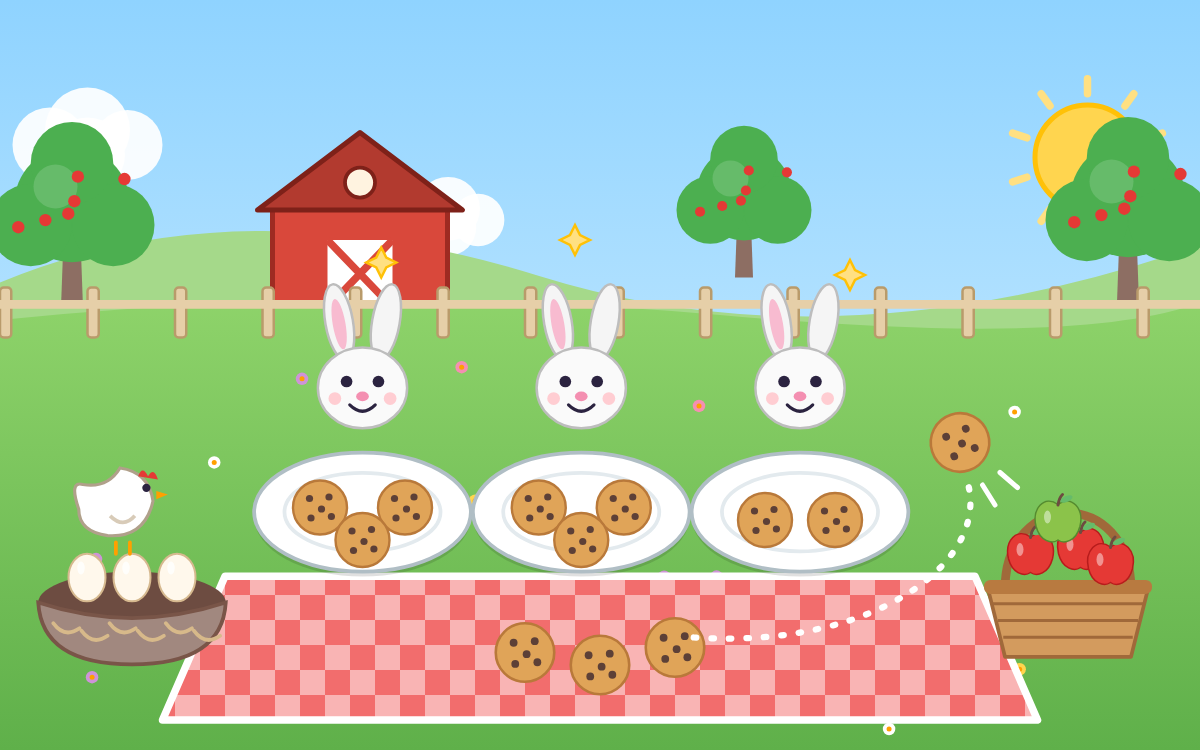
Fair Share Farm is an interactive grouping and sharing game that teaches children aged 5–6 (Year 1) to solve simple multiplication and division problems using objects, pictures and arrays.
A friendly narrator guides every step around the farm. Children count eggs in nests to check whether groups are equal, fill baskets and count them in 2s, 5s and 10s, plant carrots in rows and columns, pack strawberries into punnets and hand out cookies one at a time until each bunny has a fair share.
The game uses the words children meet in class: equal groups, an array (things set out in equal rows), grouping (we know how many go in each group) and sharing (we know how many groups). Wrong answers get a gentle hint, and a 10-puzzle Farm Fair challenge checks what has been learned.
In grouping you know how many go in each group and find how many groups you can make, like 10 socks in pairs makes 5 pairs. In sharing you know how many groups there are and find how many each one gets.
An array is a set of objects laid out in equal rows and columns, like eggs in an egg box. Because every row has the same number, children can count it row by row, for example 3 rows of 5 is 15.
Equal groups have exactly the same number of things in each group, so it is fair. Encourage your child to count every group rather than judge by looks, because spread-out objects can look like more.
It is made for children aged 5–6 in Year 1, following the England national curriculum for early multiplication and division. It also suits older children who need a refresher before learning times tables.
The game has five chapters, an optional warm-up on counting in 2s, 5s and 10s, and a 10-puzzle final challenge. Playing everything takes about 35 minutes, and each chapter can be played on its own.
 TapLearn
Getting it ready…
Great work on chapter 1! To open the next chapters, ask a grown-up to take a look.
To play this game, ask a grown-up to take a look. There are lots of free games you can play right now too!
Create a free family account and your child can play every chapter of every game for 7 days, with no card needed. Their progress is kept. After that, the free plan is free for ever, and membership is £6.99 (about $9.35) a month if you'd like to keep every chapter.
That's all the learning time for today. Great work! Flip will be ready to play again tomorrow.