Counting in 2s, 3s, 5s and 10s: Bo's Pattern Garden
Learn counting in 2s, 3s, 5s and 10s, forwards and backwards, and spot repeating patterns by hopping with Bo the bunny across a garden of number stones.
Online game, chapter 1 free · Year 2 (KS1) · ages 5–7 · national curriculum in England · no adverts · plays on a phone, tablet or computer · no sign-up to start.
An online maths game for Year 2 (KS1). It covers the national curriculum in England, Year 2 maths: “Order and arrange combinations of mathematical objects in patterns and sequences”, and 1 more statement listed under the chapters.
6 short chapters, about 35 minutes in all. Children can stop after any chapter.
Start playing for free. Plays in the browser on phones, tablets and computers: no app, no adverts.
Free for teachers: every chapter on the whiteboard with a free teacher account.
Last updated · Checked against the national curriculum in England by the TapLearn team
What you'll learn
Count in 2s, 5s and 3s from 0, forwards and backwards
Count in 10s from any number, such as 23, 33, 43
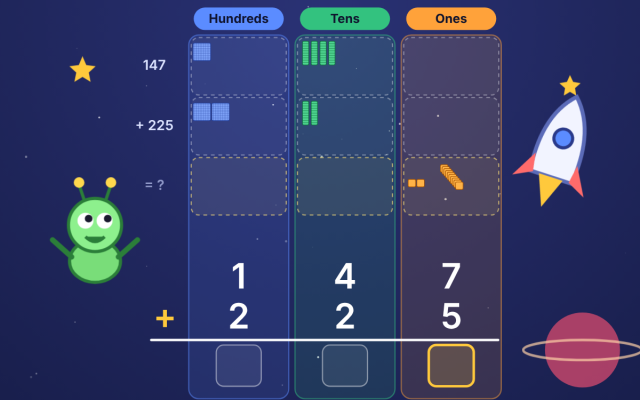
Why only the tens digit changes when adding or taking 10
Find the unit of repeat and continue a repeating pattern
Work out the rule of a number sequence and fill gaps
Spot and fix the mistake in a pattern or sequence
Chapter by chapter
Repeating patterns: find the repeating part and continue itStart playing for free
Year 2 maths · 1
Count in 2s from 0, forwards and backwards
Year 2 maths · 2
Count in 5s from 0, forwards and backwards
Year 2 maths · 2
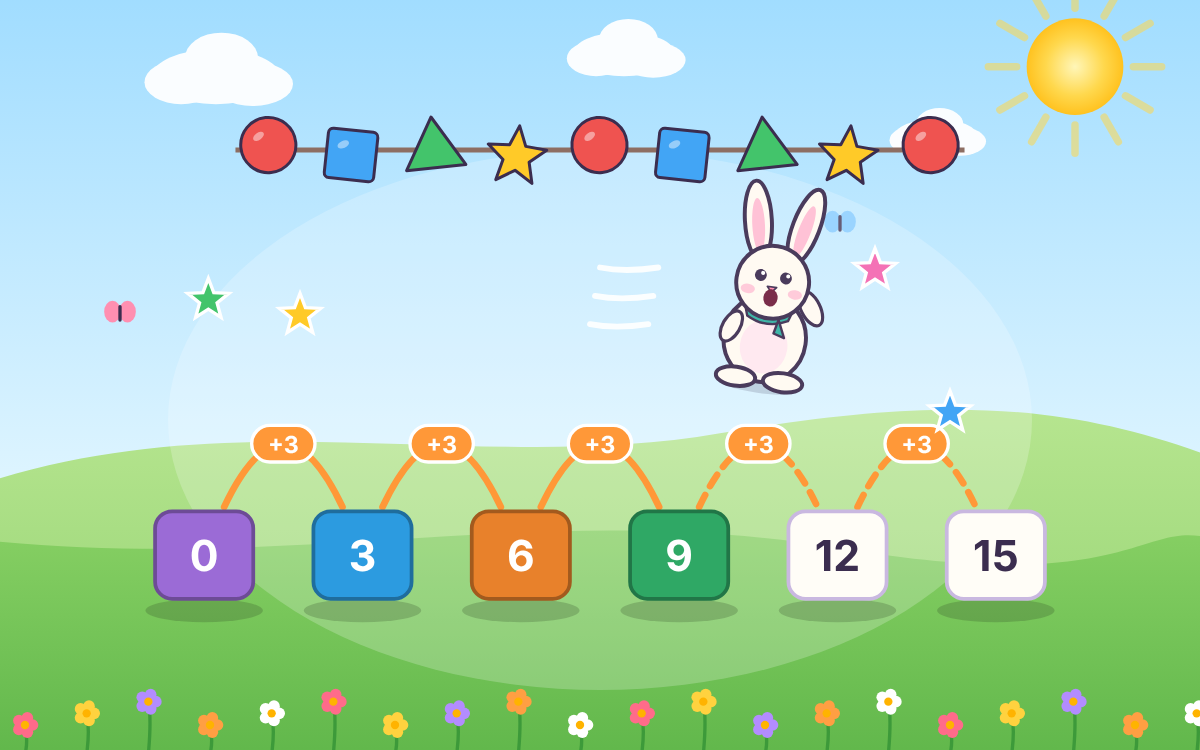
Count in 3s from 0, forwards and backwards
Year 2 maths · 2
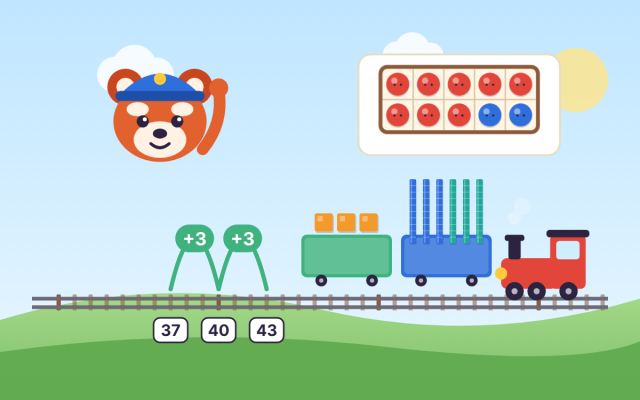
Count in 10s from any number, forwards and backwards
Year 2 maths · 2
Number sequences: find the rule and the missing numbers
Year 2 maths · 2Year 2 maths · 1
Big Garden Challenge: patterns and counting in steps (10 questions)
What the chapters cover in the national curriculum in England:
Year 2 maths: Order and arrange combinations of mathematical objects in patterns and sequences
Year 2 maths: Count in steps of 2, 3, and 5 from 0, and in 10s from any number, forward and backward
About this adventure
Counting in 2s, 3s, 5s and 10s is an interactive maths game that teaches children aged 5–7 to count in steps forwards and backwards and to continue repeating patterns, in line with Year 2 maths in England.
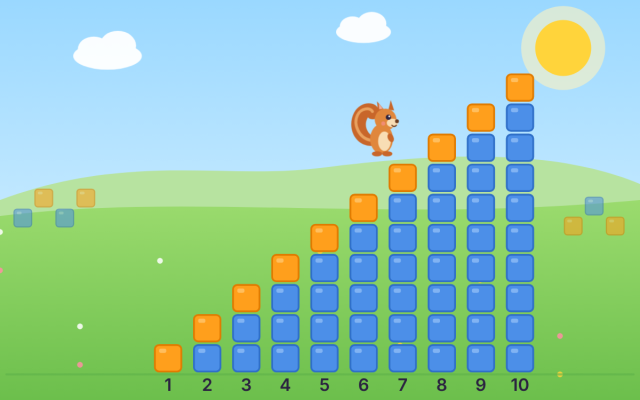
Children tap pairs of socks, hands and clover leaves to see why steps help, then help Bo hop across stepping stones and a hundred square, choosing each landing spot. They count minutes in 5s round a clock, whisper and shout their way through the 3s, and add or take away tens with blocks to see that only the tens digit changes.
They also find the unit of repeat (the part of a pattern that repeats), follow shapes that turn clockwise, fix broken patterns and number sequences, and work out the rule of a sequence. A spoken guide reads every instruction aloud, and a final challenge checks what they have learned.
Questions and answers
What does counting in steps mean?
Counting in steps means jumping by the same amount each time instead of counting in ones, for example 0, 5, 10, 15 when counting in 5s. Going backwards takes the same amount away each time, so 50, 45, 40.
How do you count in 10s from any number?
To count in 10s from any number, add one to the tens digit each time and keep the ones digit the same, so 23, 33, 43, 53. Counting back works the same way: 87, 77, 67.
What is a unit of repeat in a repeating pattern?
The unit of repeat is the smallest part of a pattern that repeats over and over. In circle, square, square, circle, square, square, the unit of repeat is circle, square, square, and knowing it tells you what comes next.
What age is this counting in steps game for?
The game is pitched at children aged 5 to 7, matching Year 2 maths in England (Key Stage 1). Every instruction is read aloud, so children who are still learning to read can play on their own.
What is included in the game and how long does it take?
The game has six chapters, each with an animated introduction and a short recap, plus a ten-question challenge with typed and multiple-choice answers. Playing everything takes about 35 minutes, and children can start from any chapter.
We count visits to make TapLearn better.We use one cookie, only on this site, to see how families find and use it. No adverts, and nothing is shared.One cookie, only on this site. No adverts.How we measure
 TapLearn