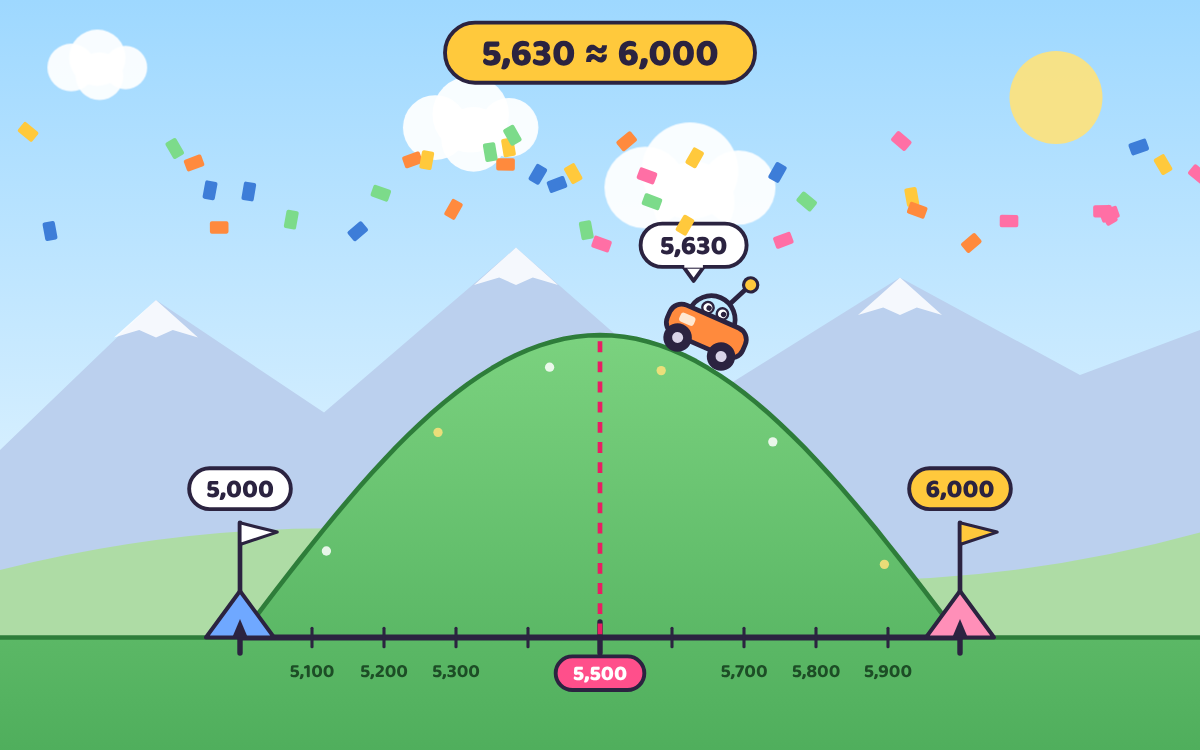
Rounding Numbers Year 5: Roll Over Hills to a Million
Learn rounding numbers to the nearest 10, 100, 1,000, 10,000 and 100,000 by rolling a rover over number hills, then use rounding to check answers.
- Ages 9–10
- About 40 min
- Some thinking
- Numbers
Learn rounding numbers to the nearest 10, 100, 1,000, 10,000 and 100,000 by rolling a rover over number hills, then use rounding to check answers.
Year 5 maths · 1
Year 5 maths · 1
Year 5 maths · 1
Year 5 maths · 2
Year 5 maths · 2
See every Maths chapter in the chapter library
What the chapters cover in the national curriculum in England:
Rounding Hills is an interactive game that teaches children aged 9–10 rounding numbers up to 1,000,000 to the nearest 10, 100, 1,000, 10,000 and 100,000, and how to use rounding to check answers. It follows the Year 5 maths national curriculum for England.
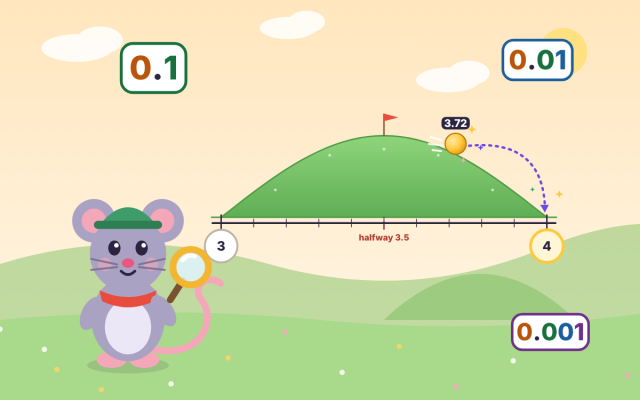
Players drag Rory the Rover onto a number hill between two multiples, find the halfway point at the top, and watch Rory roll down to the nearer one. A place value chart then shows the deciding digit, which sits just to the right of the rounding place: 5 or more rounds up, 4 or less keeps the rounding digit the same.
Later, children estimate to test a robot's calculations, meet the approximately equal sign (≈), and decide when a number should be exact, like change in a shop, and when a rounded number is clearer, like the size of a crowd.
Look at the hundreds digit, which is just to the right of the thousands place. If it is 5 or more, the thousands digit goes up by one; if it is 4 or less, it stays the same. Every digit after the thousands place becomes zero, so 4,370 rounds to 4,000.
39,960 rounds to 40,000 because its tens digit, 6, means rounding up the hundreds. The hundreds digit is 9, so it rolls over to 0 and pushes the thousands up, and that 9 rolls over too, turning the 3 ten thousands into 4.
Rounding gives a quick estimate to compare with the real answer. For 48,295 + 31,640, rounding to 50,000 + 30,000 gives about 80,000, so an answer of 52,935 must be wrong, while an answer close to 80,000 is sensible.
The game is made for children aged 9 to 10 in Year 5 and follows the national curriculum for England. It starts with rounding to the nearest 10, 100 and 1,000, so it also suits Year 6 children who want to revise.
It has five chapters, an optional place value warm-up and a 10-question Summit Challenge, and takes about 40 minutes to play everything. Instructions are read aloud, answers are typed on an on-screen keypad, and each chapter ends with a short recap.

 TapLearn
Getting it ready…
Great work on chapter 1! To open the next chapters, ask a grown-up to take a look.
To play this game, ask a grown-up to take a look. There are lots of free games you can play right now too!
Playing in class? Ask your teacher to get a free class link. Then your teacher can open every chapter on the board, and you can keep playing at home.
Teachers: play every chapter with your class, free
taplearn.co.uk/teachers
A free teacher account: games on the board, a class link for home, and no pupil data.
A teacher? Every chapter is free for your class. Get a free teacher account
A teacher? Every chapter is free for your class. Get a free teacher account
Create a free family account and your child can play every chapter of every game for 7 days, with no card needed. Their progress is kept. After that, the free plan is free for ever, and membership is £6.99 (about $9.35) a month if you'd like to keep every chapter.
That's all the learning time for today. Great work! Flip will be ready to play again tomorrow.