Negative Numbers: A Zero Line Expedition with Tundra
Learn negative numbers in real life: compare temperatures, work out rises and falls across zero and find differences such as -4°C to 7°C.
- Ages 10–11
- About 35 min
- Some thinking
- Numbers
Learn negative numbers in real life: compare temperatures, work out rises and falls across zero and find differences such as -4°C to 7°C.
Year 6 maths · 1
Year 6 maths · 1
Year 6 maths · 1
Year 6 maths · 1
See every Maths chapter in the chapter library
What the chapters cover in the national curriculum in England:
Zero Line Expedition is an interactive negative numbers game for children aged 10–11 that teaches the Year 6 skill of using negative numbers in context and calculating intervals across zero.
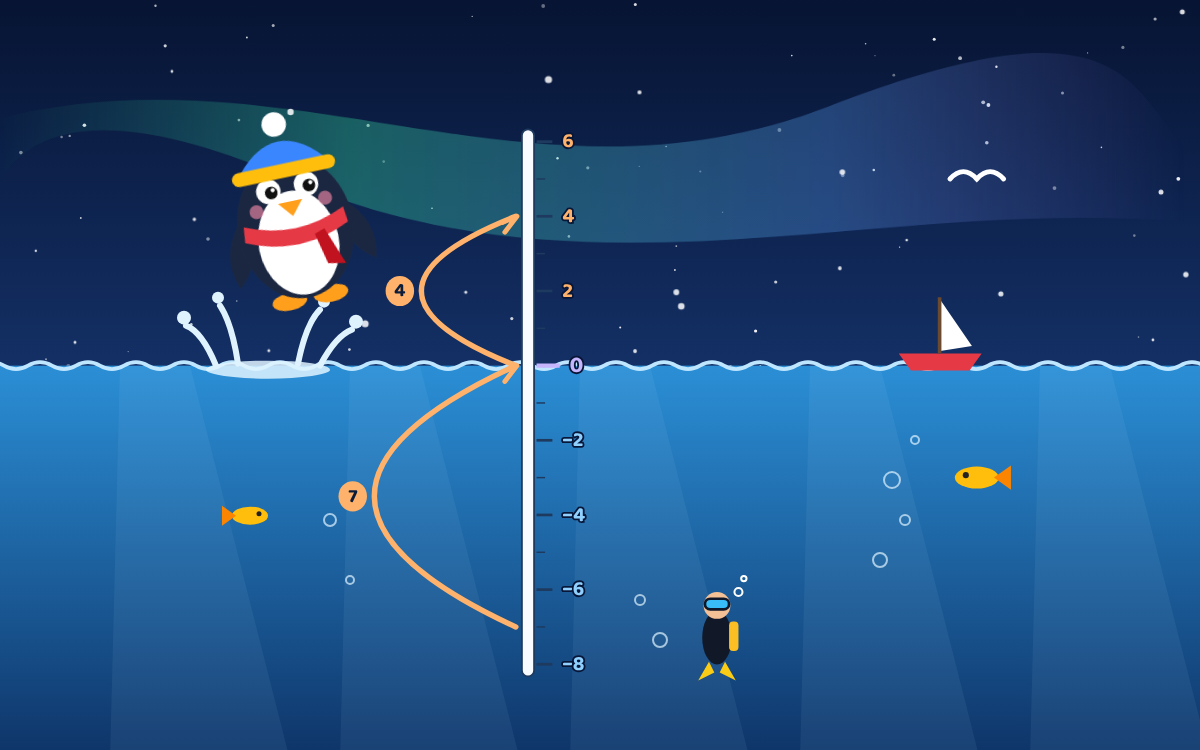
Guided by Tundra the penguin, players visit four stations on a frozen map. They drag the liquid on a thermometer, place a seal below sea level, ride a lift to basement floors and follow a diver swimming up to the surface. A number line shows every jump, so children see why -2 is greater than -6 and how to cross zero in two hops: first to zero, then the rest.
The interval is the distance between two numbers, so the difference between -4°C and 7°C is 4 + 7 = 11 degrees, not 3. Children also solve problems with temperature tables, bank overdrafts and missing starting values, then try a 12-question challenge.
Count the steps to zero, then count on to the other number and add the two parts. For -4 and 7, it is 4 steps up to zero and 7 more, so the difference is 4 + 7 = 11.
-8 is smaller than -3. On a number line, -8 is further below zero, so it is the lower number, and -8°C is colder than -3°C. The closer a negative number is to zero, the greater it is.
The new temperature is -4°C. A fall of 3 degrees takes it down to 0°C, and the other 4 degrees take it below zero to -4°C. Hopping to zero first makes these questions easier.
The game is written for children aged 10–11 in Year 6, following the English national curriculum. A short warm-up recaps the Year 5 basics, so it also suits older Year 5 pupils or anyone revising for KS2 SATs.
The game has a warm-up, four teaching stations and a 12-question Polar Challenge, which take about 35 minutes in total. Each station is spoken aloud by Tundra the penguin, mixes tapping, dragging and typed answers, and can be played on its own.
 TapLearn
Getting it ready…
Great work on chapter 1! To open the next chapters, ask a grown-up to take a look.
To play this game, ask a grown-up to take a look. There are lots of free games you can play right now too!
Playing in class? Ask your teacher to get a free class link. Then your teacher can open every chapter on the board, and you can keep playing at home.
Teachers: play every chapter with your class, free
taplearn.co.uk/teachers
A free teacher account: games on the board, a class link for home, and no pupil data.
A teacher? Every chapter is free for your class. Get a free teacher account
A teacher? Every chapter is free for your class. Get a free teacher account
Create a free family account and your child can play every chapter of every game for 7 days, with no card needed. Their progress is kept. After that, the free plan is free for ever, and membership is £6.99 (about $9.35) a month if you'd like to keep every chapter.
That's all the learning time for today. Great work! Flip will be ready to play again tomorrow.