One More One Less: Add One, Take One Away with Pip
Learn to find one more and one less than numbers 0 to 10 by shaking acorns from a tree, watching frogs jump off a log and building a staircase.
- Ages 4–6
- About 25 min
- Easy start
- Numbers
Learn to find one more and one less than numbers 0 to 10 by shaking acorns from a tree, watching frogs jump off a log and building a staircase.
Reception maths · 1 Reception maths · 2
Reception maths · 1 Reception maths · 2
Reception maths · 2 Reception maths · 1
Reception maths · 1
Reception maths · 1 Reception maths · 2
See every Maths chapter in the chapter library
What the chapters cover in the national curriculum in England:
One More One Less is an interactive maths game that teaches children aged 4–6 to find one more and one less than any number from 0 to 10, following the Reception (EYFS) maths guidance.
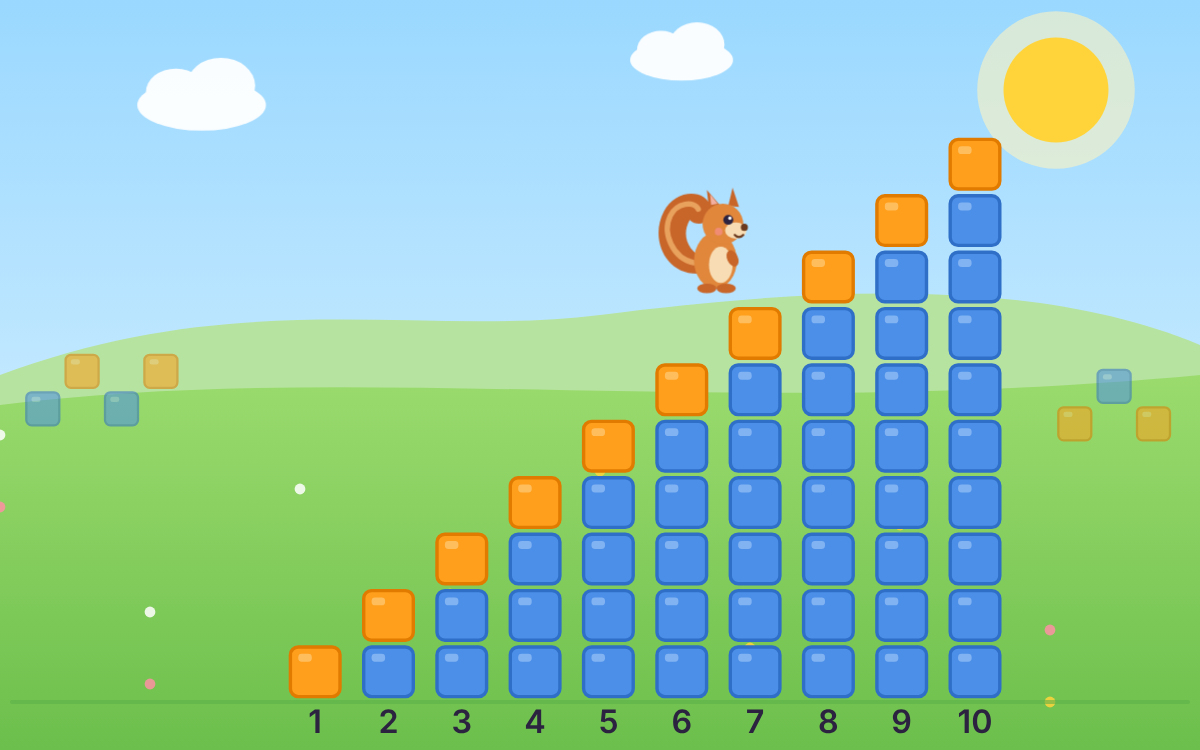
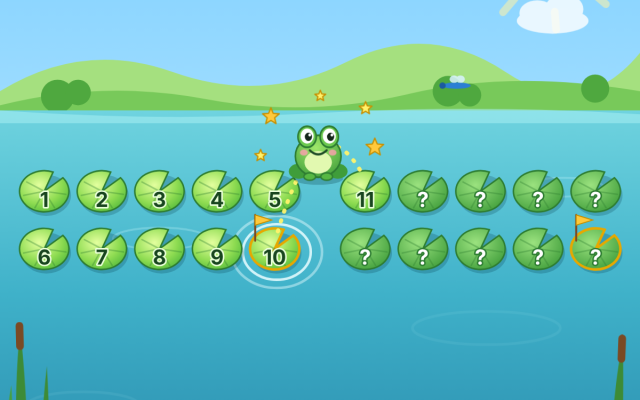
Pip the squirrel guides players through short, spoken activities. They add one acorn at a time to a tray laid out like a ten frame, take frogs away one by one, and build towers of cubes from 1 to 10 to see the staircase pattern: each counting number is one more than the number before. On a number track they find the number after (one more) and the number before (one less), even when fog hides the numbers.
Children predict first, then watch the answer happen, so the idea is seen as well as said. They also meet zero as one less than 1 and finish with a 10-question challenge.
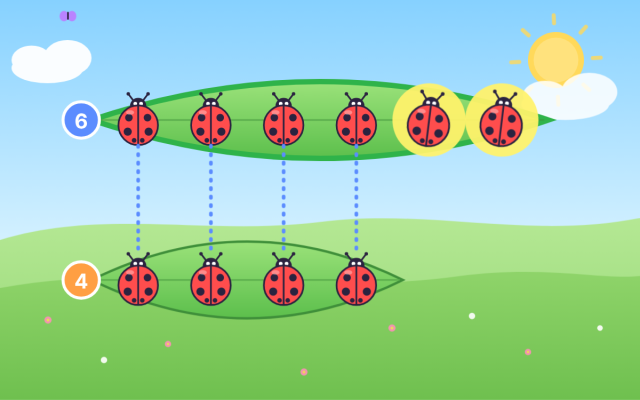
One more is the number you get when you add one, which is the next counting number. One less is the number you get when you take one away, which is the number just before. For example, one more than 5 is 6 and one less than 5 is 4.
Start with real objects: add one or take one away and count again so children see the number change. Cube towers built into a staircase and a number track from 0 to 10 then show that the number after is one more and the number before is one less.
One less than 1 is 0, or zero, which means none at all. Young children often find this tricky, so the game shows a last frog jumping off the log, leaving nothing behind, and a frog hopping back to the zero stone.
The game is made for children aged 4 to 6, matching the Reception year of the Early Years Foundation Stage in England. Year 1 children can also use it as a quick refresher before working with one more and one less beyond 10.
The game has a counting warm-up, five spoken chapters and a 10-question Big Challenge, and takes about 25 minutes to play through. Chapters can be played in any order and in short sessions, which suits young children.
 TapLearn
Getting it ready…
Great work on chapter 1! To open the next chapters, ask a grown-up to take a look.
To play this game, ask a grown-up to take a look. There are lots of free games you can play right now too!
Playing in class? Ask your teacher to get a free class link. Then your teacher can open every chapter on the board, and you can keep playing at home.
Teachers: play every chapter with your class, free
taplearn.co.uk/teachers
A free teacher account: games on the board, a class link for home, and no pupil data.
A teacher? Every chapter is free for your class. Get a free teacher account
A teacher? Every chapter is free for your class. Get a free teacher account
Create a free family account and your child can play every chapter of every game for 7 days, with no card needed. Their progress is kept. After that, the free plan is free for ever, and membership is £6.99 (about $9.35) a month if you'd like to keep every chapter.
That's all the learning time for today. Great work! Flip will be ready to play again tomorrow.