From raw marks to scaled scores
Each SATs paper is marked to give a raw score, the number of marks your child got. Because some years' papers are slightly harder than others, raw scores are turned into scaled scores, so a score means the same thing every year.
- Scaled scores run from 80 to 120.
- 100 or more means your child met the expected standard in that subject.
- Below 100 means they haven't yet met it.
- The Department for Education's statistics count 110 or more as a high score.
The raw mark needed for 100 is published in July, after the tests. In 2026 it was 56 out of 110 in maths, 25 out of 50 in reading and 34 out of 70 in grammar, punctuation and spelling. So a child doesn't need anything like full marks to meet the standard.
Which subjects get a scaled score
- Reading: one paper.
- Maths: three papers (arithmetic and two reasoning papers) combined into one score.
- Grammar, punctuation and spelling: two papers.
- Writing and science are assessed by the teacher. For writing, your child is described as working towards the expected standard, working at it, or working at greater depth. Our guide to those words explains them.
When you'll see results
Schools receive results in early July (from Tuesday 6 July in 2027). You'll usually get them with your child's end-of-year report, before the summer holidays. In 2026, results were nine days late, so don't worry if your school's date moves.
How results compare
In 2026, 75% of children met the expected standard in reading, 75% in maths and 74% in grammar, punctuation and spelling. 63% met it in reading, writing and maths combined.
If your child scored below 100
- It doesn't stop them going to secondary school or choosing subjects later.
- Secondary schools use results, with their own checks, to decide who needs extra support in Year 7, and that support is a good thing.
- Look at which subject, and talk to your child's teacher about what would help most over the summer: usually reading for pleasure and keeping number facts fresh.
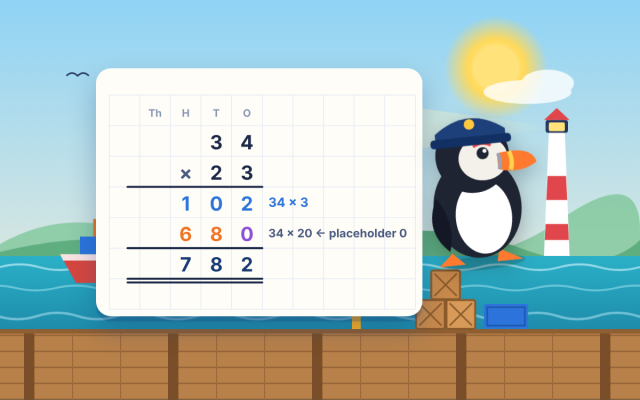
Long Multiplication and Division: A Puffin Harbour Job
Learn long multiplication and long and short division by two-digit numbers, then help Pip the puffin pack cra…
Ratio and Proportion: Sail Ratio Island with Pip
Learn ratio and proportion for Year 6: use 'for every' and a : b, scale recipes, enlarge similar shapes and s…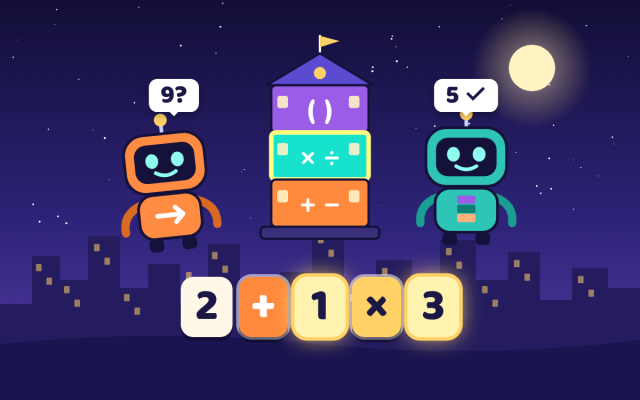
Order of Operations: Climb the Priority Tower with Ordo
Learn the order of operations: brackets, then multiply and divide, then add and subtract. Solve calculations…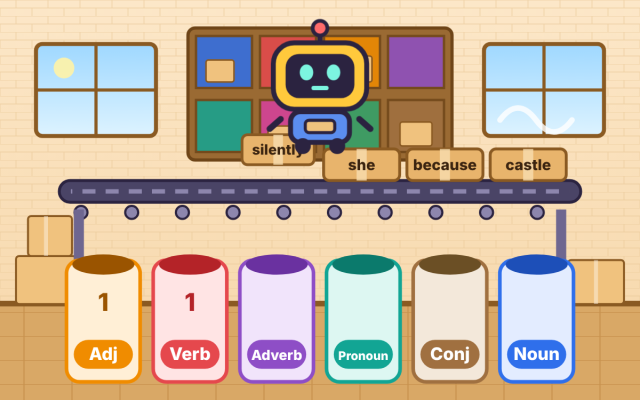
Word Classes: Sort Every Word with Dot the Robot
Learn the eight word classes, from nouns and verbs to determiners and conjunctions, by sorting word parcels i…
The Subjunctive Form: Help Percy Speak Like Royalty
Learn the subjunctive form, from If I were you to Were they to come, by helping Percy the parrot turn chatty…
 TapLearn