Correspondence problems worksheet for Year 3: Outfits and pairs
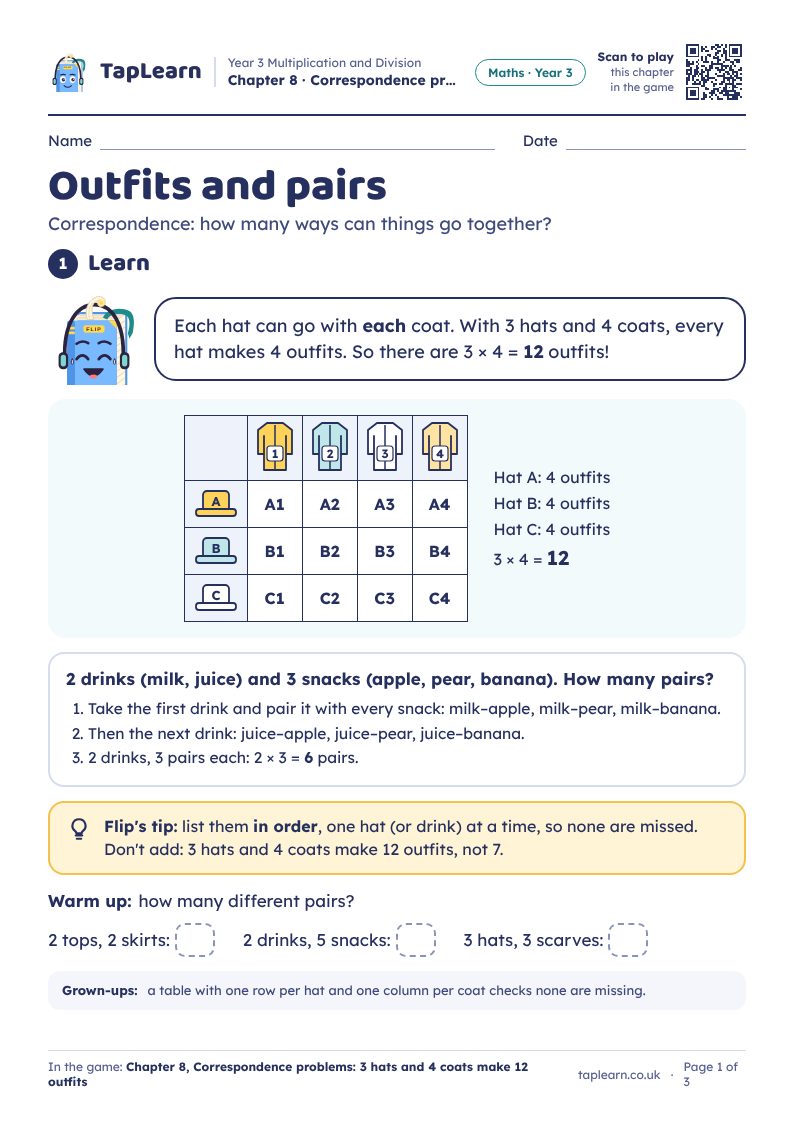
Outfits and Pairs is a printable correspondence problems worksheet for Year 3 (ages 7 to 8) that teaches children to list every pair in order, one hat at a time, and multiply: 3 hats and 4 coats make 12 outfits. It covers the Year 3 maths statement to solve problems, including missing number problems, involving multiplication and division, including scaling and correspondence problems.
This worksheet is for members
Membership opens every chapter of every game and every worksheet, for all your children.
See the plansAlready a member? Log in to print it.
Start with the free one: Fact families (chapter 1).
Print it on A4, in colour or black and white. Do it after the chapter, or before it to see what your child already knows.
What's on the worksheet
Your child solves correspondence problems such as how many outfits 3 hats and 4 coats make, by listing in order and multiplying, plus equal-group problems. Includes an outfit maker activity and an answers sheet.
- Page 1 · Learn
- A table showing 3 hats each making 4 outfits, a worked example pairing 2 drinks with 3 snacks, Flip's tip to list in order and not add, and a how-many-pairs warm-up.
- Page 2 · Try it together
- Outfit maker: lay out 2 tops and 3 bottoms, make every outfit with top 1 and then top 2, say 2 × 3 = 6, then add a top and guess the new total before listing.
- Page 3 · Practise
- Fill a sandwich table for 3 breads and 2 fillings, write × facts for flavours and cones, choose × or ÷ for bike, spider, car and table problems, find a missing number of cakes, and a challenge.
- Answers sheet
- Every answer, mix-ups like adding the groups, and breakfast-choices and legs-count ideas.
3 A4 pages and an answers sheet · about 25 minutes
Using it at home
- A table with one row per hat and one column per coat checks none are missing.
- In outfit maker, if your child gets 5 (2 + 3), lay out the outfits for real so they see each top used 3 times.
- Ask breakfast questions: 2 cereals and 3 fruits make how many breakfasts?
Watch out for
- Adding the groups, so 3 hats and 4 coats make 7.
- Make a table, one row per hat, and count the outfits.
- Missing some pairs when listing.
- Work through one hat at a time, in order.
- Multiplying when sharing, so 20 wheels with 4 on each car gives 80.
- Ask "Do we know the total already?" If yes, divide.
Questions from the worksheet
- How many different pairs? Write a × fact: 5 shirts, 3 ties.
- Some cars have 20 wheels altogether. Each car has 4 wheels. How many cars?
- A café has 3 drinks and some cakes. There are 15 different drink-and-cake pairs. How many cakes are there?
- Sam says, "4 hats and 2 scarves make 6 outfits." Is Sam right? Explain, and list the outfits if it helps.
The answers are on the answers sheet, for grown-ups.
National curriculum in England
This worksheet practises this statement from the Year 3 maths programme of study:
- Solve problems, including missing number problems, involving multiplication and division, including positive integer scaling problems and correspondence problems in which n objects are connected to m objects
Source: National curriculum in England: mathematics programmes of study (DfE)
In the classroom
- Run outfit maker with paper doll clothes in groups, recording each combination in a table.
- Use Practise C as a sorting task: which problems need × and which need ÷?
Questions and answers
What is a correspondence problem?
A correspondence problem asks how many ways things can go together, like hats and coats. Each hat goes with each coat, so you multiply: 3 × 4 = 12 outfits.
Why don't you add in outfit problems?
Each item in one group pairs with every item in the other. 3 hats and 4 coats make 12 outfits, not 7.
How do you make sure no outfits are missed?
List them in order, one hat at a time, or draw a table with one row per hat and one column per coat.
More worksheets from Year 3 Multiplication and Division: Pip's Times Market
- Chapter 1: Fact families worksheet Free
- Chapter 2: Multiplying multiples of 10 worksheet: Facts from facts Members
- Chapter 3: Partitioning to multiply worksheet: Split and multiply Members
- Chapter 4: Column multiplication worksheet: Column multiplying Members
- Chapter 5: Division by chunking worksheet: Sharing tens and ones Members
- Chapter 6: Missing number problems worksheet: Missing numbers Members
- Chapter 7: Scaling problems worksheet: Times as many Members
 TapLearn