Missing number problems worksheet for Year 3: Missing numbers
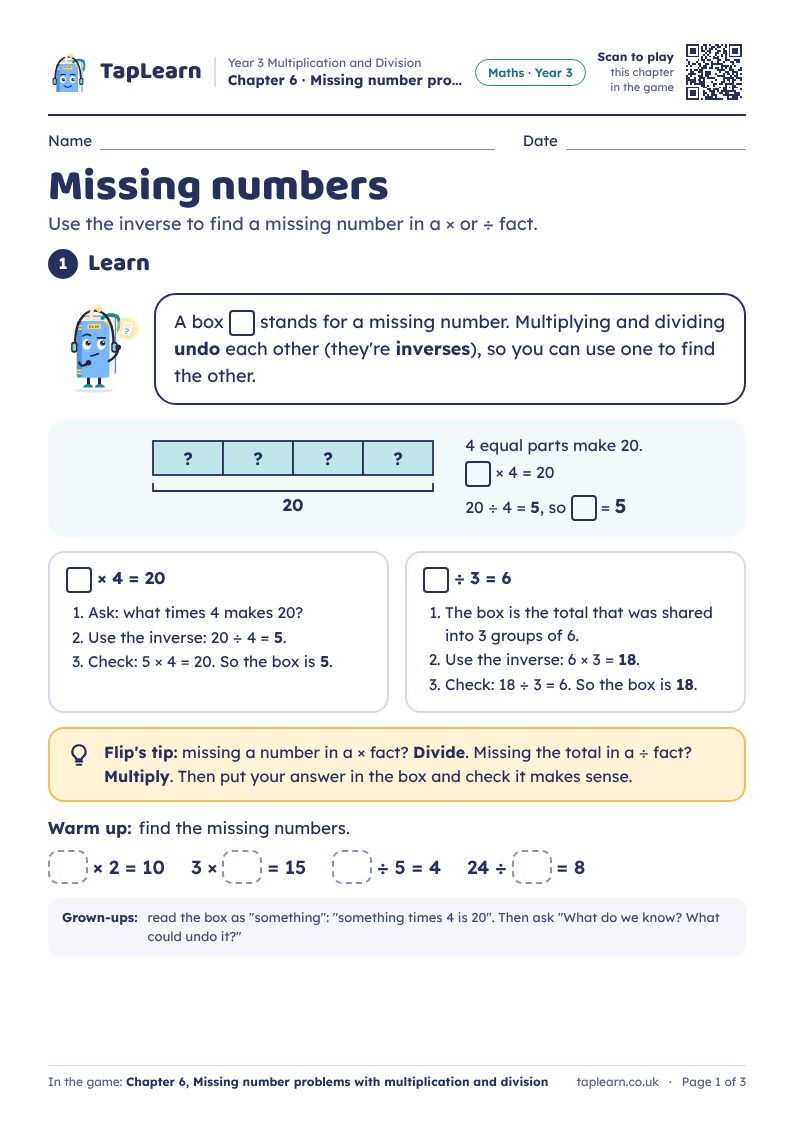
Missing Numbers is a printable missing number problems worksheet for Year 3 (ages 7 to 8) that teaches children to divide to find a missing number in a × fact and multiply to find a missing total in a ÷ fact. It covers the Year 3 maths statement to solve problems, including missing number problems, involving multiplication and division, including scaling and correspondence problems.
This worksheet is for members
Membership opens every chapter of every game and every worksheet, for all your children.
See the plansAlready a member? Log in to print it.
Start with the free one: Fact families (chapter 1).
Print it on A4, in colour or black and white. Do it after the chapter, or before it to see what your child already knows.
What's on the worksheet
Your child finds missing numbers in multiplication and division facts, like ? × 4 = 20, using the inverse, and solves missing-number stories. Includes a cups-and-buttons game and an answers sheet.
- Page 1 · Learn
- A bar of 4 equal parts making 20, worked examples for ? × 4 = 20 and ? ÷ 3 = 6, Flip's tip on which operation undoes which, and a missing-number warm-up.
- Page 2 · Try it together
- Cups and buttons: the grown-up hides the same number of buttons under 3 cups and says the total, the child writes a fact with a box, works out each cup, then lifts them to check.
- Page 3 · Practise
- Find missing numbers, find three ways to make ? × ? = 24, write facts for bar models, solve yoghurt, think-of-a-number and sticker problems, and a challenge about 20 − 4.
- Answers sheet
- Every answer, mix-ups like adding or taking away, and guess-my-number and hidden-sweets ideas.
3 A4 pages and an answers sheet · about 25 minutes
Using it at home
- Read the box as "something": "something times 4 is 20". Then ask "What do we know? What could undo it?"
- In cups and buttons, if your child guesses, ask them to check by multiplying, then show how 15 ÷ 3 finds it straight away.
- Play guess my number: "I times my number by 3 and get 21."
Watch out for
- Adding or taking away, so ? × 4 = 20 gives 16.
- Ask "Is this a × fact or a + fact? What undoes ×?"
- Multiplying when they should divide, so the box becomes 80.
- Put the answer back in: 80 × 4 isn't 20.
- Dividing when the total is missing, so ? ÷ 5 = 4 gives 1.
- The box is the total, so it's the biggest number: 4 × 5 = 20.
Questions from the worksheet
- Find three different ways to make this true: ___ × ___ = 24.
- Packs of 4 yoghurts make 32 yoghurts. How many packs? Write a fact with a box first.
- I think of a number. I divide it by 5 and get 6. What was my number?
- Leo is solving ? × 4 = 20. He says, "20 − 4 = 16, so the box is 16." Is Leo right? Explain.
The answers are on the answers sheet, for grown-ups.
National curriculum in England
This worksheet practises this statement from the Year 3 maths programme of study:
- Solve problems, including missing number problems, involving multiplication and division, including positive integer scaling problems and correspondence problems in which n objects are connected to m objects
Source: National curriculum in England: mathematics programmes of study (DfE)
In the classroom
- Play cups and buttons with the class using cups on the visualiser.
- Use Practise B as an open task: how many ways can pairs make 24?
Questions and answers
How do you find a missing number in a multiplication?
Use the inverse: divide the total by the number you know. For ? × 4 = 20, 20 ÷ 4 = 5.
How do you find a missing total in a division?
Multiply. For ? ÷ 3 = 6, 6 × 3 = 18, so the box is 18.
What does inverse mean in maths?
Multiplying and dividing undo each other, so they are inverses. You can use one to check or find the other.
More worksheets from Year 3 Multiplication and Division: Pip's Times Market
- Chapter 1: Fact families worksheet Free
- Chapter 2: Multiplying multiples of 10 worksheet: Facts from facts Members
- Chapter 3: Partitioning to multiply worksheet: Split and multiply Members
- Chapter 4: Column multiplication worksheet: Column multiplying Members
- Chapter 5: Division by chunking worksheet: Sharing tens and ones Members
- Chapter 7: Scaling problems worksheet: Times as many Members
- Chapter 8: Correspondence problems worksheet: Outfits and pairs Members
 TapLearn