Partitioning to multiply worksheet for Year 3: Split and multiply
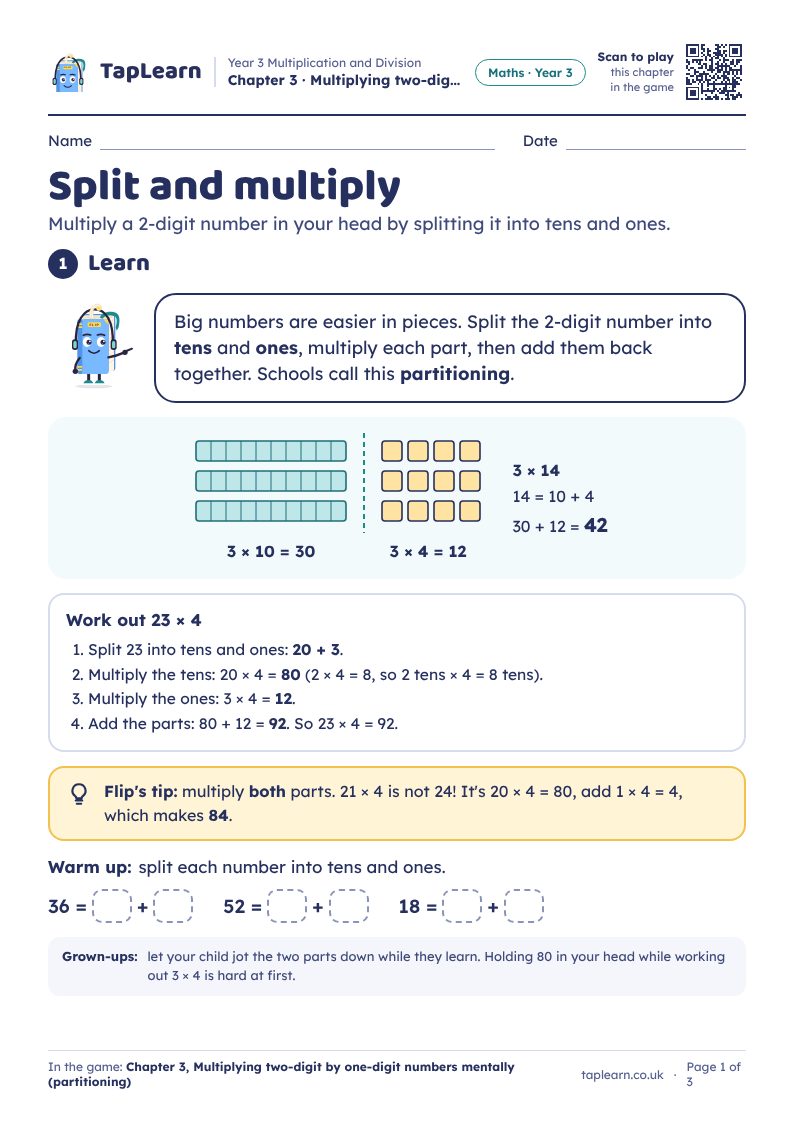
Split and Multiply is a printable partitioning to multiply worksheet for Year 3 (ages 7 to 8) that teaches children to split a number like 23 into 20 and 3, multiply each part, then add the parts. It covers the Year 3 maths statement to write and calculate × and ÷ statements using known tables, including two-digit times one-digit numbers, mentally and then with written methods.
This worksheet is for members
Membership opens every chapter of every game and every worksheet, for all your children.
See the plansAlready a member? Log in to print it.
Start with the free one: Fact families (chapter 1).
▶ Play chapter 3 in the game · How the partitioning works
Print it on A4, in colour or black and white. Do it after the chapter, or before it to see what your child already knows.
What's on the worksheet
Your child multiplies a 2-digit number by a 1-digit number in their head by partitioning it into tens and ones. Includes a pasta packs activity and an answers sheet.
- Page 1 · Learn
- 3 × 14 split into 3 × 10 and 3 × 4, a worked example for 23 × 4, Flip's tip that 21 × 4 is not 24, and a split-into-tens-and-ones warm-up.
- Page 2 · Try it together
- Pasta packs: put 14 pasta pieces in each of 3 cups, tip each into a pile of 10 and a pile of 4, push the tens and ones together, add the parts and count to check.
- Page 3 · Practise
- Split, multiply both parts and add for 16 × 3, 25 × 2 and 32 × 4, work out more products, solve sticker and bus problems, and a challenge about 21 × 4.
- Answers sheet
- Every answer, mix-ups like forgetting the tens, and shop-maths and legs-and-wheels ideas.
3 A4 pages and an answers sheet · about 25 minutes
Using it at home
- Let your child jot the two parts down while they learn. Holding 80 in your head while working out 3 × 4 is hard at first.
- In pasta packs, if the total doesn't match when you count every piece, count the 10 piles again first.
- Ask legs-and-wheels questions: how many legs on 13 dogs?
Watch out for
- Forgetting the tens, so 21 × 4 = 24.
- Ask "What did you do with the 20?"
- Adding instead of multiplying, so 13 × 3 = 16.
- Say it as "13, three times" and draw 3 lots of 13.
- Losing a part when adding up.
- Writing both parts down before adding helps.
Questions from the worksheet
- Work these out. Write the parts on the line if it helps: 13 × 3, 24 × 2, 15 × 4, 21 × 5, 18 × 3, 12 × 8.
- A pack has 14 stickers. How many stickers are in 4 packs? Show how you split the number.
- A bus has 32 seats. How many seats are on 3 buses?
- Leo says, "21 × 4 = 24. I did 1 × 4 = 4 and kept the 2." Is Leo right? Explain what he should do.
The answers are on the answers sheet, for grown-ups.
National curriculum in England
This worksheet practises this statement from the Year 3 maths programme of study:
- Write and calculate mathematical statements for multiplication and division using the multiplication tables that they know, including for two-digit numbers times one-digit numbers, using mental and progressing to formal written methods
Source: National curriculum in England: mathematics programmes of study (DfE)
In the classroom
- Model pasta packs with place value counters, then have pairs try 3 × 14 and 4 × 12.
- Use Leo's challenge as a quick check that both parts are multiplied.
Questions and answers
What does partitioning mean in multiplication?
Partitioning means splitting a number into tens and ones, like 23 = 20 + 3, multiplying each part, then adding: 80 + 12 = 92.
How do you multiply 2-digit by 1-digit numbers in your head?
Split the 2-digit number into tens and ones, multiply both parts by the 1-digit number, then add the answers.
Why is 21 × 4 not 24?
Both parts need multiplying: 20 × 4 = 80 and 1 × 4 = 4, so 21 × 4 = 84.
More worksheets from Year 3 Multiplication and Division: Pip's Times Market
- Chapter 1: Fact families worksheet Free
- Chapter 2: Multiplying multiples of 10 worksheet: Facts from facts Members
- Chapter 4: Column multiplication worksheet: Column multiplying Members
- Chapter 5: Division by chunking worksheet: Sharing tens and ones Members
- Chapter 6: Missing number problems worksheet: Missing numbers Members
- Chapter 7: Scaling problems worksheet: Times as many Members
- Chapter 8: Correspondence problems worksheet: Outfits and pairs Members
 TapLearn