Scaling problems worksheet for Year 3: Times as many
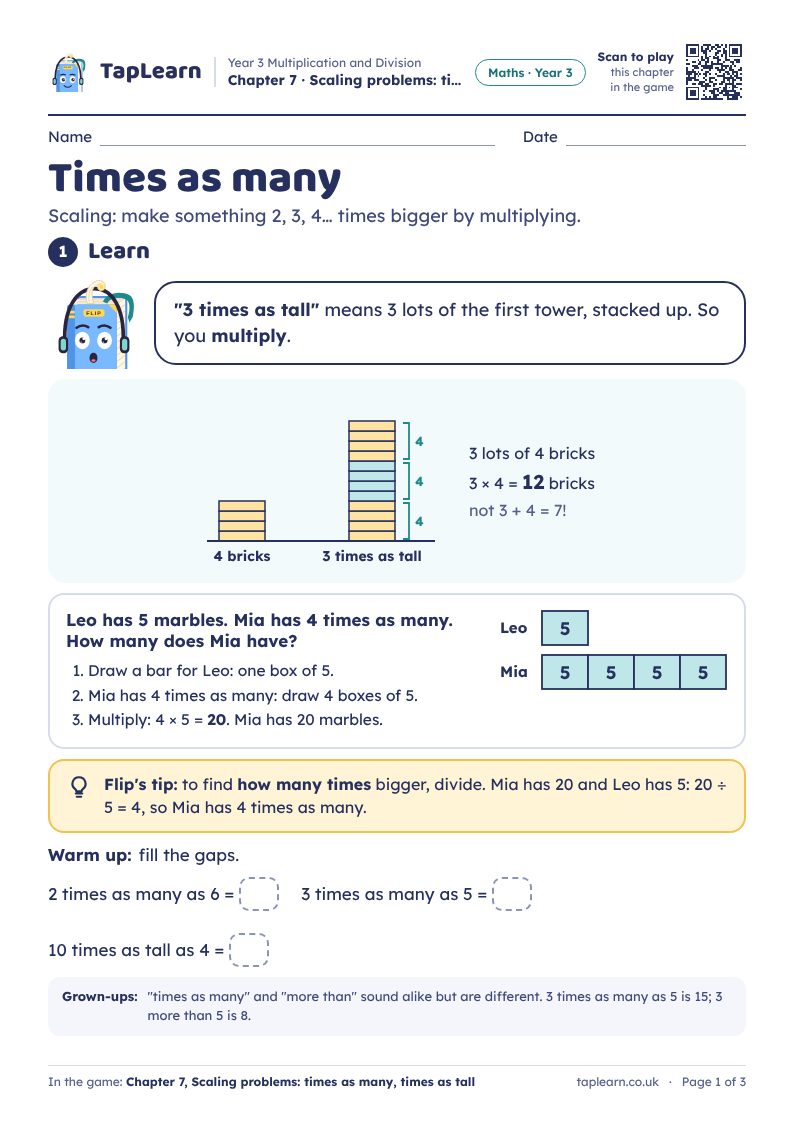
Times as Many is a printable scaling problems worksheet for Year 3 (ages 7 to 8) that teaches children that 3 times as tall means 3 lots of the first amount, and to divide to find how many times bigger. It covers the Year 3 maths statement to solve problems, including missing number problems, involving multiplication and division, including scaling and correspondence problems.
This worksheet is for members
Membership opens every chapter of every game and every worksheet, for all your children.
See the plansAlready a member? Log in to print it.
Start with the free one: Fact families (chapter 1).
Print it on A4, in colour or black and white. Do it after the chapter, or before it to see what your child already knows.
What's on the worksheet
Your child solves scaling problems like 3 times as tall or 4 times as many by multiplying, and finds how many times bigger by dividing, with bar models. Includes a taller towers activity and an answers sheet.
- Page 1 · Learn
- A tower of 4 bricks and one 3 times as tall, a worked bar model for Mia having 4 times as many marbles as Leo, Flip's tip on dividing to compare, and a warm-up.
- Page 2 · Try it together
- Taller towers: build a tower of 3 bricks, then one 4 times as tall and say 4 × 3 = 12, then work out how many times taller a tower of 10 is than a tower of 2.
- Page 3 · Practise
- Draw bar models for sticker and ribbon problems, fill a table of 2, 3 and 5 times as many, divide for tree and reading problems, tick true sentences about shells, and a challenge.
- Answers sheet
- Every answer, mix-ups like finding the difference instead, and twice-as-tall and recipe-scaling ideas.
3 A4 pages and an answers sheet · about 25 minutes
Using it at home
- "Times as many" and "more than" sound alike but are different: 3 times as many as 5 is 15, and 3 more than 5 is 8.
- Keep towers to about 20 bricks so they don't topple, and talk about how the second tower is made of copies of the first.
- If a recipe needs 2 eggs, ask how many for 3 times as much.
Watch out for
- Adding instead of multiplying, so 3 times as many as 7 becomes 10.
- Draw the bar: 3 boxes, each holding 7.
- Finding the difference when asked "how many times".
- The difference answers "how many more"; division answers "how many times".
- Muddling who has more.
- In the shells question, Mia has more, so Sam can't have 3 times as many.
Questions from the worksheet
- Sam has 6 stickers. Ava has 3 times as many. How many stickers does Ava have?
- A tree is 12 m tall. A shed is 3 m tall. How many times taller is the tree?
- Mia has 15 shells. Sam has 5 shells. Tick each sentence that is true: Mia has 10 more shells than Sam. Mia has 3 times as many shells as Sam.
- Ava says, "3 times as many as 7 is 10, because 3 + 7 = 10." Is Ava right? Explain, and draw a bar model if it helps.
The answers are on the answers sheet, for grown-ups.
National curriculum in England
This worksheet practises this statement from the Year 3 maths programme of study:
- Solve problems, including missing number problems, involving multiplication and division, including positive integer scaling problems and correspondence problems in which n objects are connected to m objects
Source: National curriculum in England: mathematics programmes of study (DfE)
In the classroom
- Build taller towers with cubes in pairs and record each as a multiplication fact.
- Use the true-or-false shell sentences as a discussion starter on more than and times as many.
Questions and answers
What is a scaling problem in Year 3?
A scaling problem makes an amount 2, 3, 4 or more times bigger, like 4 times as many. You solve it by multiplying.
What is the difference between times as many and more than?
3 times as many as 5 is 15, because it means 3 lots of 5. 3 more than 5 is 8.
How do you find how many times bigger something is?
Divide the bigger amount by the smaller one. Mia has 20 and Leo has 5, so 20 ÷ 5 = 4 times as many.
More worksheets from Year 3 Multiplication and Division: Pip's Times Market
- Chapter 1: Fact families worksheet Free
- Chapter 2: Multiplying multiples of 10 worksheet: Facts from facts Members
- Chapter 3: Partitioning to multiply worksheet: Split and multiply Members
- Chapter 4: Column multiplication worksheet: Column multiplying Members
- Chapter 5: Division by chunking worksheet: Sharing tens and ones Members
- Chapter 6: Missing number problems worksheet: Missing numbers Members
- Chapter 8: Correspondence problems worksheet: Outfits and pairs Members
 TapLearn