Division by chunking worksheet for Year 3: Sharing tens and ones
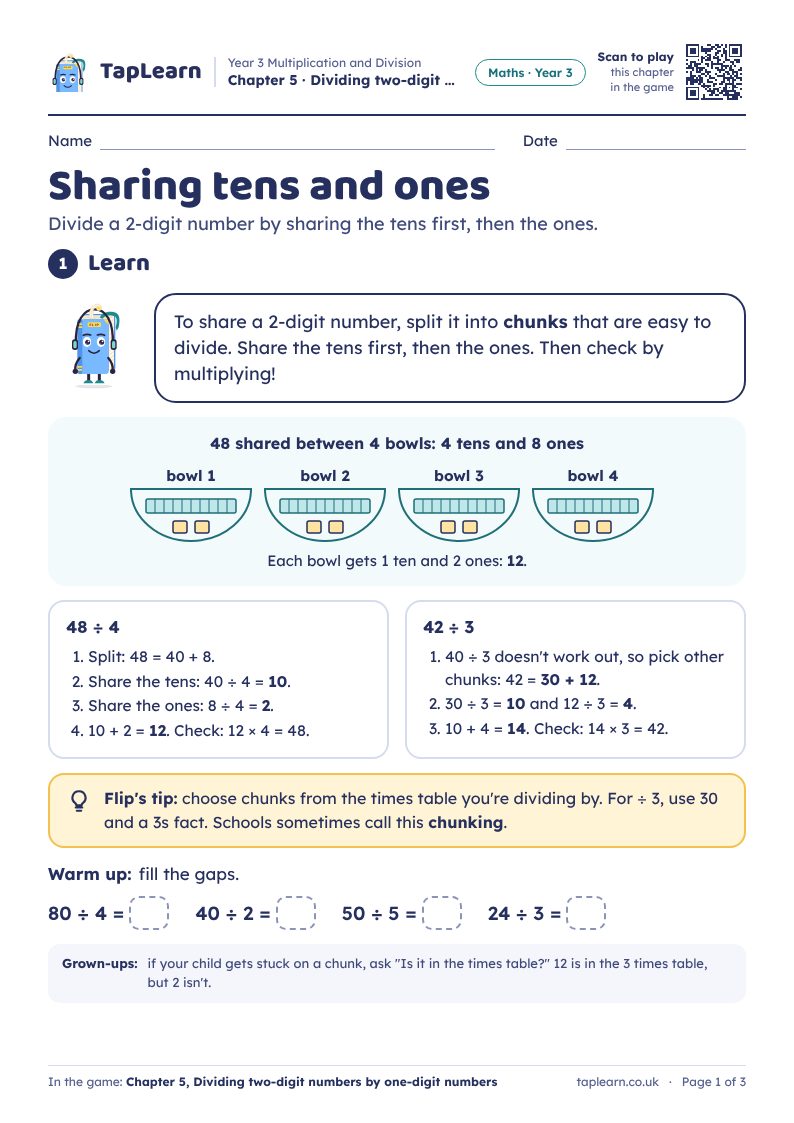
Sharing Tens and Ones is a printable division by chunking worksheet for Year 3 (ages 7 to 8) that teaches children to split a number into chunks that are easy to divide, like 42 = 30 + 12 for ÷ 3, and check by multiplying. It covers the Year 3 maths statement to write and calculate × and ÷ statements using known tables, including two-digit times one-digit numbers, mentally and then with written methods.
This worksheet is for members
Membership opens every chapter of every game and every worksheet, for all your children.
See the plansAlready a member? Log in to print it.
Start with the free one: Fact families (chapter 1).
▶ Play chapter 5 in the game · How the chunking works
Print it on A4, in colour or black and white. Do it after the chapter, or before it to see what your child already knows.
What's on the worksheet
Your child divides a 2-digit number by a 1-digit number by sharing the tens and then the ones, choosing helpful chunks, and checks by multiplying. Includes a pasta sharing activity and an answers sheet.
- Page 1 · Learn
- 48 shared between 4 bowls as tens and ones, worked examples for 48 ÷ 4 and 42 ÷ 3, Flip's tip to choose chunks from the times table, and a warm-up.
- Page 2 · Try it together
- Pasta sharing: count out 48 pasta pieces as 4 tens and 8 ones, share the tens into 4 bowls then the ones, check by multiplying, then share 36 between 3 and 26 between 2.
- Page 3 · Practise
- Share tens then ones for 69 ÷ 3, 84 ÷ 4 and 55 ÷ 5, solve cake and pencil problems, split numbers into helpful chunks, check divisions by multiplying, and a challenge.
- Answers sheet
- Every answer, mix-ups like multiplying instead of dividing, and fair-shares and check-it ideas.
3 A4 pages and an answers sheet · about 25 minutes
Using it at home
- If your child gets stuck on a chunk, ask "Is it in the times table?" 12 is in the 3 times table, but 2 isn't.
- In pasta sharing, for 26 ÷ 2, share the 2 tens, then the 6 ones: each bowl gets 13.
- Share a bag of grapes or raisins between the family and say the division fact.
Watch out for
- Multiplying instead of dividing, so 48 ÷ 4 = 192.
- Ask "Should the answer be bigger or smaller than 48 when we share?"
- Choosing unhelpful chunks, like 40 + 2 for ÷ 3.
- Look for a chunk in the times table, like 30 or 12.
- Forgetting to add the parts, so 69 ÷ 3 = 20.
- Both the tens and the ones need sharing.
Questions from the worksheet
- Split each number into helpful chunks. Then divide: 52 ÷ 4, 45 ÷ 3, 64 ÷ 4, 96 ÷ 8.
- 60 pencils are put into packs of 5. How many packs?
- Check each answer by multiplying. Ring right or wrong: 56 ÷ 4 = 15, 48 ÷ 2 = 22.
- Sam is working out 42 ÷ 3. He says, "I split 42 into 40 and 2, but 40 ÷ 3 doesn't work. So 42 can't be divided by 3." Is Sam right? How could he split 42 instead?
The answers are on the answers sheet, for grown-ups.
National curriculum in England
This worksheet practises this statement from the Year 3 maths programme of study:
- Write and calculate mathematical statements for multiplication and division using the multiplication tables that they know, including for two-digit numbers times one-digit numbers, using mental and progressing to formal written methods
Source: National curriculum in England: mathematics programmes of study (DfE)
In the classroom
- Use pasta sharing with base 10 equipment in small groups.
- Use Practise D as a mini-whiteboard check: right or wrong, and how do you know?
Questions and answers
What is chunking in division?
Chunking means splitting a number into parts that are easy to divide, dividing each part, then adding the answers. 42 ÷ 3 is 30 ÷ 3 + 12 ÷ 3 = 14.
How do you divide a 2-digit number by a 1-digit number?
Share the tens first, then the ones. 48 ÷ 4 is 40 ÷ 4 = 10 and 8 ÷ 4 = 2, so 12.
How do you check a division answer?
Multiply the answer by the number you divided by. 12 × 4 = 48, so 48 ÷ 4 = 12 is right.
More worksheets from Year 3 Multiplication and Division: Pip's Times Market
- Chapter 1: Fact families worksheet Free
- Chapter 2: Multiplying multiples of 10 worksheet: Facts from facts Members
- Chapter 3: Partitioning to multiply worksheet: Split and multiply Members
- Chapter 4: Column multiplication worksheet: Column multiplying Members
- Chapter 6: Missing number problems worksheet: Missing numbers Members
- Chapter 7: Scaling problems worksheet: Times as many Members
- Chapter 8: Correspondence problems worksheet: Outfits and pairs Members
 TapLearn