Fact families worksheet for Year 3
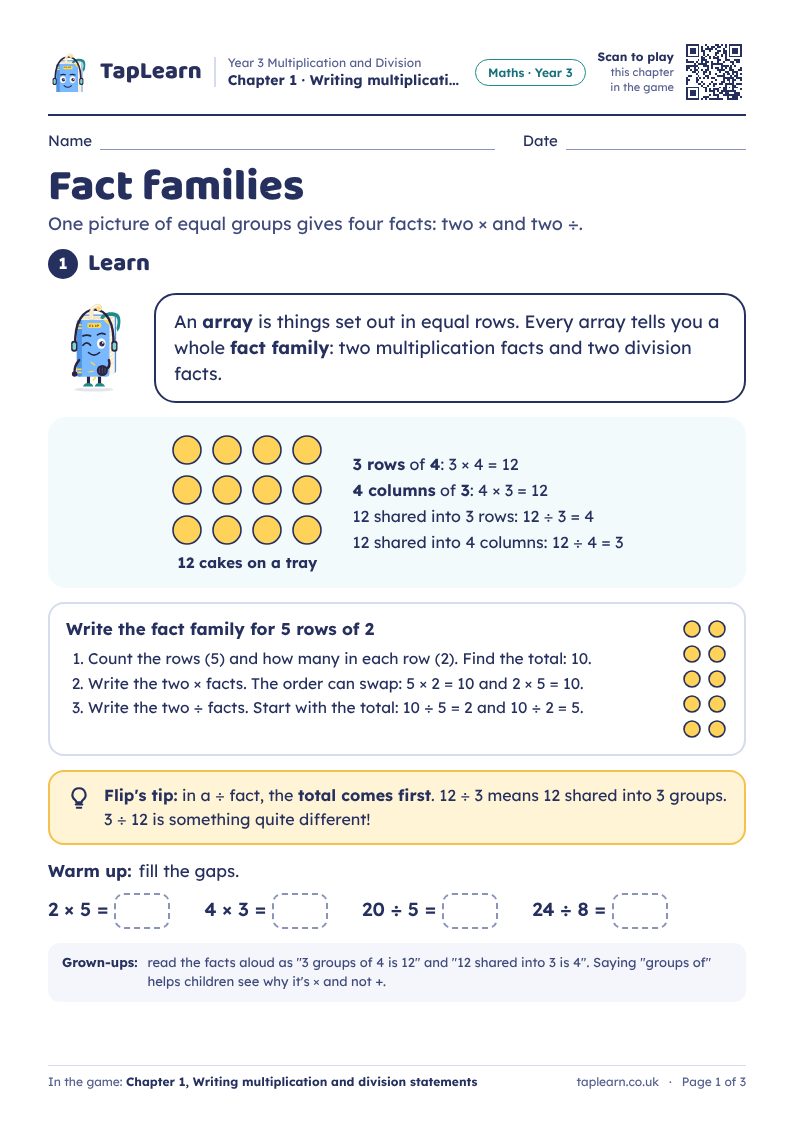
Fact Families is a printable fact families worksheet for Year 3 (ages 7 to 8) that teaches children to write the two multiplication and two division facts shown by one array, putting the total first in a division fact. It covers the Year 3 maths statement to write and calculate × and ÷ statements using known tables, including two-digit times one-digit numbers, mentally and then with written methods.
Free to print, no account needed.
Print it on A4, in colour or black and white. Do it after the chapter, or before it to see what your child already knows.
What's on the worksheet
Your child writes multiplication and division facts for arrays and equal groups, and completes fact families like 3 × 4 = 12 and 12 ÷ 3 = 4. Includes a pasta arrays activity and an answers sheet.
- Page 1 · Learn
- 12 cakes in 3 rows of 4 giving four facts, a worked example writing the fact family for 5 rows of 2, Flip's tip that the total comes first in a ÷ fact, and a fill-the-gaps warm-up.
- Page 2 · Try it together
- Pasta arrays: make 2 rows of 5 pasta pieces, say and write its four facts, then make 3 rows of 8, and take turns making an array for the other person to name.
- Page 3 · Practise
- Write × and ÷ facts for arrays, finish fact families for 5 × 8 = 40 and 18 ÷ 3 = 6, ring sentences that match 4 plates of 5 strawberries, write number sentences for stories, and a challenge.
- Answers sheet
- Every answer, mix-ups like adding instead of multiplying, and spot-an-array and four-facts ideas.
3 A4 pages and an answers sheet · about 25 minutes
Using it at home
- Read facts aloud as "3 groups of 4 is 12" and "12 shared into 3 is 4". Saying "groups of" shows why it's × and not +.
- In pasta arrays, turn the array a quarter turn: 2 rows of 5 becomes 5 rows of 2, and the total doesn't change.
- Spot arrays in egg boxes, windows or muffin trays and say the fact family together.
Watch out for
- Adding instead of multiplying, so 4 plates of 5 becomes 9.
- Ask "How many groups? How many in each?" and count in 5s together.
- Swapping a ÷ fact round, like 4 ÷ 20.
- Say it as sharing: "20 shared into 4". The total comes first.
- Worrying about rows and columns.
- Either way round gives the same total, so both × facts are right.
Questions from the worksheet
- Finish each fact family: 5 × 8 = 40; 18 ÷ 3 = 6.
- There are 4 plates with 5 strawberries on each. Ring every number sentence that matches: 4 + 5 = 9, 4 × 5 = 20, 5 × 4 = 20, 20 ÷ 4 = 5, 4 ÷ 20 = 5.
- Write a number sentence for each story, and solve it: 24 sweets shared equally between 4 children. How many each?
- Mia says, "12 ÷ 3 and 3 ÷ 12 are the same, because 3 × 4 and 4 × 3 are the same." Is Mia right? Explain.
The answers are on the answers sheet, for grown-ups.
National curriculum in England
This worksheet practises this statement from the Year 3 maths programme of study:
- Write and calculate mathematical statements for multiplication and division using the multiplication tables that they know, including for two-digit numbers times one-digit numbers, using mental and progressing to formal written methods
Source: National curriculum in England: mathematics programmes of study (DfE)
In the classroom
- Use pasta arrays in pairs with counters, one making the array and the other writing the four facts.
- Say one fact as a starter, like 5 × 3 = 15, and ask children to write the other three on mini-whiteboards.
Questions and answers
What is a fact family in multiplication?
A fact family is the four facts from one set of numbers: two multiplication and two division facts, like 3 × 4 = 12, 4 × 3 = 12, 12 ÷ 3 = 4 and 12 ÷ 4 = 3.
Can you swap the numbers in a division fact?
No. You can swap the numbers in a × fact, but not in a ÷ fact. 12 ÷ 3 = 4, but 3 ÷ 12 is much less than 1.
What is an array?
An array is things set out in equal rows. It shows multiplication and division facts at the same time.
More worksheets from Year 3 Multiplication and Division: Pip's Times Market
- Chapter 2: Multiplying multiples of 10 worksheet: Facts from facts Members
- Chapter 3: Partitioning to multiply worksheet: Split and multiply Members
- Chapter 4: Column multiplication worksheet: Column multiplying Members
- Chapter 5: Division by chunking worksheet: Sharing tens and ones Members
- Chapter 6: Missing number problems worksheet: Missing numbers Members
- Chapter 7: Scaling problems worksheet: Times as many Members
- Chapter 8: Correspondence problems worksheet: Outfits and pairs Members
 TapLearn