Column multiplication worksheet for Year 3: Column multiplying
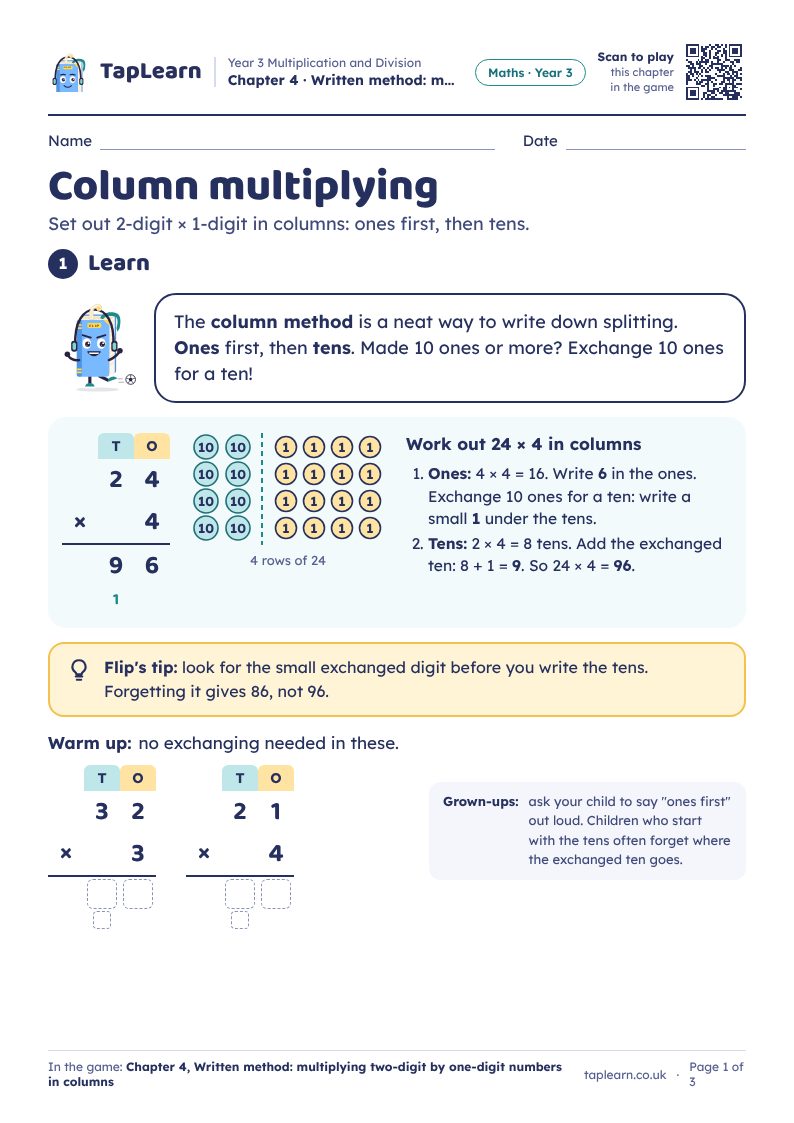
Column Multiplying is a printable column multiplication worksheet for Year 3 (ages 7 to 8) that teaches children to multiply the ones first, exchange 10 ones for a ten, then multiply the tens and add the exchanged ten. It covers the Year 3 maths statement to write and calculate × and ÷ statements using known tables, including two-digit times one-digit numbers, mentally and then with written methods.
This worksheet is for members
Membership opens every chapter of every game and every worksheet, for all your children.
See the plansAlready a member? Log in to print it.
Start with the free one: Fact families (chapter 1).
Print it on A4, in colour or black and white. Do it after the chapter, or before it to see what your child already knows.
What's on the worksheet
Your child uses the column method to multiply a 2-digit number by a 1-digit number, exchanging 10 ones for a ten. Includes a say-it-out-loud activity and an answers sheet.
- Page 1 · Learn
- 24 × 4 shown as 4 rows of 24 and in columns, with 16 ones exchanged for a ten, Flip's tip to look for the exchanged digit, and a warm-up with no exchanging.
- Page 2 · Try it together
- Say it out loud: the grown-up writes 26 × 3 in columns, the child says each step aloud, ones first, then checks by splitting into 20 × 3 and 6 × 3.
- Page 3 · Practise
- Use the column method with and without a hundreds column, solve egg-box and class-size problems, and a challenge about Ava getting 86 for 24 × 4.
- Answers sheet
- Every answer, mix-ups like writing 16 in the ones column, and check-it-two-ways and talk-it-through ideas.
3 A4 pages and an answers sheet · about 25 minutes
Using it at home
- Ask your child to say "ones first" out loud. Children who start with the tens often forget where the exchanged ten goes.
- In say it out loud, if the column answer and the splitting answer don't match, find the step that's different. It's often the exchanged ten.
- Say a calculation like 17 × 3 and let your child explain each step without writing.
Watch out for
- Forgetting the exchanged ten, so 24 × 4 = 86.
- Ask "Did you make 10 ones or more? Where did that ten go?"
- Writing 16 in the ones column.
- Only one digit fits in each column: the 1 ten moves to the tens.
- Multiplying the tens first.
- Start with the ones so the exchanged ten is ready to add.
Questions from the worksheet
- A box holds 18 eggs. How many eggs are in 5 boxes? Use the column method.
- There are 26 children in each class. How many children are in 3 classes?
- Ava worked out 24 × 4 and got 86. What did she forget? What is the right answer?
The answers are on the answers sheet, for grown-ups.
National curriculum in England
This worksheet practises this statement from the Year 3 maths programme of study:
- Write and calculate mathematical statements for multiplication and division using the multiplication tables that they know, including for two-digit numbers times one-digit numbers, using mental and progressing to formal written methods
Source: National curriculum in England: mathematics programmes of study (DfE)
In the classroom
- Model the column method alongside place value counters, then have children say each step to a partner.
- Use Ava's 86 as a find-the-mistake starter.
Questions and answers
How do you do column multiplication in Year 3?
Write the numbers in columns, multiply the ones first, exchange any 10 ones for a ten, then multiply the tens and add the exchanged ten.
What does exchanging mean in multiplication?
When the ones make 10 or more, swap 10 ones for 1 ten and add it to the tens column. 16 ones becomes 1 ten and 6 ones.
How can my child check a column multiplication?
Work it out again by splitting: 26 × 3 is 20 × 3 = 60 and 6 × 3 = 18, which makes 78.
More worksheets from Year 3 Multiplication and Division: Pip's Times Market
- Chapter 1: Fact families worksheet Free
- Chapter 2: Multiplying multiples of 10 worksheet: Facts from facts Members
- Chapter 3: Partitioning to multiply worksheet: Split and multiply Members
- Chapter 5: Division by chunking worksheet: Sharing tens and ones Members
- Chapter 6: Missing number problems worksheet: Missing numbers Members
- Chapter 7: Scaling problems worksheet: Times as many Members
- Chapter 8: Correspondence problems worksheet: Outfits and pairs Members
 TapLearn