Blending worksheet for Year 2: Sound out and blend
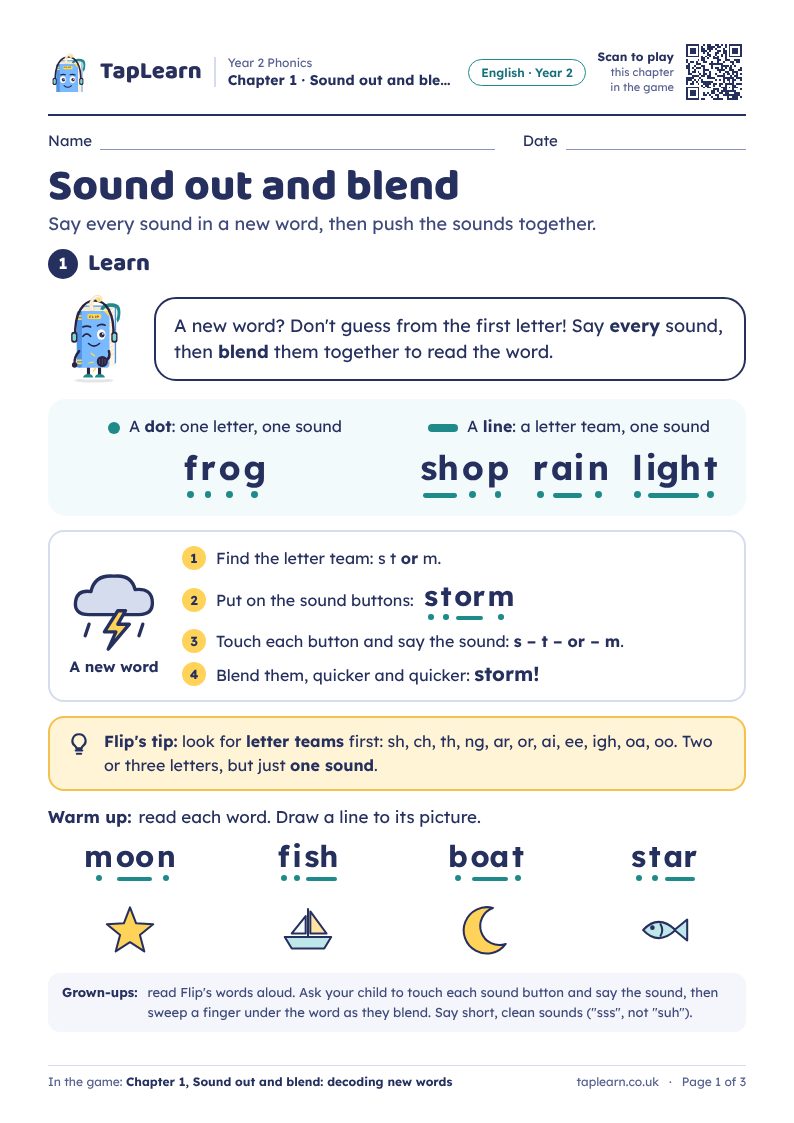
Sound Out and Blend is a printable blending worksheet for Year 2 (ages 6 to 7) that teaches children to put sound buttons under each sound, spot letter teams like or and igh, then blend the sounds to read a new word. It covers the Year 2 statement on blending the sounds in words that contain the graphemes taught so far.
Free to print, no account needed.
▶ Play chapter 1 in the game · How the sound buttons and blending works
Print it on A4, in colour or black and white. Do it after the chapter, or before it to see what your child already knows.
What's on the worksheet
Your child uses sound buttons to spot letter teams like sh, ar and igh, says every sound and blends it into a word, then reads made-up alien words. Includes a button blending activity and an answers sheet.
- Page 1 · Learn
- Dots and lines as sound buttons, a worked example blending storm, Flip's list of letter teams, and a read-and-match warm-up.
- Page 2 · Try it together
- Button blending: the grown-up writes a word with gaps between its sounds, the child puts one button under each sound (one for a letter team), touches each and blends.
- Page 3 · Practise
- Draw sound buttons on words, ring the picture a word matches, read alien words like zort and chab, read and draw a sentence, and a challenge about shark.
- Answers sheet
- Every answer, mix-ups like adding "uh" to sounds, and sound-talk I spy and robot-orders ideas.
3 A4 pages and an answers sheet · about 20 minutes
Using it at home
- Ask your child to sweep a finger under the word as they blend. Say short, clean sounds ("sss", not "suh").
- If your child guesses, cover the word and uncover one sound at a time.
- Play sound-talk I spy: "I spy a ch-air." Your child blends to find it, then has a turn.
Watch out for
- Guessing from the first letter or a picture.
- Cover the word and uncover it one sound at a time, so every sound gets read.
- Splitting a letter team, like "s-h-o-p" for shop.
- Point to the two letters together: "these two make one sound, sh".
- Turning alien names into real words, like zort into "sort".
- Praise careful sounding: alien names don't have to be real words.
Questions from the worksheet
- Draw the sound buttons: a dot for one letter, a line for a letter team. Then read the word: chop, sheep, night, card.
- Read every sound in the word. Draw a ring round the picture it matches: snail, chick, boat, fork.
- Alien names! Draw the sound buttons, read each one, then tick it: zort, chab, theep, blaim.
- Leo sees shark. He looks at sh and says, "Shell!" Is he right? What should he do?
The answers are on the answers sheet, for grown-ups.
National curriculum in England
This worksheet practises these statements from the Year 2 english programme of study:
- Continue to apply phonic knowledge and skills as the route to decode words until automatic decoding has become embedded and reading is fluent
- Read accurately by blending the sounds in words that contain the graphemes taught so far, especially recognising alternative sounds for graphemes
In the classroom
- Give robot orders as a starter: "Touch your n-o-se!" and pupils blend and do it.
- Use alien words on mini whiteboards to check blending without guessing.
Questions and answers
What are sound buttons?
Sound buttons are dots and lines under a word: a dot for a sound made by one letter, and a line for a letter team like sh or igh.
What is blending in phonics?
Blending is saying each sound in a word and pushing them together to read it, like s-t-or-m, storm.
Why do schools use alien or nonsense words?
Made-up words check that children are reading every sound rather than guessing from a word they already know.
More worksheets from Year 2 Phonics: Blend, Read and Spell on Word Island
- Chapter 2: Alternative sounds worksheet: Try another sound Members
- Chapter 3: Syllables worksheet: Long word chunks Members
- Chapter 4: Suffixes worksheet: Word endings Members
- Chapter 5: Reading fluency worksheet: Read it in a flash Members
- Chapter 6: Segmenting worksheet: Spell it sound by sound Members
- Chapter 7: Alternative spellings worksheet: New ways to spell Members
- Chapter 8: Homophones worksheet: Sound-alike words Members
 TapLearn