Alternative sounds worksheet for Year 2: Try another sound
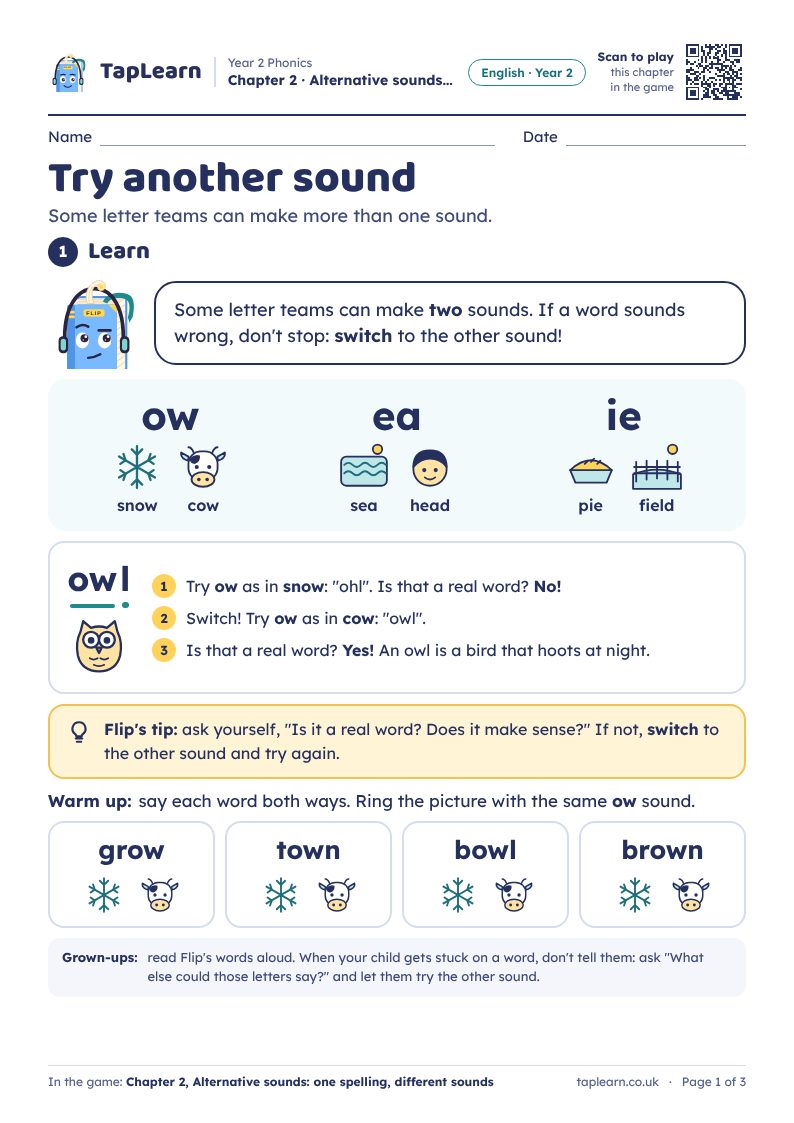
Try Another Sound is a printable alternative sounds worksheet for Year 2 (ages 6 to 7) that teaches children that some letter teams make two sounds, and to switch to the other one when a word doesn't sound real. It covers the Year 2 statement on blending the sounds in words, especially recognising alternative sounds for graphemes.
This worksheet is for members
Membership opens every chapter of every game and every worksheet, for all your children.
See the plansAlready a member? Log in to print it.
Start with the free one: Sound out and blend (chapter 1).
Print it on A4, in colour or black and white. Do it after the chapter, or before it to see what your child already knows.
What's on the worksheet
Your child reads letter teams that make two sounds, like ow in snow and cow, ea in sea and head, and ie in pie and field, and switches sounds when a word sounds wrong. Includes a bowl sort game and an answers sheet.
- Page 1 · Learn
- Ow, ea and ie with two sounds each, a worked example switching ow to read owl, Flip's tip to ask "Is it a real word?", and a same-ow-sound warm-up.
- Page 2 · Try it together
- Bowl sort: write ow words like snow, cow and window on scraps of paper, read each one, decide whether the ow sounds like snow or cow, and drop it in the right bowl.
- Page 3 · Practise
- Sort ea words into sea and head, match ie words to pie or field, read sentences switching sounds when needed, read and draw a sentence, and a challenge about owl.
- Answers sheet
- Every answer, mix-ups like reading on when it doesn't make sense, and silly-switch and sound-spotting ideas.
3 A4 pages and an answers sheet · about 20 minutes
Using it at home
- When your child gets stuck on a word, ask "What else could those letters say?" and let them try the other sound.
- In the bowl sort, if a word sounds wrong one way, say "Try the other sound!"
- Read a sentence with the wrong sound, like "Look at the brone cow!", and your child spots it.
Watch out for
- Sticking with the first sound learned, like reading owl to rhyme with bowl.
- Ask "What else could ow say?" and let your child try it.
- Reading on when it doesn't make sense.
- Stop and ask, "Did that make sense?" Then go back and switch.
- Words that can go both ways, like bow and read.
- The rest of the sentence tells you which sound it is.
Questions from the worksheet
- Does ea sound like sea or head? bread, team, leaf, feather, dream, heavy.
- Does ie sound like pie or field? tie, chief, cried, shield, lie, thief.
- Read each sentence. If a word sounds wrong, switch! The clown has a big bow tie. I had bread and a peach.
- Sam reads owl to rhyme with bowl. "Ohl? That's not a word!" What should Sam try next?
The answers are on the answers sheet, for grown-ups.
National curriculum in England
This worksheet practises this statement from the Year 2 english programme of study:
- Read accurately by blending the sounds in words that contain the graphemes taught so far, especially recognising alternative sounds for graphemes
In the classroom
- Sort ow, ea and ie words into two-column charts as a class.
- Spot alternative sounds in a shared reading book and decide which sound each makes.
Questions and answers
What are alternative sounds in phonics?
Alternative sounds are different sounds the same letters can make, like ow in snow and ow in cow.
What should children do if a word sounds wrong?
Switch to the other sound and ask, "Is it a real word? Does it make sense?"
What sounds can ea make?
Ea can sound like the ee in sea or the e in head.
More worksheets from Year 2 Phonics: Blend, Read and Spell on Word Island
- Chapter 1: Blending worksheet: Sound out and blend Free
- Chapter 3: Syllables worksheet: Long word chunks Members
- Chapter 4: Suffixes worksheet: Word endings Members
- Chapter 5: Reading fluency worksheet: Read it in a flash Members
- Chapter 6: Segmenting worksheet: Spell it sound by sound Members
- Chapter 7: Alternative spellings worksheet: New ways to spell Members
- Chapter 8: Homophones worksheet: Sound-alike words Members
 TapLearn