Homophones worksheet for Year 2: Sound-alike words
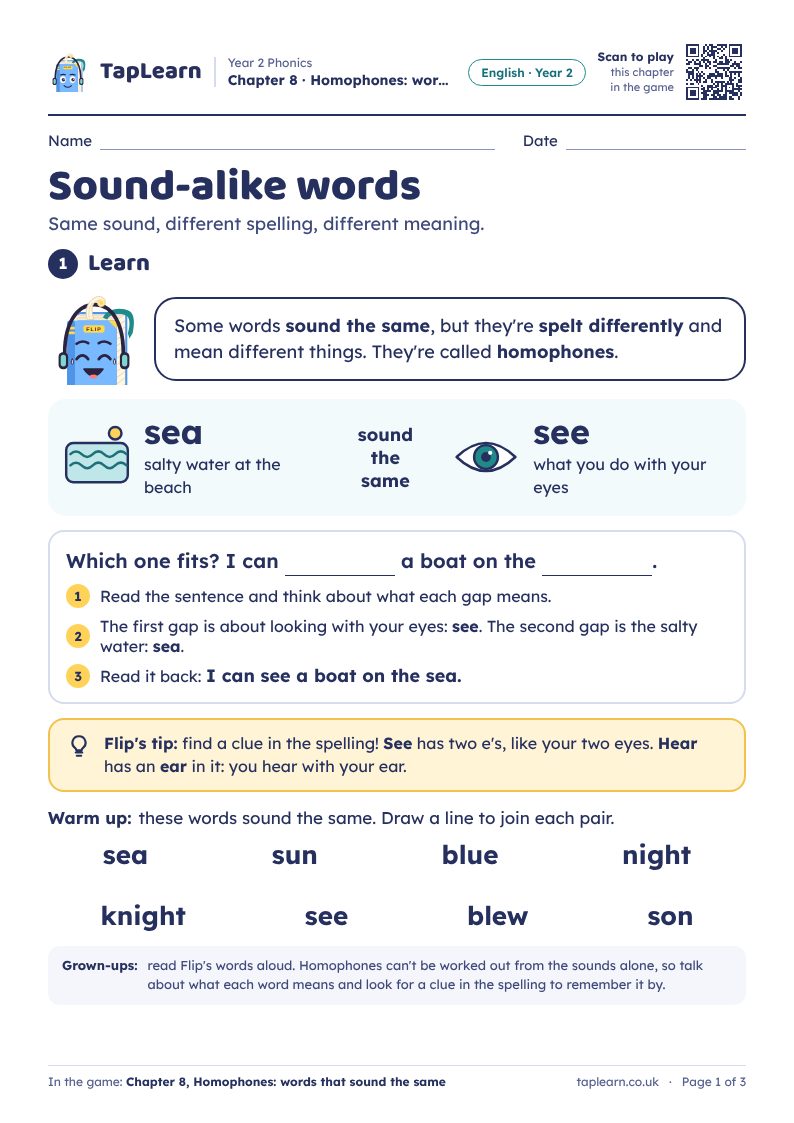
Sound-Alike Words is a printable homophones worksheet for Year 2 (ages 6 to 7) that teaches children to choose between words that sound the same by their meaning, using clues like see has two e's for two eyes. It covers the Year 2 statement on learning new ways of spelling sounds, including a few common homophones.
This worksheet is for members
Membership opens every chapter of every game and every worksheet, for all your children.
See the plansAlready a member? Log in to print it.
Start with the free one: Sound out and blend (chapter 1).
Print it on A4, in colour or black and white. Do it after the chapter, or before it to see what your child already knows.
What's on the worksheet
Your child chooses the right spelling for words that sound the same, like sea and see, sun and son, night and knight, blue and blew, and here and hear. Includes a picture pairs activity and an answers sheet.
- Page 1 · Learn
- Sea and see with their meanings, a worked example completing "I can see a boat on the sea", Flip's spelling clues, and a join-the-pairs warm-up.
- Page 2 · Try it together
- Picture pairs: read each homophone pair, draw a quick picture for each word, then point to the picture and spelling that fits a sentence the other person says.
- Page 3 · Practise
- Ring the right word in six sentences, write here or hear, write be or bee, draw night and a knight, and a challenge about "I can sea the see".
- Answers sheet
- Every answer, mix-ups like using one spelling for both meanings, and which-one and silly-sentence ideas.
3 A4 pages and an answers sheet · about 20 minutes
Using it at home
- Talk about what each word means and look for a clue in the spelling to remember it by.
- In picture pairs, swap over so your child says a sentence and you point.
- Make silly sentences with both words: "I can see the sea." "The knight rode at night."
Watch out for
- Swapping homophones, like sea for see.
- Ask "What does it mean here?" and use the clue: see has two e's, like two eyes.
- Using the spelling learned first for both meanings.
- Practise one pair at a time, with a picture for each word.
- Mixing up here and hear.
- You hear with your ear. Here is about a place: "Come here."
Questions from the worksheet
- Read each sentence. Ring the right word: We swam in the sea / see. The wind blue / blew my hat off. The night / knight rode a big horse.
- Write here or hear in each gap: Come over ___ and sit with me. I can ___ a dog barking.
- Write be or bee in each gap: A ___ buzzed round the flowers. When I grow up, I want to ___ a vet.
- Sam wrote: "I can sea the see." Is he right? Write it the right way.
The answers are on the answers sheet, for grown-ups.
National curriculum in England
This worksheet practises this statement from the Year 2 english programme of study:
- Spell by: learning new ways of spelling phonemes for which 1 or more spellings are already known, and learn some words with each spelling, including a few common homophones
In the classroom
- Play which one?: say a sentence and pupils hold up the right spelling card.
- Make a class homophone display with a picture for each word in a pair.
Questions and answers
What are homophones?
Homophones are words that sound the same but are spelt differently and mean different things, like sea and see.
How can children remember sea and see?
See has two e's, like your two eyes. Sea is the salty water at the beach.
How do you remember here and hear?
Hear has an ear in it, and you hear with your ear. Here is about a place.
More worksheets from Year 2 Phonics: Blend, Read and Spell on Word Island
- Chapter 1: Blending worksheet: Sound out and blend Free
- Chapter 2: Alternative sounds worksheet: Try another sound Members
- Chapter 3: Syllables worksheet: Long word chunks Members
- Chapter 4: Suffixes worksheet: Word endings Members
- Chapter 5: Reading fluency worksheet: Read it in a flash Members
- Chapter 6: Segmenting worksheet: Spell it sound by sound Members
- Chapter 7: Alternative spellings worksheet: New ways to spell Members
 TapLearn