Alternative spellings worksheet for Year 2: New ways to spell
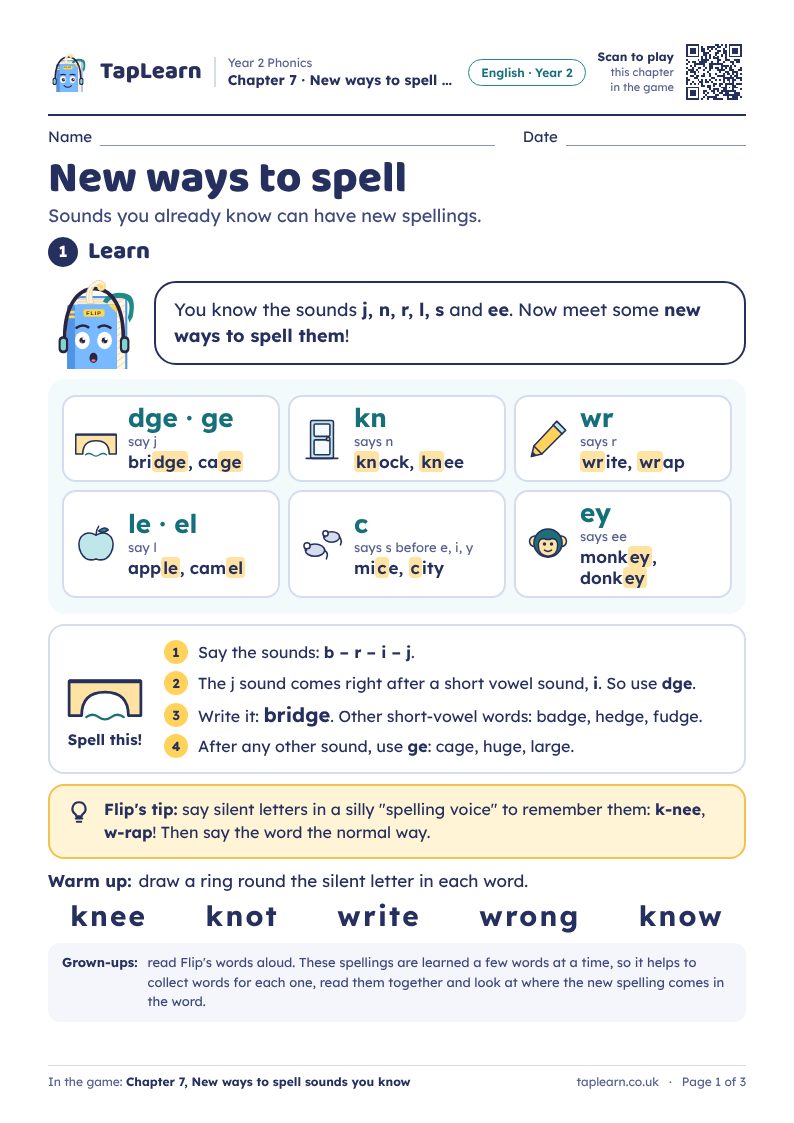
New Ways to Spell is a printable alternative spellings worksheet for Year 2 (ages 6 to 7) that teaches children new spellings for sounds they know, like dge after a short vowel, silent k in knee and le at the end of apple. It covers the Year 2 statement on learning new ways of spelling phonemes for which one or more spellings are already known.
This worksheet is for members
Membership opens every chapter of every game and every worksheet, for all your children.
See the plansAlready a member? Log in to print it.
Start with the free one: Sound out and blend (chapter 1).
Print it on A4, in colour or black and white. Do it after the chapter, or before it to see what your child already knows.
What's on the worksheet
Your child learns new spellings for known sounds: dge and ge, kn and wr, le and el, c for s in ice, and ey in monkey. Includes a word wall hunt at home and an answers sheet.
- Page 1 · Learn
- New spellings for j, n, r, l, s and ee sounds with example words, a worked example spelling bridge, Flip's spelling-voice tip, and a ring-the-silent-letter warm-up.
- Page 2 · Try it together
- Word wall: read the first word in each column, then hunt through books and packets for words with dge or ge, kn or wr, and le or el, and underline the new spelling.
- Page 3 · Practise
- Choose dge or ge, kn or wr, and le or el from clues, ring soft c spellings like mice, finish ey words like monkey, and a challenge about nife.
- Answers sheet
- Every answer, mix-ups like leaving out a silent letter, and spelling-voice and spot-it ideas.
3 A4 pages and an answers sheet · about 25 minutes
Using it at home
- Collect words for each new spelling, read them together and look at where the new spelling comes in the word.
- Some words to add to the word wall: hedge, badge, knot, write, puzzle, tunnel, towel.
- Say silent letters in a silly spelling voice to remember them: k-nee, w-rap.
Watch out for
- Leaving out a silent letter, like "nife" for knife.
- Praise the sounds, then show the kn or wr spelling and say it in a spelling voice: k-nife.
- Mixing up -le and -el, or -dge and -ge.
- -le is far more common; -dge comes straight after a short vowel sound.
- Writing s where c is needed, like "mise" for mice.
- A c before e, i or y says s, as in ice, city and face.
Questions from the worksheet
- dge or ge? Write the missing letters: ba__ (a pin to wear on a coat), hu__ (very big), ca__ (a home for a pet bird).
- kn or wr? Say the word. Does it start with an n sound or an r sound? __ee, __ap, __ock, __ite.
- le or el? Write the missing letters: app__, cam__, tab__, tunn__, litt__, tow__.
- c says s before e, i and y. Ring the right spelling: mise or mice? sity or city?
- Leo wrote nife. Mia wrote knife. Who is right? How do you know?
The answers are on the answers sheet, for grown-ups.
National curriculum in England
This worksheet practises this statement from the Year 2 english programme of study:
- Spell by: learning new ways of spelling phonemes for which 1 or more spellings are already known, and learn some words with each spelling, including a few common homophones
In the classroom
- Build a class word wall for dge, kn, wr and le and add to it through the week.
- Play spelling voice as a starter: say k-nock or w-rist for pupils to name the word.
Questions and answers
When do you use dge instead of ge?
Use dge straight after a short vowel sound, as in bridge and badge. After other sounds, use ge, as in cage and huge.
Why does knife have a k?
Knife starts with a silent k, like knee and knot. The kn spelling makes the n sound.
When does c say s?
C says s before e, i or y, as in ice, city and face.
More worksheets from Year 2 Phonics: Blend, Read and Spell on Word Island
- Chapter 1: Blending worksheet: Sound out and blend Free
- Chapter 2: Alternative sounds worksheet: Try another sound Members
- Chapter 3: Syllables worksheet: Long word chunks Members
- Chapter 4: Suffixes worksheet: Word endings Members
- Chapter 5: Reading fluency worksheet: Read it in a flash Members
- Chapter 6: Segmenting worksheet: Spell it sound by sound Members
- Chapter 8: Homophones worksheet: Sound-alike words Members
 TapLearn