Suffixes worksheet for Year 2: Word endings
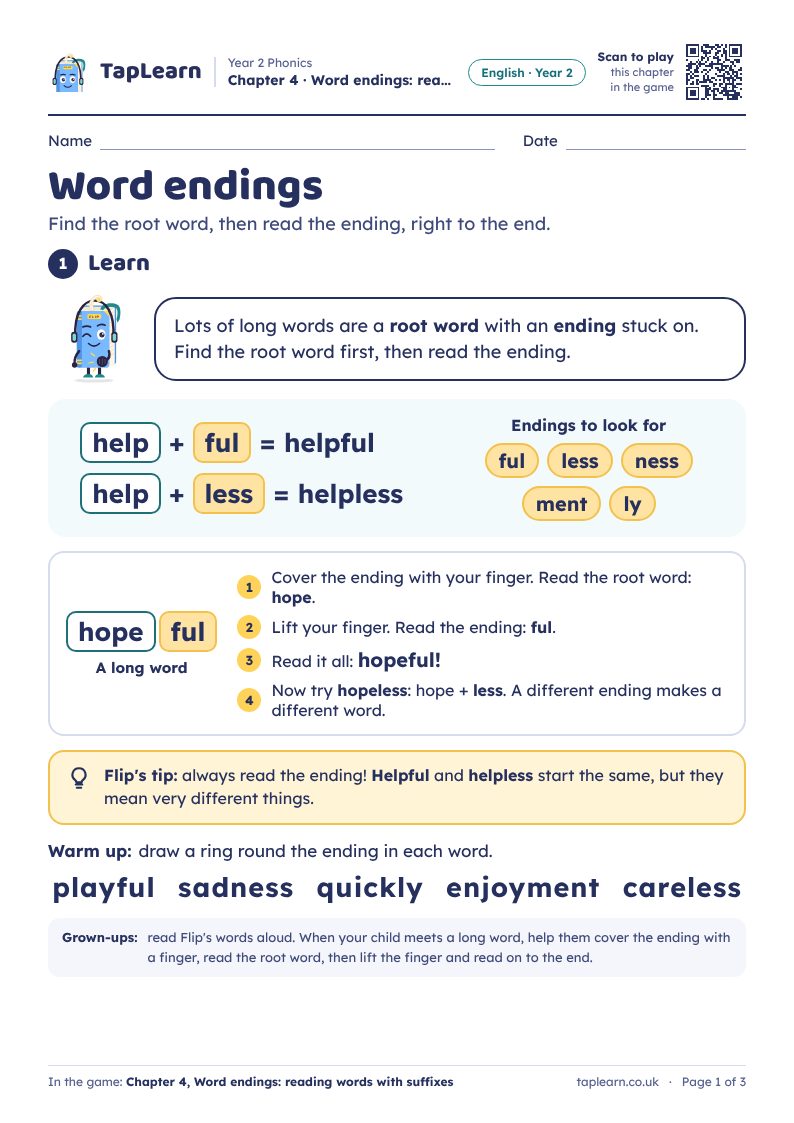
Word Endings is a printable suffixes worksheet for Year 2 (ages 6 to 7) that teaches children to cover the ending, read the root word, then read on to the end, so hopeful and hopeless don't get mixed up. It covers the Year 2 statement on reading words containing common suffixes.
This worksheet is for members
Membership opens every chapter of every game and every worksheet, for all your children.
See the plansAlready a member? Log in to print it.
Start with the free one: Sound out and blend (chapter 1).
Print it on A4, in colour or black and white. Do it after the chapter, or before it to see what your child already knows.
What's on the worksheet
Your child finds the root word and reads the ending in words with -ful, -less, -ness, -ment and -ly, like hopeful and hopeless. Includes a storybook ending hunt and an answers sheet.
- Page 1 · Learn
- Help with -ful and -less, a worked example reading hopeful, Flip's tip to always read the ending, and a ring-the-ending warm-up.
- Page 2 · Try it together
- Ending hunt: look through a storybook for words ending in ful, less, ness, ment or ly, cover the ending to read the root word, then read the whole word.
- Page 3 · Practise
- Split words into root and ending, ring the word that fits a sentence, add endings to make new words, read and draw a playful kitten, and a challenge about hopeless.
- Answers sheet
- Every answer, mix-ups like missing an ending completely, and ending ping-pong and act-the-opposites ideas.
3 A4 pages and an answers sheet · about 20 minutes
Using it at home
- Cover the ending with a finger, read the root word, then lift the finger and read on to the end.
- If there are few ending words in your book, make one together: kind + ness = kindness.
- Take turns acting careful and careless, or hopeful and hopeless, while the other guesses.
Watch out for
- Reading the root word and guessing the ending, like "hopeful" for hopeless.
- Cover the root word and read the ending on its own, then the whole word.
- Missing an ending completely, like "slow" for slowly.
- Ask, "Have you read to the very end of the word?"
- Mixing up the meaning.
- -less means "without" (useless: no use) and -ful means "full of" (playful: full of play).
Questions from the worksheet
- Split each word into its root word and its ending: painful, darkness, sadly, payment, homeless.
- Ring the word that fits: The pen has no ink left. It is useful / useless.
- Add the ending. Write the new word, then read it: play + ful, kind + ness, slow + ly, enjoy + ment.
- Sam reads hopeless and says, "Hopeful!" Is he right? What should he check?
The answers are on the answers sheet, for grown-ups.
National curriculum in England
This worksheet practises this statement from the Year 2 english programme of study:
- Read words containing common suffixes
In the classroom
- Play ending ping-pong: say a root word and pupils add an ending to make a new word.
- Use Practise B as a quick show-me with two answer cards.
Questions and answers
What is a suffix?
A suffix is an ending added to a root word, like -ful in helpful or -ness in sadness.
What is the difference between -ful and -less?
-ful means "full of" (hopeful) and -less means "without" (hopeless), so they make opposite words.
How can children read words with suffixes?
Find the root word first, then read the ending, right to the end of the word.
More worksheets from Year 2 Phonics: Blend, Read and Spell on Word Island
- Chapter 1: Blending worksheet: Sound out and blend Free
- Chapter 2: Alternative sounds worksheet: Try another sound Members
- Chapter 3: Syllables worksheet: Long word chunks Members
- Chapter 5: Reading fluency worksheet: Read it in a flash Members
- Chapter 6: Segmenting worksheet: Spell it sound by sound Members
- Chapter 7: Alternative spellings worksheet: New ways to spell Members
- Chapter 8: Homophones worksheet: Sound-alike words Members
 TapLearn