Reading fluency worksheet for Year 2: Read it in a flash
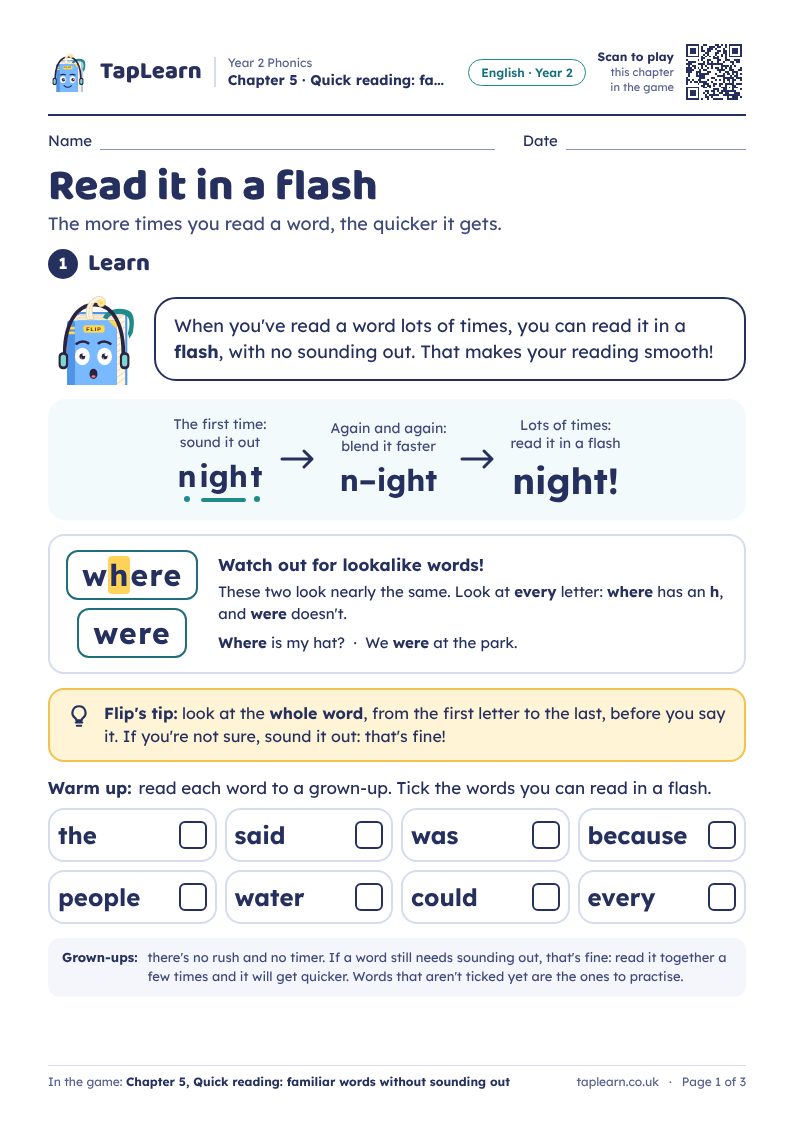
Read It in a Flash is a printable reading fluency worksheet for Year 2 (ages 6 to 7) that teaches children that words read many times become quick to read, and to look at every letter in lookalike words like where and were. It covers the Year 2 statement on reading most words quickly and accurately, without overt sounding and blending, when they have been frequently encountered.
This worksheet is for members
Membership opens every chapter of every game and every worksheet, for all your children.
See the plansAlready a member? Log in to print it.
Start with the free one: Sound out and blend (chapter 1).
Print it on A4, in colour or black and white. Do it after the chapter, or before it to see what your child already knows.
What's on the worksheet
Your child reads familiar words like because, people, water and could straight away, tells lookalike words such as were and where apart, and reads a short story. Includes a flash cards game and an answers sheet.
- Page 1 · Learn
- How a word goes from sounding out to reading in a flash, where and were compared, Flip's tip to look at the whole word, and a tick-the-words warm-up.
- Page 2 · Try it together
- Flash cards: write words like because, people and water on cards, show each for a moment, and sort them into a Flash pile and a Practise pile.
- Page 3 · Practise
- Find the matching word among lookalikes, fill gaps with where, were, said, could and because, read a short park story and answer questions, and a challenge about were.
- Answers sheet
- Every answer, mix-ups like rushing, and read-it-again and word-spotting ideas.
3 A4 pages and an answers sheet · about 20 minutes
Using it at home
- Read the warm-up words a few times and they will get quicker. Words that aren't ticked yet are the ones to practise.
- In the flash card game, start with words your child almost knows for quick wins.
- Re-read a favourite book: each time, familiar words come more quickly.
Watch out for
- Mixing up lookalike words like where and were, or was and saw.
- Ask your child to look at every letter, then say the word.
- Guessing from the shape or first letter of a word.
- If a guess is wrong, go back to sounding out: it is the safe way to check.
- Rushing.
- Reading in a flash means reading easily, not racing. Smooth reading that makes sense is the goal.
Questions from the worksheet
- Look at the word in the box. Find the same word in its row: were (where, were, wear, here). saw (was, paw, saw, sow).
- Write a word from the box in each gap: where, were, said, could, because. We ___ at the park all day.
- Read the story about Ava and her dad at the park. What could Ava see on the water?
- Leo reads were and says, "Where!" What is different about the two words?
The answers are on the answers sheet, for grown-ups.
National curriculum in England
This worksheet practises these statements from the Year 2 english programme of study:
- Continue to apply phonic knowledge and skills as the route to decode words until automatic decoding has become embedded and reading is fluent
- Read most words quickly and accurately, without overt sounding and blending, when they have been frequently encountered
In the classroom
- Use flash cards as a daily two-minute starter with words from the class reader.
- Read the short story chorally, then in pairs.
Questions and answers
What does reading fluency mean in Year 2?
Reading fluency means reading familiar words quickly and accurately without sounding them out, so reading is smooth and makes sense.
How can children tell where and were apart?
Look at every letter: where has an h after the w. Where rhymes with air, and were rhymes with her.
Is it fine to sound out a familiar word?
Yes. If a child isn't sure, sounding out is the safe way to check.
More worksheets from Year 2 Phonics: Blend, Read and Spell on Word Island
- Chapter 1: Blending worksheet: Sound out and blend Free
- Chapter 2: Alternative sounds worksheet: Try another sound Members
- Chapter 3: Syllables worksheet: Long word chunks Members
- Chapter 4: Suffixes worksheet: Word endings Members
- Chapter 6: Segmenting worksheet: Spell it sound by sound Members
- Chapter 7: Alternative spellings worksheet: New ways to spell Members
- Chapter 8: Homophones worksheet: Sound-alike words Members
 TapLearn