Nouns worksheet for Year 2: Spot the nouns
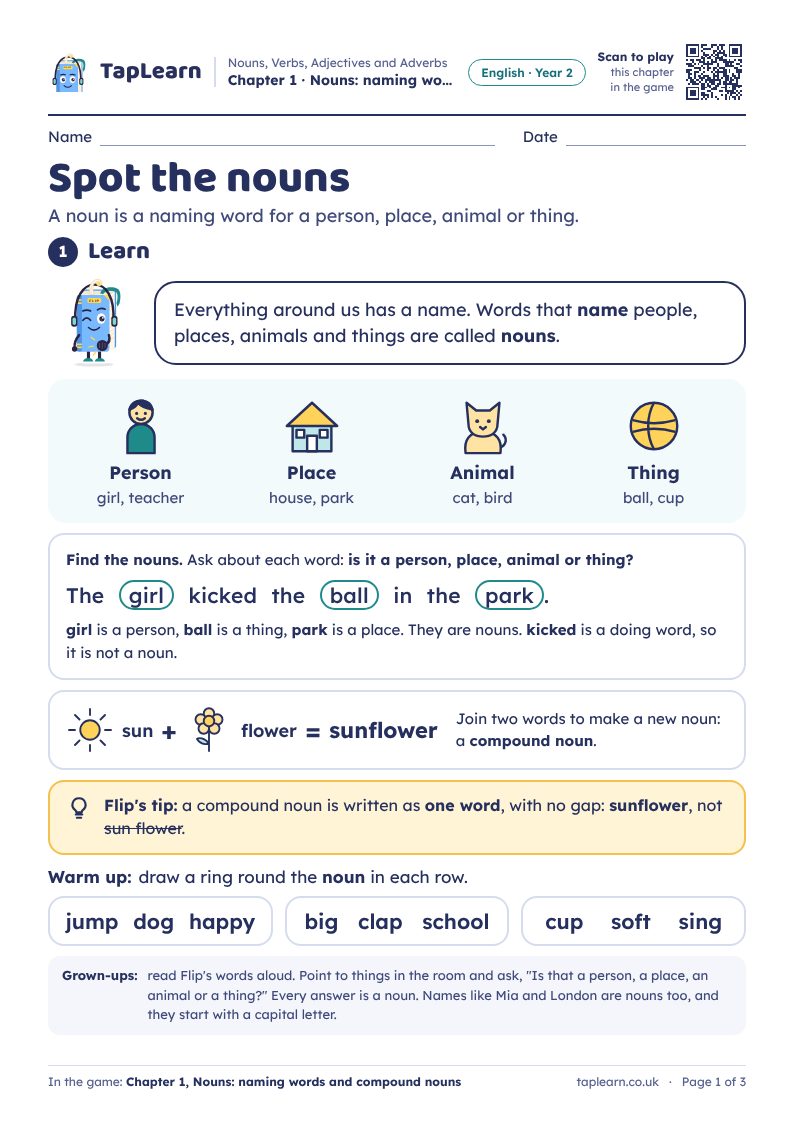
Spot the Nouns is a printable nouns worksheet for Year 2 (ages 6 to 7) that teaches children to ask whether a word names a person, place, animal or thing, and to join two words into a compound noun like sunflower. It covers the Year 2 grammar terminology noun and compound.
Free to print, no account needed.
▶ Play chapter 1 in the game · How the word classes works
Print it on A4, in colour or black and white. Do it after the chapter, or before it to see what your child already knows.
What's on the worksheet
Your child spots nouns, the naming words for people, places, animals and things, and joins two words to make compound nouns like sunflower. Includes a noun hunt round the home and an answers sheet.
- Page 1 · Learn
- Nouns sorted into people, places, animals and things, a worked example finding the nouns in a sentence, how sun + flower makes sunflower, Flip's tip, and a ring-the-noun warm-up.
- Page 2 · Try it together
- Noun hunt: walk slowly round a room, point at things and say "That's a noun!", sort each into person, place, animal or thing, then hunt for compound nouns like toothbrush.
- Page 3 · Practise
- Write nouns for pictures, ring every noun in sentences, join words to make compound nouns, picture sums like star + fish, and a challenge about jump.
- Answers sheet
- Every answer, mix-ups like picking a describing word, and I-spy-a-noun and compound-noun ping-pong ideas.
3 A4 pages and an answers sheet · about 20 minutes
Using it at home
- Ask "Is it a person, a place, an animal or a thing?" Names like Mia and London are nouns too, and start with a capital letter.
- In the noun hunt, look for compound nouns at home like teapot and hairbrush, and say each slowly so your child hears the two words.
- Say a word like snow and your child adds a word to make a compound noun: snowman, snowball.
Watch out for
- Picking a doing word, like kicked or ran, as a noun.
- Ask, "Is it a person, place, animal or thing, or is it something you do?"
- Picking a describing word, like red or happy, as a noun.
- In "a red pen", red tells us what the pen is like; the pen is the noun.
- Writing a compound noun as two words, like foot ball.
- Clap the two parts, then push them together: football.
Questions from the worksheet
- Draw a ring round every noun. The number tells you how many: Sam ate an apple in the kitchen. (3)
- Draw a ring round every noun: My teacher has a red pen. (2)
- Draw a line to join two words that make a compound noun: sun, foot, tooth, rain, cup and cake, ball, flower, brush, bow.
- Leo reads: "I jump over the log." He says, "jump is the noun." Is he right? Which word is the noun?
The answers are on the answers sheet, for grown-ups.
National curriculum in England
This worksheet practises this statement from the Year 2 english programme of study:
- Terminology: noun, noun phrase, statement, question, exclamation, command, compound, suffix, adjective, adverb, verb, tense (past, present), apostrophe, comma
In the classroom
- Play I spy a noun as a starter, naming a category each time.
- Use Practise C as a pairs matching race for compound nouns.
Questions and answers
What is a noun?
A noun is a naming word for a person, place, animal or thing, like girl, park, cat or ball.
What is a compound noun?
A compound noun is made by joining two words, like sun + flower = sunflower. It is written as one word with no gap.
How can children find the nouns in a sentence?
Ask about each word: is it a person, place, animal or thing? If yes, it is a noun.
 TapLearn