Adverbs worksheet for Year 2: How words: adverbs
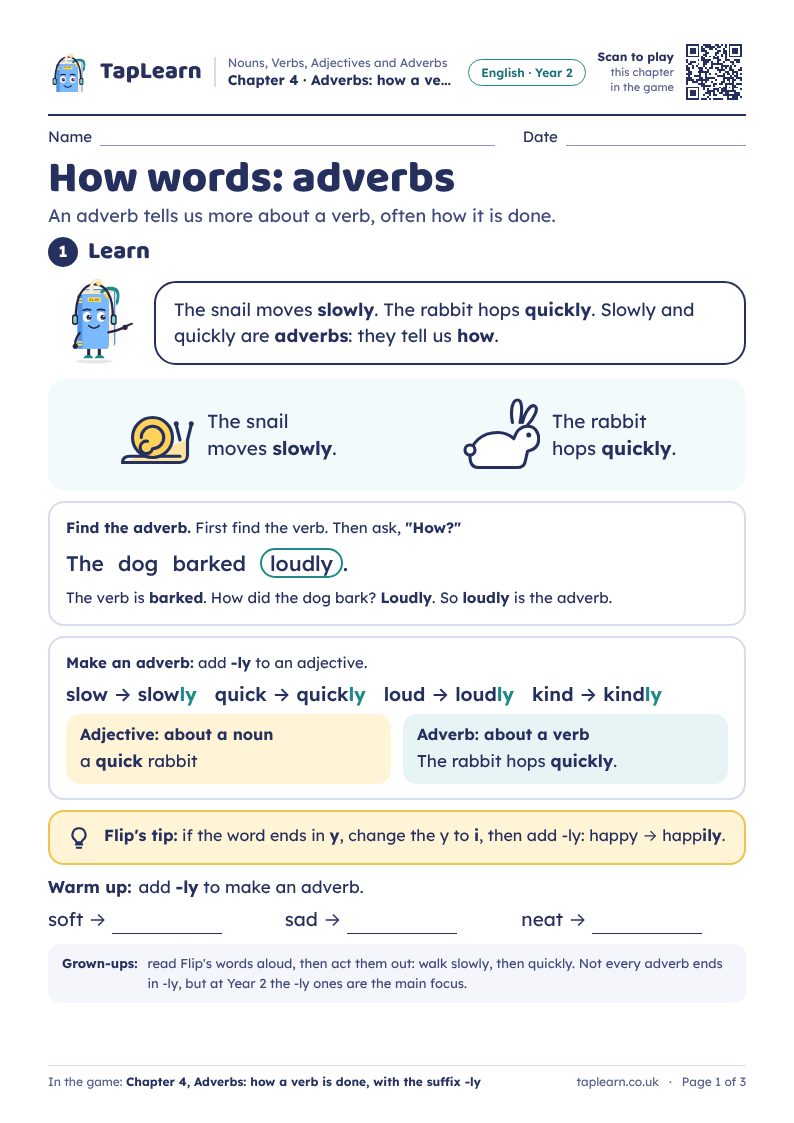
How Words: Adverbs is a printable adverbs worksheet for Year 2 (ages 6 to 7) that teaches children to find the verb, then ask "How?" to find the adverb, and to add -ly to an adjective to make one. It covers the Year 2 grammar terminology adverb, adjective and suffix.
This worksheet is for members
Membership opens every chapter of every game and every worksheet, for all your children.
See the plansAlready a member? Log in to print it.
Start with the free one: Spot the nouns (chapter 1).
Print it on A4, in colour or black and white. Do it after the chapter, or before it to see what your child already knows.
What's on the worksheet
Your child spots adverbs that tell us how a verb is done, turns adjectives into adverbs with -ly, and chooses between pairs like quick and quickly. Includes a do-it-how acting game and an answers sheet.
- Page 1 · Learn
- A slow snail and a quick rabbit, a worked example finding loudly, adjectives turned into -ly adverbs, Flip's tip on happy to happily, and an add-ly warm-up.
- Page 2 · Try it together
- Do it... how?: put verbs in one cup and adverbs in another, pick one from each and act it out, like clap quietly, while the other guesses the adverb.
- Page 3 · Practise
- Ring adverbs in sentences, turn adjectives into adverbs, choose adjective or adverb, finish sentences with your own adverb, and a challenge about hopped quick.
- Answers sheet
- Every answer, mix-ups like quick and quickly, and adverb-walk and say-it-like-this ideas.
3 A4 pages and an answers sheet · about 20 minutes
Using it at home
- Some adverbs don't end in -ly, but at Year 2 the -ly ones are the main focus.
- In the acting game, point out that each adverb is an adjective with -ly on the end: slow to slowly, sad to sadly.
- Say "Good morning" loudly, sadly or quietly, and your child guesses the adverb.
Watch out for
- Mixing up adjectives and adverbs, like quick and quickly.
- Ask, "Is it telling us about a thing, or about how something is done?"
- Spelling happily as happyly.
- The y changes to i before -ly.
- Thinking every -ly word is an adverb.
- Friendly and lovely describe nouns, so they are adjectives. Don't worry about this unless your child asks.
Questions from the worksheet
- Draw a ring round the adverb: The mouse crept quietly. Mia smiled happily.
- Turn each adjective into an adverb: quick, brave, careful, happy.
- Ring the right word: The tortoise is very slow / slowly. The tortoise walked slow / slowly.
- Finish each sentence with an adverb of your own: The lion roared ___. The baby slept ___.
- Leo wrote: "The rabbit hopped quick." What should he change, and why?
The answers are on the answers sheet, for grown-ups.
National curriculum in England
This worksheet practises this statement from the Year 2 english programme of study:
- Terminology: noun, noun phrase, statement, question, exclamation, command, compound, suffix, adjective, adverb, verb, tense (past, present), apostrophe, comma
In the classroom
- Play adverb walk: call out an adverb and pupils walk across the room that way.
- Use Practise C as a quick-fire adjective-or-adverb check.
Questions and answers
What is an adverb?
An adverb tells us more about a verb, often how it is done. In "The snail moves slowly", slowly is the adverb.
How do you make an adverb?
Add -ly to an adjective: slow becomes slowly and loud becomes loudly. If it ends in y, change y to i: happy becomes happily.
What is the difference between quick and quickly?
Quick is an adjective that describes a noun (a quick rabbit). Quickly is an adverb that says how (hops quickly).
 TapLearn