Parts of speech worksheet for Year 2: Word jobs
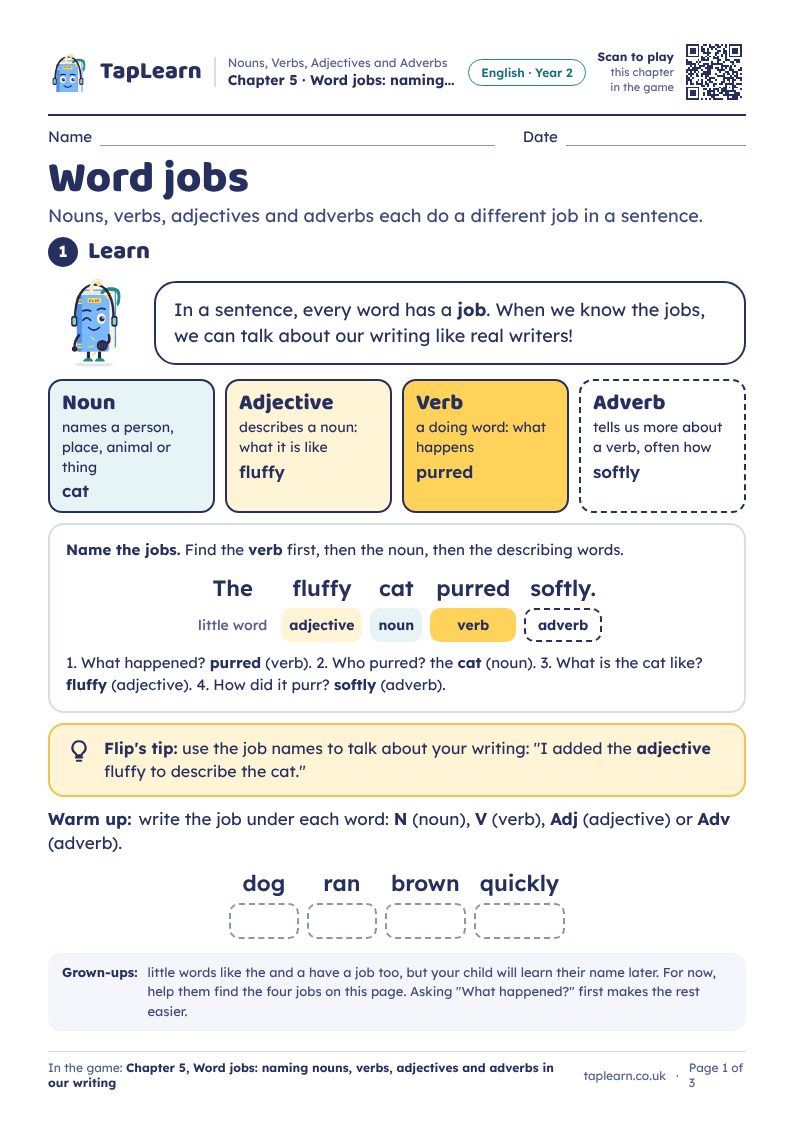
Word Jobs is a printable parts of speech worksheet for Year 2 (ages 6 to 7) that teaches children to find the verb first, then the noun, then the describing words, and name each word's job in a sentence. It covers the Year 2 statement on using and understanding grammatical terminology in discussing their writing.
This worksheet is for members
Membership opens every chapter of every game and every worksheet, for all your children.
See the plansAlready a member? Log in to print it.
Start with the free one: Spot the nouns (chapter 1).
Print it on A4, in colour or black and white. Do it after the chapter, or before it to see what your child already knows.
What's on the worksheet
Your child names each word's job in a sentence, noun, verb, adjective or adverb, and uses those grammar words to talk about writing. Includes a silly sentence builder game and an answers sheet.
- Page 1 · Learn
- The four word jobs with examples, a worked example labelling "The fluffy cat purred softly", Flip's tip on talking about writing, and a write-the-job warm-up.
- Page 2 · Try it together
- Silly sentence builder: write adjectives, nouns, verbs and adverbs on scraps of paper in four piles, pick one from each to build a sentence like "The purple dragon danced quietly".
- Page 3 · Practise
- Sort twelve words into nouns, verbs, adjectives and adverbs, label words in sentences, make "The dog barked" better, and a challenge about brave and slowly.
- Answers sheet
- Every answer, mix-ups like labelling every little word, and bedtime-word-hunt and writer's-chat ideas.
3 A4 pages and an answers sheet · about 20 minutes
Using it at home
- Asking "What happened?" first makes the rest easier to find.
- In the silly sentence builder, if the words are in the wrong order, like "The purple quietly danced dragon", it sounds odd, which is a good clue.
- When your child writes, ask "Which adjective did you choose? Could an adverb show how it happened?"
Watch out for
- Mixing up adjectives and adverbs.
- Ask, "Is it telling us about a thing (adjective), or about how something is done (adverb)?"
- Mixing up nouns and verbs.
- Ask, "Is it something you can point to, or something you do?"
- Labelling every word.
- Little words like the and a have another job, which children learn about later.
Questions from the worksheet
- Sort the words into nouns, verbs, adjectives and adverbs: dog, jumped, tiny, slowly, park, sang, green, loudly.
- Write the job under each word, N, V, Adj or Adv: The tall girl ran quickly.
- Make this sentence better. Add an adjective and an adverb: The dog barked.
- Mia reads: "The brave knight rode slowly." She says slowly is an adjective, because it describes. Is she right? What job does slowly do? What about brave?
The answers are on the answers sheet, for grown-ups.
National curriculum in England
This worksheet practises these statements from the Year 2 english programme of study:
- Terminology: noun, noun phrase, statement, question, exclamation, command, compound, suffix, adjective, adverb, verb, tense (past, present), apostrophe, comma
- Use and understand the grammatical terminology in English appendix 2 in discussing their writing
In the classroom
- Play silly sentence builder in groups with four colour-coded word piles.
- Hunt for a noun, verb, adjective and adverb in a sentence from the class story.
Questions and answers
What are parts of speech?
Parts of speech are the jobs words do in a sentence. In Year 2, children learn nouns, verbs, adjectives and adverbs.
How can children work out a word's job?
Find the verb first (what happened?), then the noun (who or what?), then the adjective (what is it like?) and the adverb (how?).
What is the difference between an adjective and an adverb?
An adjective describes a noun (a brave knight). An adverb tells us more about a verb (rode slowly).
 TapLearn