Verbs worksheet for Year 2: Doing words
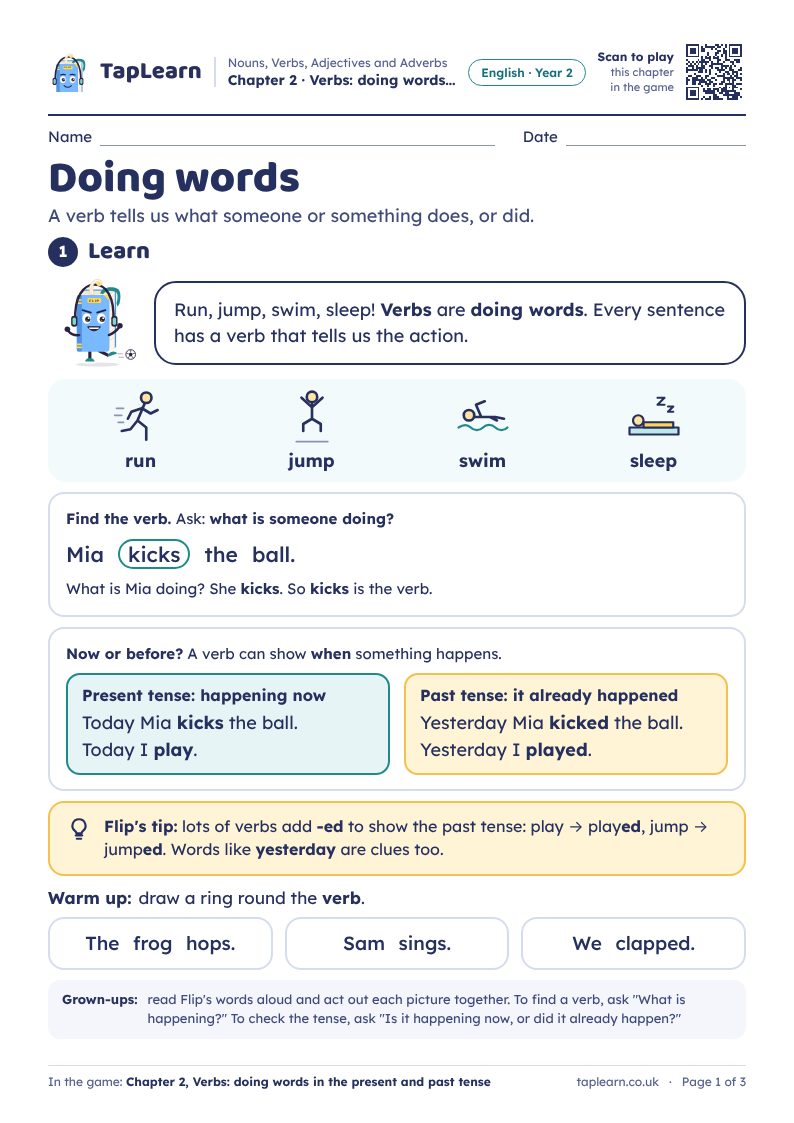
Doing Words is a printable verbs worksheet for Year 2 (ages 6 to 7) that teaches children to find the verb by asking what someone is doing, and to tell the present tense from the past tense. It covers the Year 2 grammar terminology verb and tense (past, present).
This worksheet is for members
Membership opens every chapter of every game and every worksheet, for all your children.
See the plansAlready a member? Log in to print it.
Start with the free one: Spot the nouns (chapter 1).
Print it on A4, in colour or black and white. Do it after the chapter, or before it to see what your child already knows.
What's on the worksheet
Your child spots verbs, the doing words, and tells whether they are in the present tense or the past tense, adding -ed to make the past. Includes a verb charades game and an answers sheet.
- Page 1 · Learn
- Doing words like run and jump, a worked example finding the verb kicks, present and past tense compared, Flip's tip on -ed, and a ring-the-verb warm-up.
- Page 2 · Try it together
- Verb charades: write doing words like hop and wave on scraps of paper, act one out with no talking while the other guesses, then say what you did in the past tense.
- Page 3 · Practise
- Ring the verb in sentences, tick present or past tense, change verbs to the past tense, write a sentence about yesterday, and a challenge about dog and chased.
- Answers sheet
- Every answer, mix-ups like present and past, and a yesterday-I idea.
3 A4 pages and an answers sheet · about 20 minutes
Using it at home
- To find the verb, ask "What is happening?" To check the tense, ask "Is it happening now, or did it already happen?"
- In verb charades, write the past tense for your child if they need it, and talk about what changed.
- At teatime, take turns saying one thing you did today in the past tense: "I painted", "I played".
Watch out for
- Picking a naming word, like dog or ball, as the verb.
- Ask, "What is the dog doing?" The answer is the verb.
- Mixing up present and past.
- Put "today" or "yesterday" in front of the sentence and listen to which sounds right.
- Spelling -ed.
- Some verbs double a letter (hopped) or drop an e (baked), and some don't use -ed (ran): fine to notice, not needed here.
Questions from the worksheet
- Draw a ring round the verb in each sentence: The cat sleeps on the mat. We baked a cake.
- Present tense or past tense? Leo plays in the garden. Mia painted a picture. The dog barked.
- Change the verb to the past tense: Today I jump. Yesterday I ___. Today Sam cooks. Yesterday Sam ___.
- Mia reads: "The dog chased the ball." She says, "The verb is dog." Is she right? Which word is the verb? Is it present or past tense?
The answers are on the answers sheet, for grown-ups.
National curriculum in England
This worksheet practises this statement from the Year 2 english programme of study:
- Terminology: noun, noun phrase, statement, question, exclamation, command, compound, suffix, adjective, adverb, verb, tense (past, present), apostrophe, comma
In the classroom
- Play verb charades as a class warm-up.
- Use Practise B as a show-me check with present and past cards.
Questions and answers
What is a verb?
A verb is a doing word. It tells us what someone or something does, like run, jump or swim.
What is the difference between present and past tense?
Present tense is happening now (Mia kicks the ball). Past tense already happened (Mia kicked the ball).
How do you make the past tense?
Lots of verbs add -ed: play becomes played and jump becomes jumped.
 TapLearn