Adjectives worksheet for Year 2: Describing words
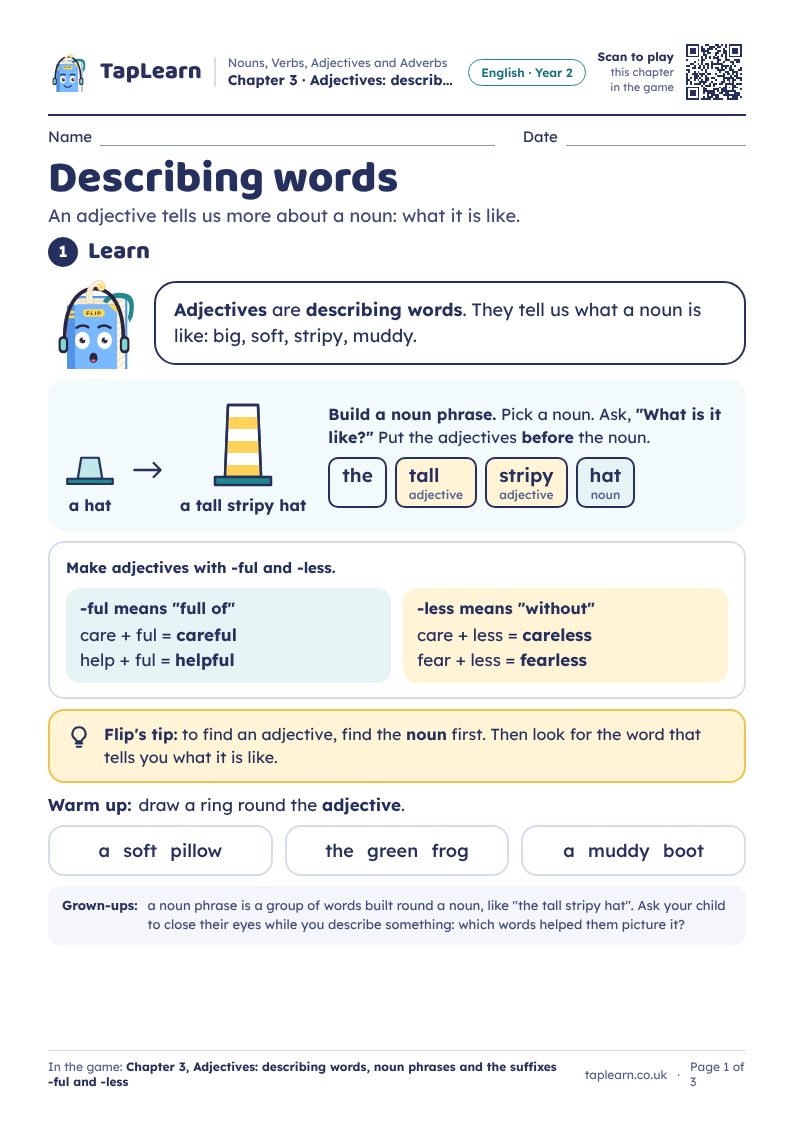
Describing Words is a printable adjectives worksheet for Year 2 (ages 6 to 7) that teaches children to find the noun, ask what it is like, and put adjectives before it to build a noun phrase, as well as making adjectives with -ful and -less. It covers the Year 2 grammar terminology adjective, noun phrase and suffix.
This worksheet is for members
Membership opens every chapter of every game and every worksheet, for all your children.
See the plansAlready a member? Log in to print it.
Start with the free one: Spot the nouns (chapter 1).
Print it on A4, in colour or black and white. Do it after the chapter, or before it to see what your child already knows.
What's on the worksheet
Your child spots adjectives, uses them to build noun phrases like the tall stripy hat, and makes adjectives with -ful and -less. Includes a guess-my-toy game and an answers sheet.
- Page 1 · Learn
- Adjectives like big and stripy, a hat growing into a tall stripy hat, -ful and -less with meanings, Flip's tip to find the noun first, and a ring-the-adjective warm-up.
- Page 2 · Try it together
- Guess my toy: line up some toys, secretly pick one and describe it with two adjectives for the other to guess, then write the noun phrase together.
- Page 3 · Practise
- Ring adjectives and underline nouns, add adjectives to make noun phrases, add -ful or -less, ring the right word in sentences, and a challenge about noisy and barked.
- Answers sheet
- Every answer, mix-ups like -ful with two l's, and feely-bag and adjective-ladder ideas.
3 A4 pages and an answers sheet · about 20 minutes
Using it at home
- Ask your child to close their eyes while you describe something: which words helped them picture it?
- In guess my toy, ask "What does it look or feel like?" Colour, size, shape and feel are good places to start.
- Start with "a dog" and take turns adding one describing word: "a big dog", "a big hairy dog".
Watch out for
- Picking the noun instead of the describing word.
- Ask, "What is the cat like?"
- Picking a doing word, like barked, as an adjective.
- Adjectives tell us what something is like, not what it does.
- Mixing up -ful and -less.
- Say the meaning: careful means full of care, careless means without care. And -ful has one l.
Questions from the worksheet
- Draw a ring round the adjective. Underline the noun it describes: The fluffy cat sat down. I found a shiny coin.
- Add an adjective to make a noun phrase: the ___ sun, a ___ snail, a ___ tree.
- Add -ful or -less. Write the new adjective: help + ful, colour + ful, fear + less, use + less.
- Ring the right word: The pencil has no lead. It is useful / useless.
- Sam reads: "The noisy dog barked." He says barked is the adjective, because it tells us about the dog. Is he right? Which word is the adjective?
The answers are on the answers sheet, for grown-ups.
National curriculum in England
This worksheet practises these statements from the Year 2 english programme of study:
- Terminology: noun, noun phrase, statement, question, exclamation, command, compound, suffix, adjective, adverb, verb, tense (past, present), apostrophe, comma
- Use and understand the grammatical terminology in English appendix 2 in discussing their writing
In the classroom
- Play adjective ladder round the class, each pupil adding a describing word.
- Use a feely bag: pupils give two adjectives before guessing the object.
Questions and answers
What is an adjective?
An adjective is a describing word. It tells us what a noun is like, such as big, soft, stripy or muddy.
What is a noun phrase in Year 2?
A noun phrase is a group of words built round a noun, with adjectives before it, like "the tall stripy hat".
What do -ful and -less mean?
-ful means "full of" (careful) and -less means "without" (careless).
 TapLearn